Essay
The 2027 Marketing Playbook: How to Generate So Much Demand It Breaks Your Business
Jay Yang·October 31, 2026·40 min read
First published on X.
Why do most businesses need more customers, not a better product?
Here's a mental model I like to give people. Imagine I tripled the amount of leads coming into your business. What would happen?
If you're a somewhat competent business owner, your business would grow. When you have more demand than supply, it's pretty hard to lose.
In this article, I want to walk you through how I'd build future demand, how I write the copy behind it, and how I capture current demand with paid ads.
Before we start, I want to define terms, because if we're not on the same page, communication gets a lot harder. Marketing, to me, is the process of reaching and converting customers. If you can get in front of the right people and convince them to buy your thing, you win.
Why does this matter more now? Code is the back end of the internet, and media (copywriting) is the front end. In an age where AI can basically build anything, the only remaining alpha is distribution.
If you can shift the supply and demand curve in your favor, if you can make yourself oversubscribed, if you can develop distribution because of your skills, the world is yours.
And when you do marketing right, you can feel it:
- Prospects book calls talking about a problem you wrote about in a post.
- They reference things you made.
- Other founders start asking how you're getting so much inbound.
- Potential teammates want to start working with you.
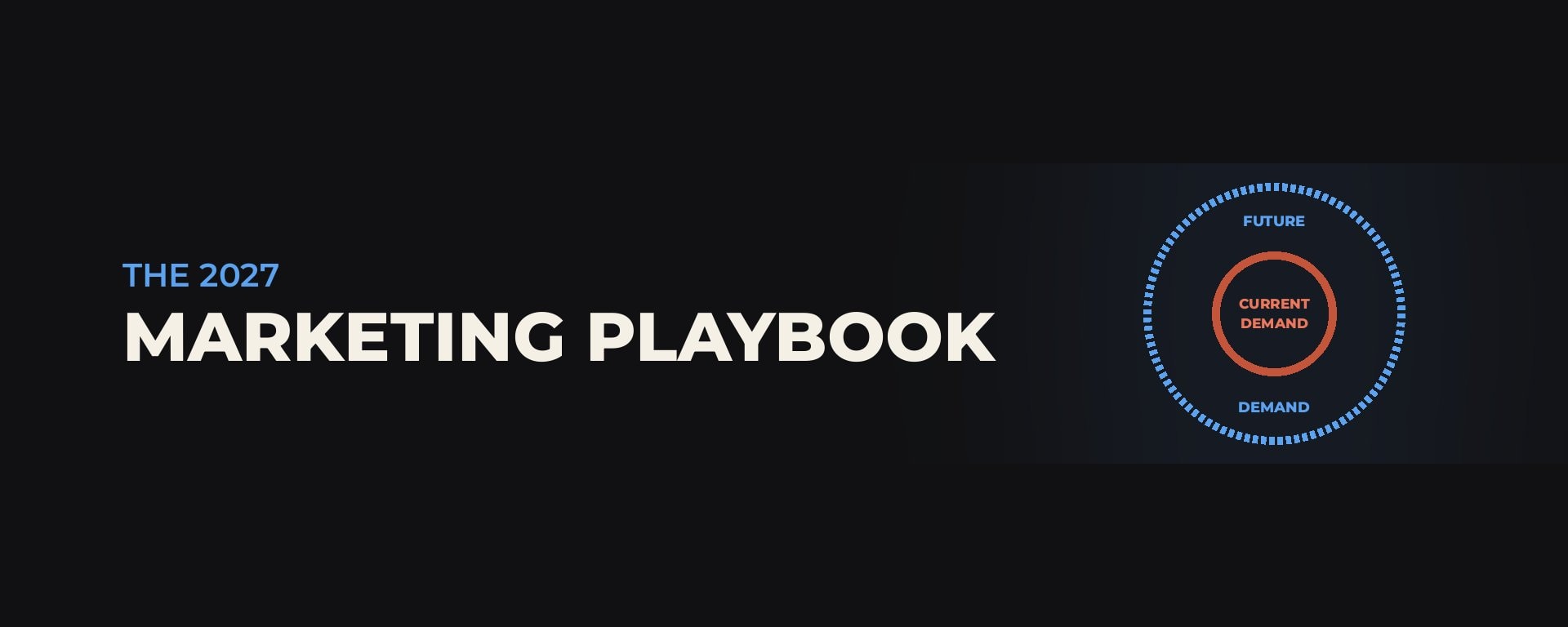
What's the difference between future demand and current demand?
If I asked you, "What's the likelihood you buy a new car in the next 2 weeks?" you'd probably say pretty low.
If I asked, "What's the likelihood you buy a new car in the next 10 years?" your answer would probably be a lot higher.
So if I'm a car company, the goal of my marketing isn't to right hook you right away. It's to increase your brand affinity, so that when you get into the buying window and want to buy a car, you think of my brand first.
There are 2 types of demand:
- Current demand is the amount of customers who want your product or service right now.
- Future demand is the amount of customers who will potentially want your product in the future.
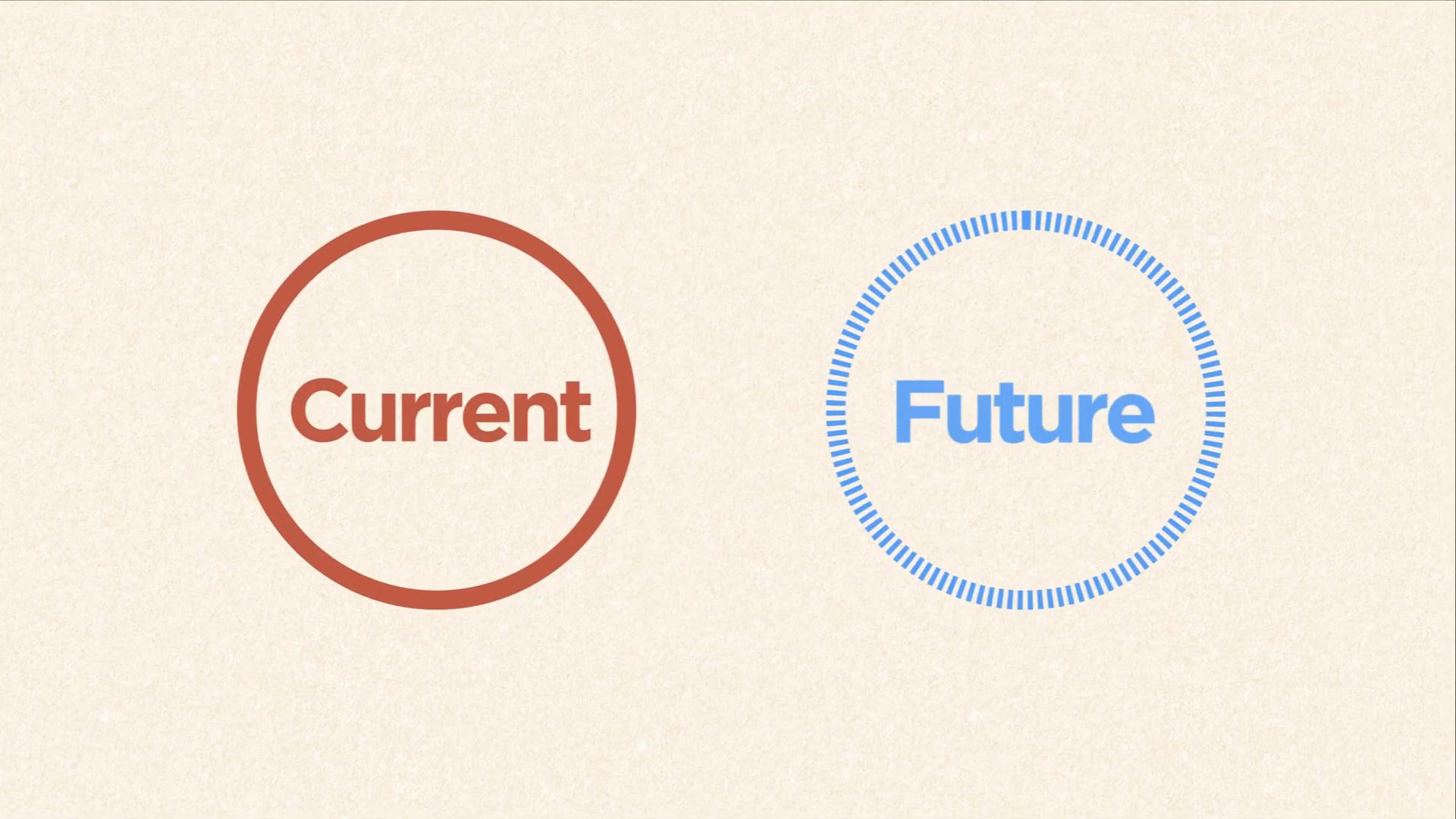
Most marketers view marketing as capturing current demand, because it's easy to track and measure. They put all of their time, energy, and resources toward it, and in marketing we call this direct response advertising.
Great marketers realize it's a dance between capturing current demand and generating future demand, because not everything that can be immediately measured matters.
So how do you generate future demand? You build a brand.
There are a lot of definitions of what a brand is. Some people say it's a logo, some say it's a color, some say it's a feeling. To me, a brand is about teaching.
If I point at a car and say the word "car," a kid will associate the vehicle with the sound. A brand is teaching the associations you want your audience to have.
Bad branding is when your audience makes those associations on your behalf. Good branding is when you make those associations for your audience. It's intentional.
So here's a question to reflect on: What do I need to be associated with, so that when my audience has a problem, they think of me first?
For me, I want people to know that I'm the best damn social media copywriter in the space, that I'm a marketing strategist, and that I have a lot of proof at a young age. (Investing in me is like investing in Bitcoin in 2008.)
How do you teach those associations? Use PTL: power, trust, and likeness
If you're thinking, "Okay Jay, that makes sense, but how do I actually do that tactically?" my favorite way to create these associations is the PTL framework.
PTL stands for power, trust, and likeness. Our goal is to influence our audience, which means changing people's behavior, and people are primarily influenced by 3 things.
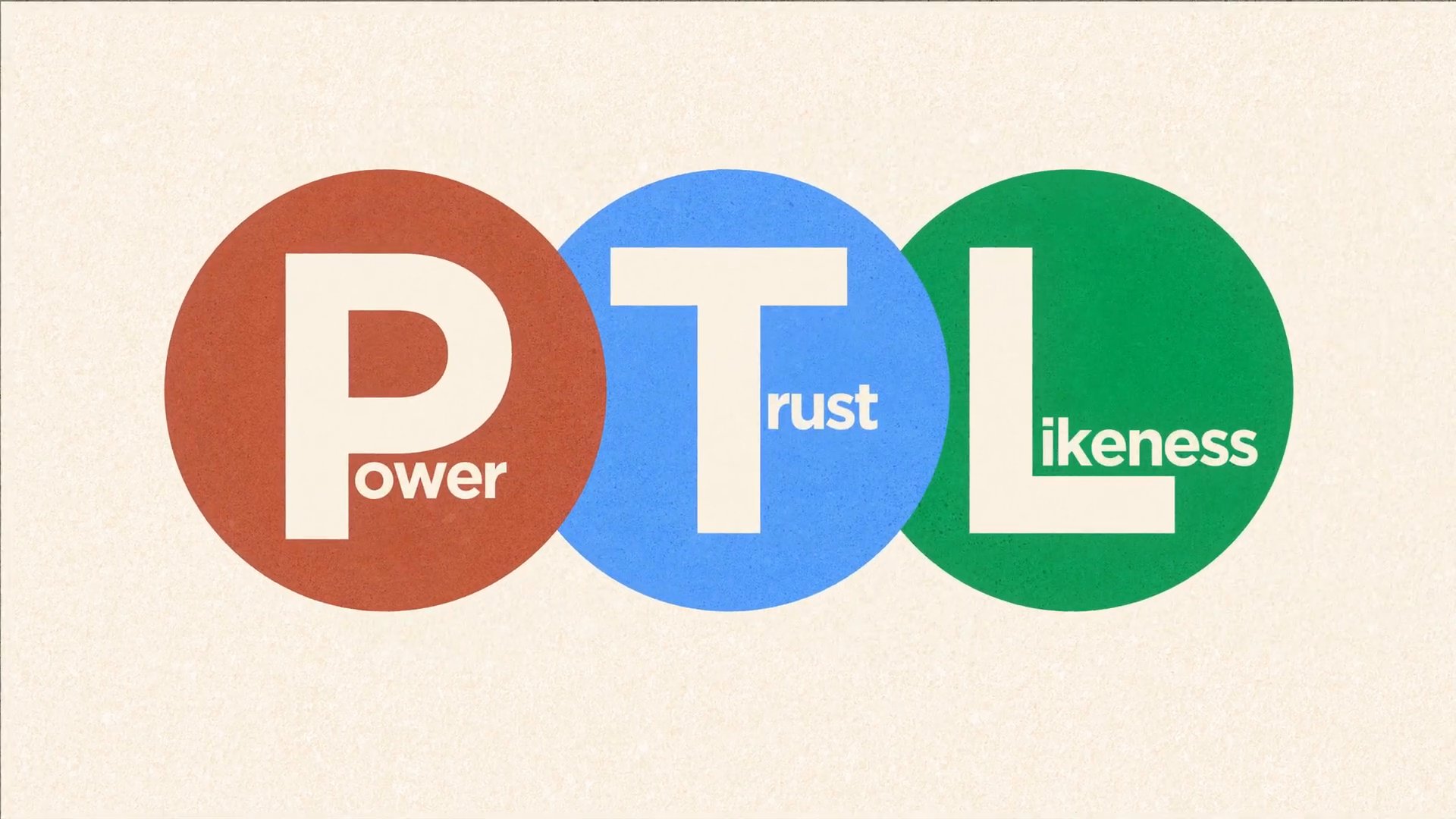
Power
Power is your ability to affect change in the world. To demonstrate it, you want to show that you can do things.
Most people record a video in front of a mansion, or in front of a car with a fancy watch. There are other ways to show power too. You can demonstrate your skill set, your network, or your audience. If you can show an audience that you have what they want, the likelihood they listen to you goes up.
A side point: power is relative.
Imagine you're in a bar. The bartender has a lot of power over you, because they control the flow of the drinks. Once they step outside the bar, they lose it.
Or say you're an investor with a lot of startup founders pitching you. You have power over them in that room. Once you step outside and you're at your kid's soccer game, you're just a parent.
So in your content, think about how you can show power both verbally and visually. Verbally, you could say something like, "My portfolio generated over $250 million in aggregate revenue last year." Visually, you could record an ad in front of your headquarters.
Here's a prompt to work through: What do my customers want, both internally (their beliefs and values) and externally?
Trust
Trust is belief with evidence. Belief without evidence is called faith.
Trust gets built when I tell you to do something, you do it, a good result happens, and you associate that value with me.
Take Martha Stewart. For years she gave women step-by-step directions (recipes) to bake something good. The women followed them and got compliments from their friends, families, and neighbors. They associated that value with Martha, so the next time she told them to buy her cookbook or her program, they did.
We usually have high trust with our parents for the same reason. For years we listened to them and got good results. Eat your veggies and you'll grow strong. Don't touch the fire and you won't get burned.
So the prompt here is: What step-by-step directions can I give my audience to get positive results?
For example:
- Read these 50 books on marketing.
- Use this tool to distribute your content.
- Use these hooks in your content.
Likeness
Likeness is how similar you are to your audience. In psychology we call this the in-group effect, which basically means we have a higher likelihood of listening to people in the same group we identify with. People show favoritism and trust toward their in-group, and skepticism toward people outside of it.
You can demonstrate likeness in 2 ways:
- Externally: how you talk, what you're wearing, what you look like.
- Internally: what you believe and what you value.
Some external attributes you can change, but the majority of the time I focus on the internal ones. The question to ask yourself is: What are the core beliefs or values my audience has, that I can signal to show we value the same things?
This is why the first thing I do when I'm doing marketing for a company is get really clear on who we're targeting. The first P in my copy process is people, because that dictates a lot of the marketing you do. We'll get to that in the next part.
If you want to build an influential brand in 2027 and beyond, you demonstrate power, trust, and likeness over and over and over again in your content.
Do you need to pick one niche? Skyscraper vs city
People always say you only need 1,000 true fans to make a living online. Sure, but your 1,000 true fans, the ones who will buy anything you sell, are probably not going to be your first 1,000 followers.
You'll probably have to get 10,000 followers, or maybe 100,000, and nurture them and educate them into being fans.
There are typically 2 approaches to creating content. The first is to only talk about one thing and only reach people who are interested in that thing right now. The second is to basically be yourself, reach lots of people who are interested in what you're talking about, educate them on your interests, and turn them into customers.
I think about this as building a skyscraper vs building a city. Most people will tell you to pick a topic and call it your niche, and yes, you can build a decent business doing that.
But to me, it's more durable and more fun, and in the long run better for your business, to not niche by topic. Niche by transformation. If you take someone from A to Z, there are a lot of sub topics underneath that transformation journey that you can talk about.
As long as it's relevant in helping your audience get from where they are to where they want to be, you can talk about many different things.
Why does a brand matter in the math?
A business survives because of one equation: LTV to CAC. That's lifetime value to customer acquisition cost, or how much it costs to acquire a customer vs how much you make from that customer in their lifetime.
The best businesses have a high LTV to CAC ratio. They make a lot per customer, and it doesn't cost them a lot to get customers. You know what increases that ratio? Building a brand.
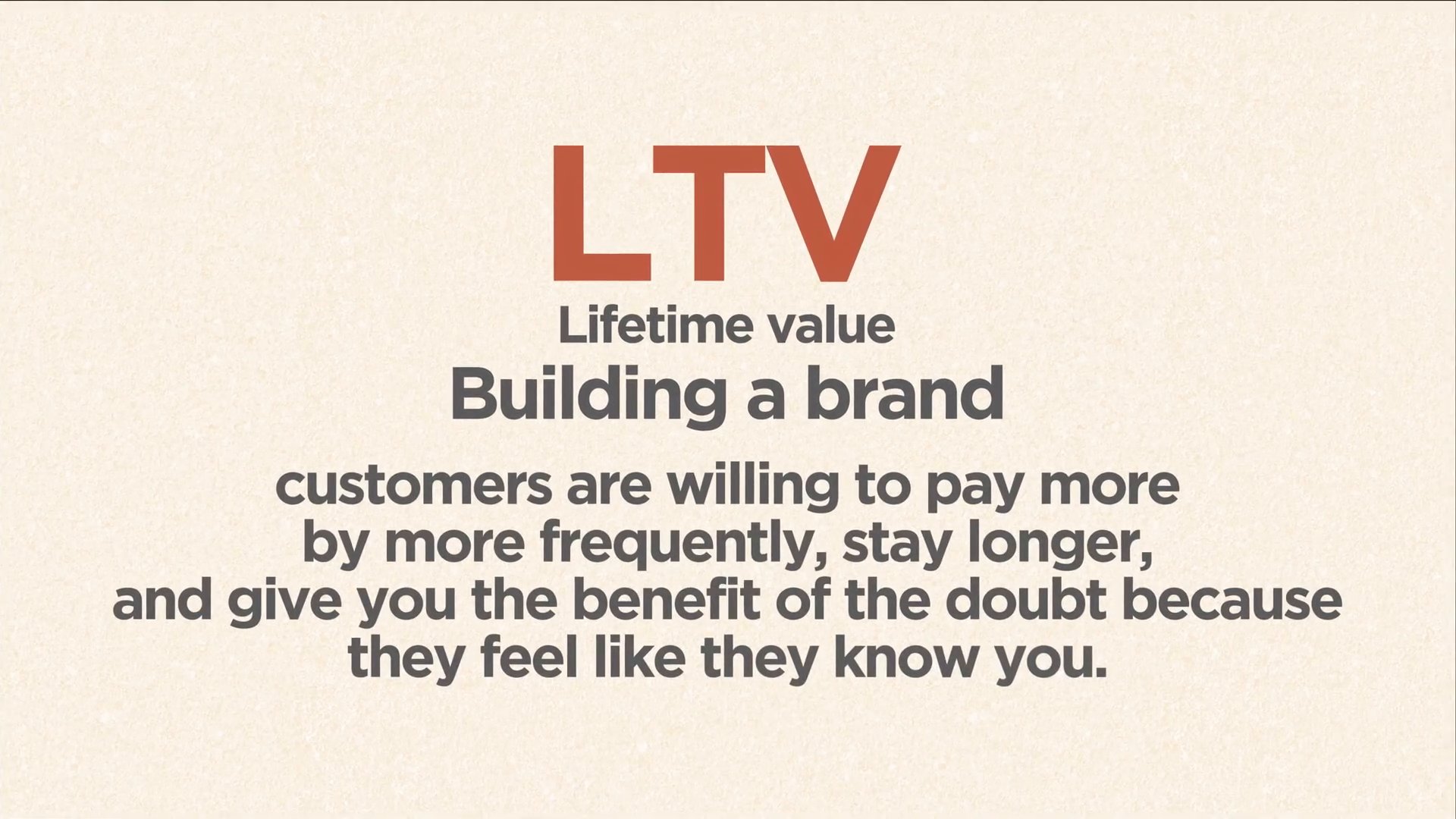
- On the CAC side: one piece of content can reach millions of people, so you get more leads. Those leads also convert at a higher rate, because they feel like they know, like, and trust you. They're already pre-sold.
- On the LTV side: customers are willing to pay more, buy more frequently, stay longer, and give you the benefit of the doubt, because they feel like they know you.
How do the top personal brands post so much, on so many platforms?
If you've ever wondered how these people post multiple times a day, on multiple platforms, at such a high level, it's because of a system behind the scenes. I call it the content multiplication system.
For most of the content I do for people, it all starts on Twitter or X, for 2 reasons.
- You're not penalized for posting 10+ times a day.
- When a tweet does well, we know it's the idea behind the tweet, because there's no fancy visual, graphic, or video. It's just the idea.
Once a tweet does well, you know the angle is validated, so you multiply it. We do that with what I call the 3 Rs: repost, repurpose, and remix.
R1: Repost. When a piece of content does well, we post it again 90 days later.
If you're thinking your audience is going to get tired of you, they won't. When you post the first time, a large majority of your audience hasn't seen it. And for the people who did see your first post and then see your second, we need to be reminded about the core few things more than we need to be taught new things. They actually appreciate it.
R2: Repurpose. If a tweet does well, how can we post it on Instagram? How can we post it on LinkedIn? How can we turn it into a hook for ads? How can we expand it into a YouTube video or a newsletter?
It's not as easy as taking a tweet and posting it on another platform. Treat every platform like a separate channel. You take the idea or the angle behind the tweet, but you reformat it for each one.
R3: Remix. This is one of my favorite ways to engage in the content multiplication system. If a tweet does well, how can you rewrite it in many different ways? There are 2 ways I like to remix:
- Same idea, different format.
- Different idea, same format.
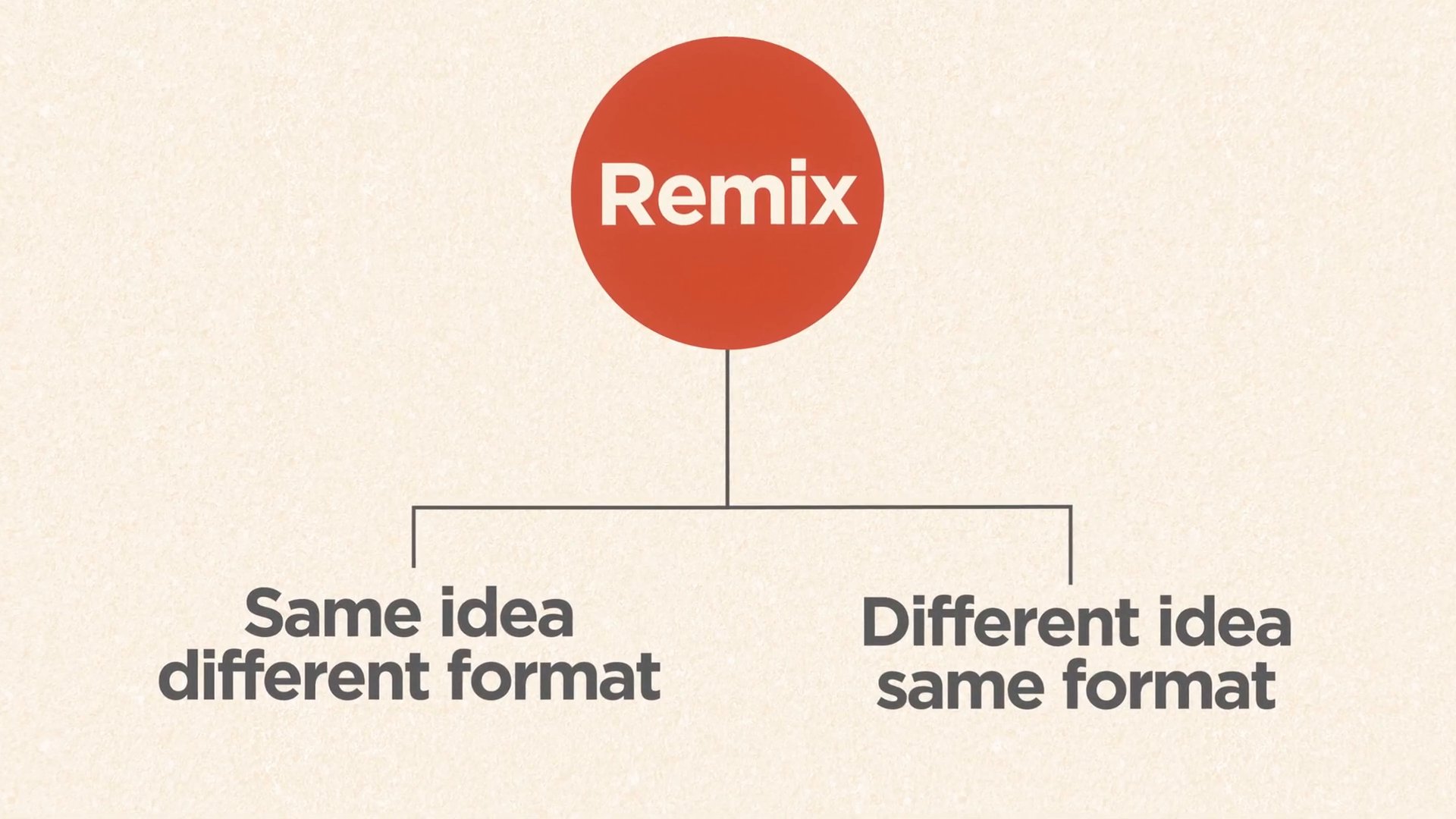
Let me explain. Say I wrote a tweet that said, "Winners get better, losers get bitter." What's the fundamental idea there? Don't envy, be inspired.
I can say that same idea in a different format: "The fastest way to never get what you want is to be bitter when other people are winning." It's the same idea, said differently.
I can also take that same template, "X people do X, Y people do Y," and install a different idea: "Rich people focus on saving time, poor people focus on saving money." It's a different idea, but the same template.
So when a tweet or a written post does well, you can go through a remixing checklist of all the different ways to say it. You can turn 1 idea into 10.
How do you know what to repost, repurpose, and remix?
I use what I call a Hall of Fame. It's a database where you take any post that does above your average engagement or impressions and save it. Each row has:
- The name of the post
- A link to the post
- When it was posted
- Whether you've posted it again already
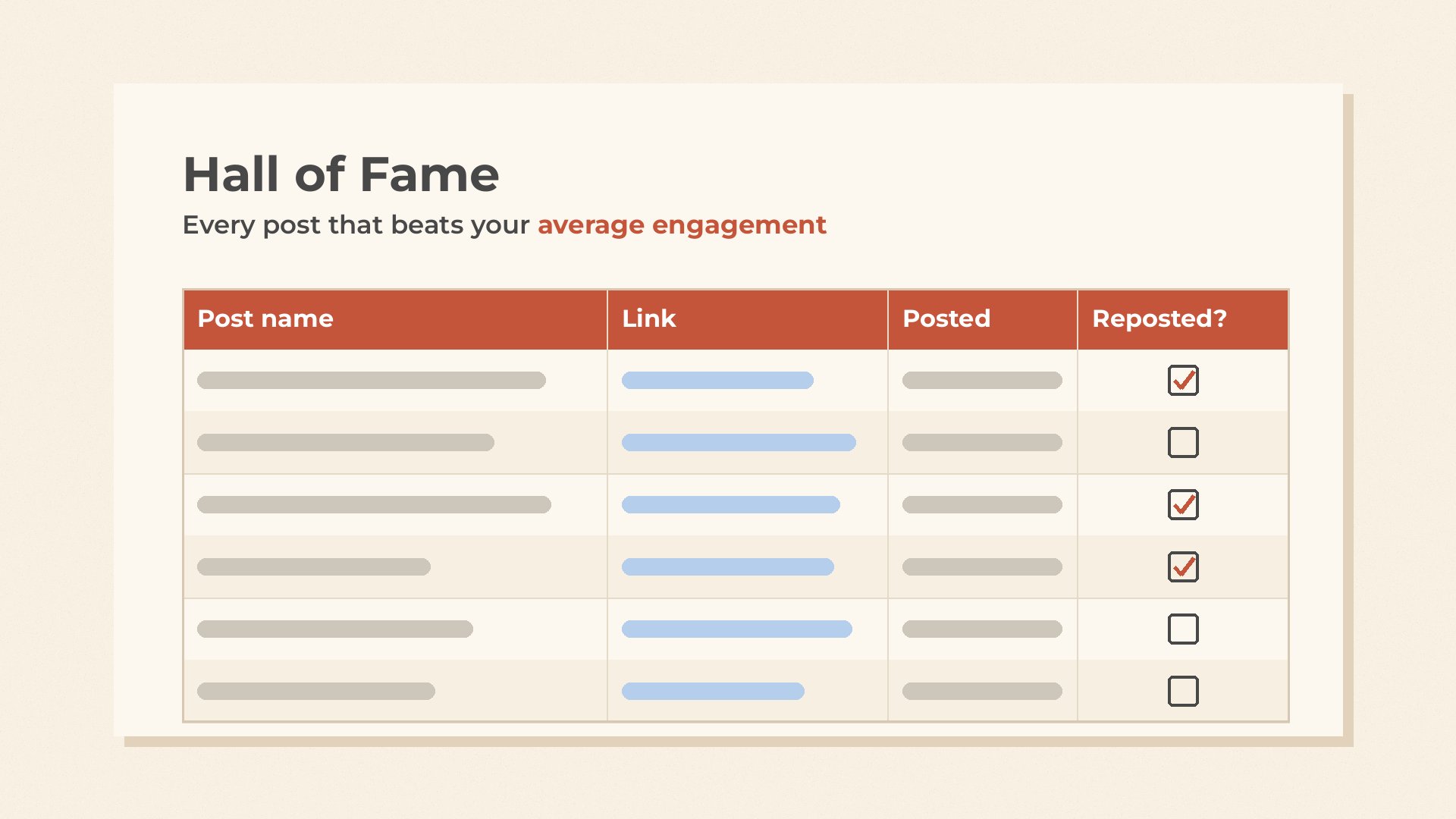
Over time you build a library of your best ideas. It's kind of like being a musician. When an artist goes on tour, they're not playing new songs, they're playing their already proven songs.
Here's the quick recap:
- Step 1: Build a Hall of Fame.
- Step 2: Use the 3 Rs on everything in it.
If you master how to generate future demand like this, you'll never run out of ideas to post, and every post works toward the same associations in your audience's mind.
What is copywriting, and why is the thinking the hard part?
When I first heard of copywriting, I thought it was the little C logos you see next to trademarks. I first heard about it from Sam Parr, who sold a media company for tens of millions of dollars, and I figured that if it worked for him, learning it would probably be useful for me too.
Copywriting is transferring information from one brain to another in the simplest way possible. It's persuasive writing.
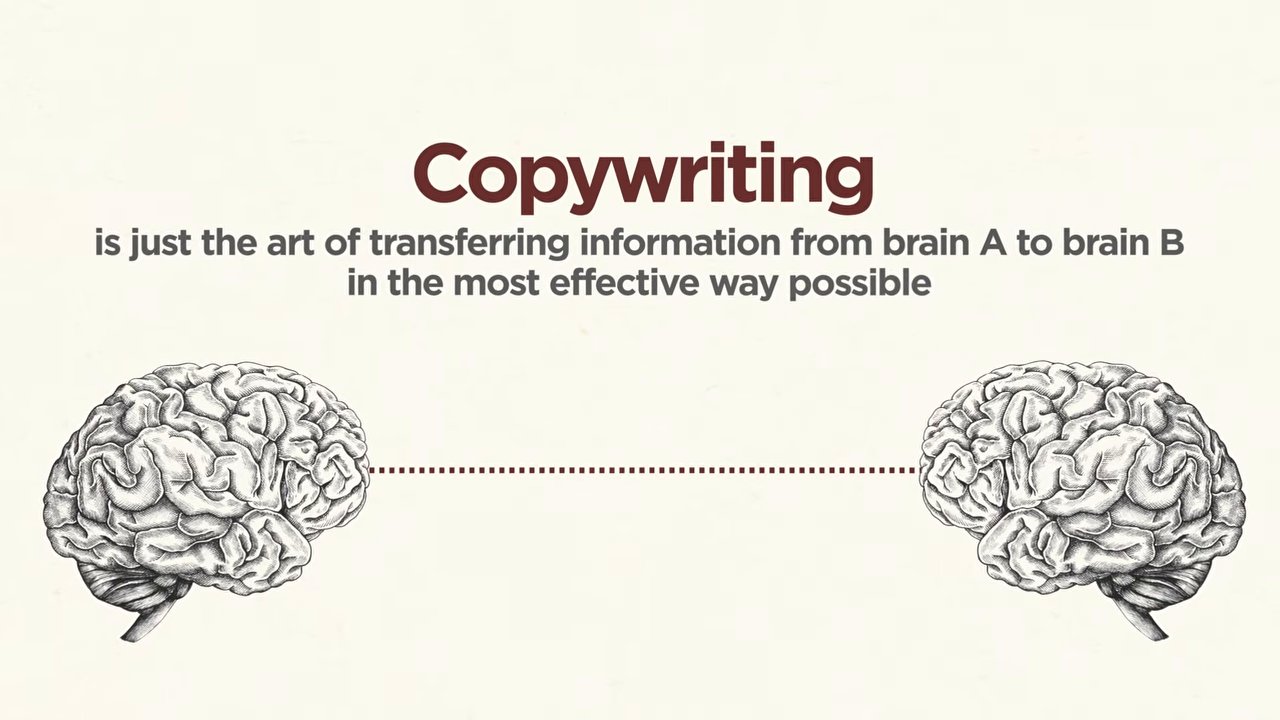
A blog post is copywriting. A YouTube script is copywriting. A short script, an email, and an ad are all copywriting, so the better you get at it, the better you get at everything else.
It's also a life skill. If you're an investor, you have to convince LPs to give you money. If you're a founder, you have to convince investors to fund you and your team to join you. If you're an employee, you have to convince a team to hire you. If you're a parent, you have to convince your kids to go to bed on time.
So how do you get better? The first step is to realize that it was never about the writing in the first place. It was about the thinking.
I could give you a bunch of templates and hacks that make you feel like you're getting value. Identity-based hooks like "business owners" or "chiropractors." Outcome-based hooks like "If you're ambitious but inconsistent, watch this video." Promise hooks like "We will build your entire webinar funnel for free and just take a percentage of what we make you, or you don't have to pay at all."
I'd much rather teach you how to fish than give you fish, because otherwise you're stuck repeating templates without understanding why they work.
This is also why the best copywriters I know don't have English degrees. They aren't poets, they're masters of psychology. The game is won before the pen is even used.
What are the 6 Ps of copy thinking?
Before I write any piece of content, copy, or messaging for a client, I run the same process. I call it the 6 Ps of copy thinking: people, positioning, promise, proof, priority, and process.
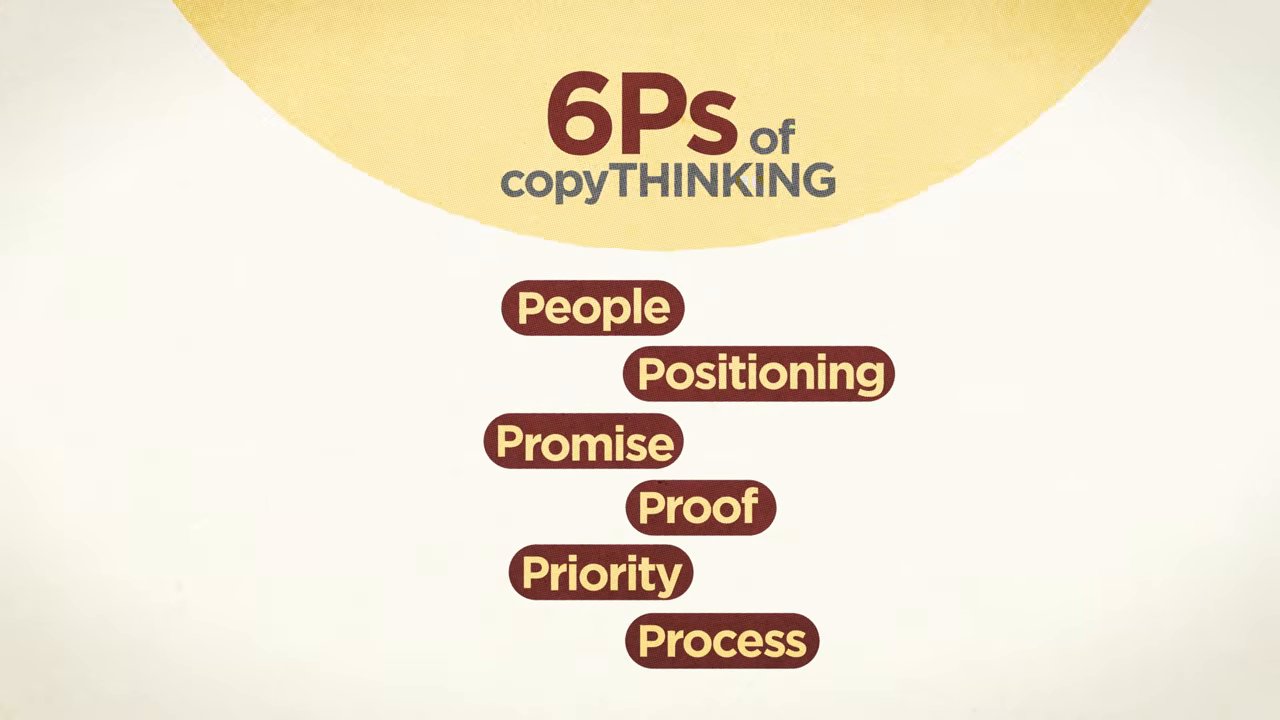
P1: People. Who is your offer for?
You can't answer "why should they choose us?" until you know who "they" is.
Say you're selling a marathon training program. A beginner who's never run one is probably afraid of not finishing, so your promise is that they'll finish their first marathon. A busy professional is afraid of not sticking to the plan, so your promise is a training plan that fits a 60-hour work week. A runner over 40 is afraid of getting injured, so your promise is that they'll run the marathon while staying healthy. Someone chasing a Boston qualifying time is afraid of missing the mark by 90 seconds, so your promise is to get them over the line by a lot. Someone coming back from an injury is afraid of re-tearing it, so your promise is that they'll run while staying healthy.
Same program, 5 different messages. That's why step 1 is getting crystal clear on who your avatar is.
My favorite way to do that is an empathy map. Draw one line going up and one going down, then fill in 4 areas:
- Current: What is your avatar doing on a daily basis? What are they seeing, hearing, smelling, and feeling? What does their daily reality look like?
- Future fears: Where don't they want to end up? This is hell, their worst possible reality.
- Current frustrations: What in their daily life do they dislike or want to avoid? If they have a 9 to 5, maybe it's sitting in traffic, dressing up for work, or being told when to go to the bathroom.
- Future goals: The reality they want to get to. This is heaven.
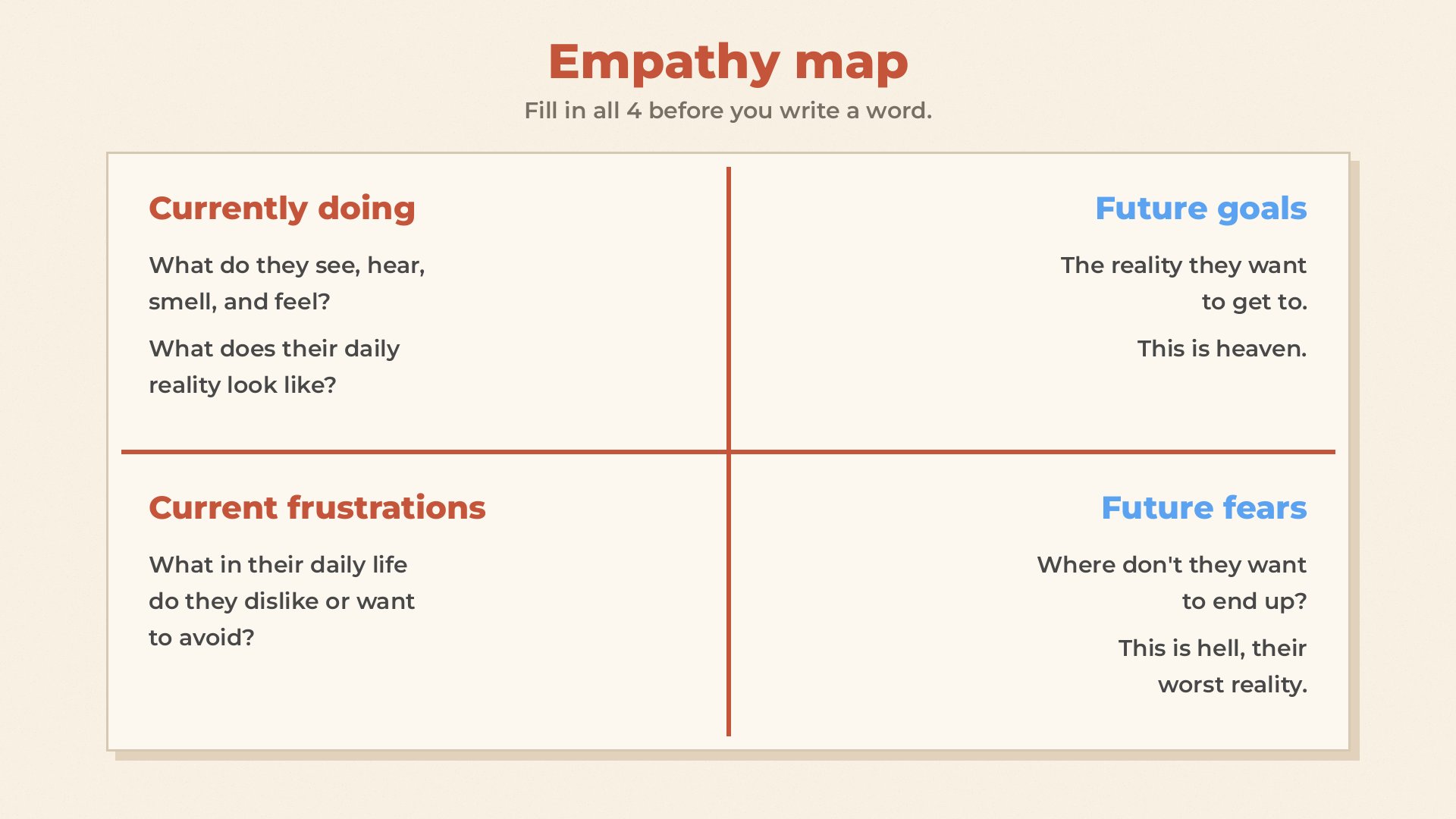
People talk about the golden rule, which is to treat others the way you want to be treated. There's a rule above it, the platinum rule: treat other people the way they want to be treated. That's true empathy, putting yourself in their shoes instead of putting them in yours.
My personal rule is that I don't start writing until I feel like I have almost too much to say. The best way to get there is to talk to your customers and use their exact words. (I'll show you how I do that with sales calls in the ads section, with what I call the why they buy sheet.)
Here's how it plays out. Say someone writes, "I've been a stay-at-home mom for quite a few years, and with my kids in school I feel like I finally have the time to do something for myself and make some damn money." The ad hook might be: "If you've been looking for a way to make money around your kids' schedule without starting a whole business, you need to hear this."
Or say someone writes that she's broke and overworked, chased her dream of working in sports at 20, and is turning 30 this year and ready for financial stability. The hook might be: "If hard work was the answer, the donkey would own the farm."
P2: Positioning. Why should people choose you over anyone else?
Positioning is how your product is perceived in your customer's mind. When it's strong, it increases brand recognition, it makes the sales process easier, and it makes it simpler for others to talk about you.
Seth Godin put it well: "Successful brands are built with your customers talking about you, not you talking about you."
My favorite story here is Claude Hopkins saving Schlitz Beer. They were dead last in sales, competing on "our beer is pure," but every other beer company was saying the same. Claude asked what pure even meant, so he toured the factory.
He found 4,000-foot artesian water wells, expensive filters, and a thousand-year-old mother yeast cell. He asked why nobody had talked about this, and the staff said every beer company does the same. Claude said that's exactly why it mattered. He built a campaign around all the ways Schlitz filtered its beer, and they became number one in sales.
They weren't doing anything differently. They were simply stating the facts, and they were the first to state them.
You can use AI to write for you, but AI can't uncover these hidden advantages and strengths of your clients. That part is on you.
P3: Promise. What do people get?
The promise is the outcome, who you're helping your customer become. Features and deliverables don't belong here. Steve Jobs didn't say the product has 5 GB of data. He said it holds a thousand songs and it goes right in your pocket.
My favorite test is the "so what" test. Say you're selling an artisan rug. It's a 5x5 rug made out of silk. So what? It's large enough to anchor your room. So what? Your room will feel pulled together instead of random. So what? When people walk in, it feels intentional and clean. So what? You'll get compliments and people will think you're awesome. So what? You'll feel like someone with great taste and a home worth showing off.
That's how you get from a deliverable to the core outcome your customer wants. If you're not clear on that outcome, they won't be either, and if you confuse, you lose.
P4: Proof. Why should they trust you?
Proof is the evidence that backs up your promise. (Like I said in the trust section, trust is belief with evidence.) There are 3 types:
- Authority by association: an authority figure backs you up. "Elon Musk says X, Y, and Z."
- Your results: "I scaled my business to 500k a year and here are the 5 lessons I learned."
- Your clients' stories and results: this is the strongest type. "This is Sabrina. I helped her go from making $50,000 a year as a teacher to making $50,000 a month as a high ticket closer."
Proof is also relative, so match it to your avatar. If you're selling to a middle-aged 50-year-old Asian woman, case studies of other middle-aged Asian women will hit harder than one of a young white kid from Alabama.
My favorite exercise is the deaf and mute test. Imagine you can't say anything, you can't explain or argue, and all you can do is point. You can't point at "trusted by industry leaders," but you can point at logos. You can't point at "proven results," but you can point at a number. You can't point at "highly experienced," but you can point at "400 clients, 11 years in the industry."
For me, I can't point at "I'm a great copywriter," but I can point at "helped write ads for a $106.6 million launch in 3 days."
P5: Priority. Why should people act now?
There are only 2 reasons people act: they want to go toward something pleasurable, or away from something painful. I prefer pain in my ads, because people will jog toward pleasure but they'll sprint away from pain.
There are 3 simple ways to build priority:
- Scarcity: there are limited spots.
- Urgency: this goes away in a set number of days.
- Cost of inaction: what happens if you stay on your current path. This is my favorite.
The gap between where someone is and where they want to be creates deprivation, and deprivation is the cousin of motivation. If you're drowning underwater, you don't casually swim up to the surface. You kick and claw and fight your way up to get air.
P6: Process. How does your offer work?
If I say "I'll help you lose weight," there are many ways to do that. GLP-1s, a caloric deficit diet, Pilates, training for a marathon. Each one is a different process to get to the same outcome.
I'll go deeper on this in the ads section, where it's called a unique mechanism. Here's the short version: everyone thinks you have to start a business to start making money online, but you can get paid without being an influencer or building a whole business. It's called high ticket sales.
What does it look like when all 6 come together?
Here's how I'd fill it out for one of Alex Hormozi's workshops.
- People: business owners doing over $500,000 a year in revenue.
- Positioning: we teach you what's working in our portfolio companies.
- Promise: learn the 1 to 3 changes that scale you past your current level.
- Proof: last year the portfolio generated over $250 million in aggregate revenue.
- Priority: if you don't act, all problems route to you and you don't have a business, you have a job. Workshops get booked out.
- Process: the value acceleration method, the compilation of everything he's done across all the different industries.
Once you know all 6, the ad almost writes itself. Here's an excerpt: "If your business is doing between 1 to $3 million a year, then you're in what we call the swamp. You're too busy to work on the business because you're drowning in the business, but you don't have enough cash to hire the key hires you need. You can't grow without help, and you can't afford help without growth."
It's about the thinking behind the words. If you understand the 6 Ps of copy thinking, you'll never go broke. This is how you build campaigns, position products, and scale brands.
What are the 5 Cs of writing on the internet?
Once you know how to think like a copywriter, the next step is learning to write like one. I call these the 5 Cs, and they're the opposite of what school taught you.
In school, you learned to write 5-paragraph essays with big words and long sentences to sound smart, and a teacher was paid to read your writing. Out here, your job is to make the reader feel smart. They don't owe you their attention, so I operate from the lens that my readers are busy, distracted, and read below a fifth grade level.
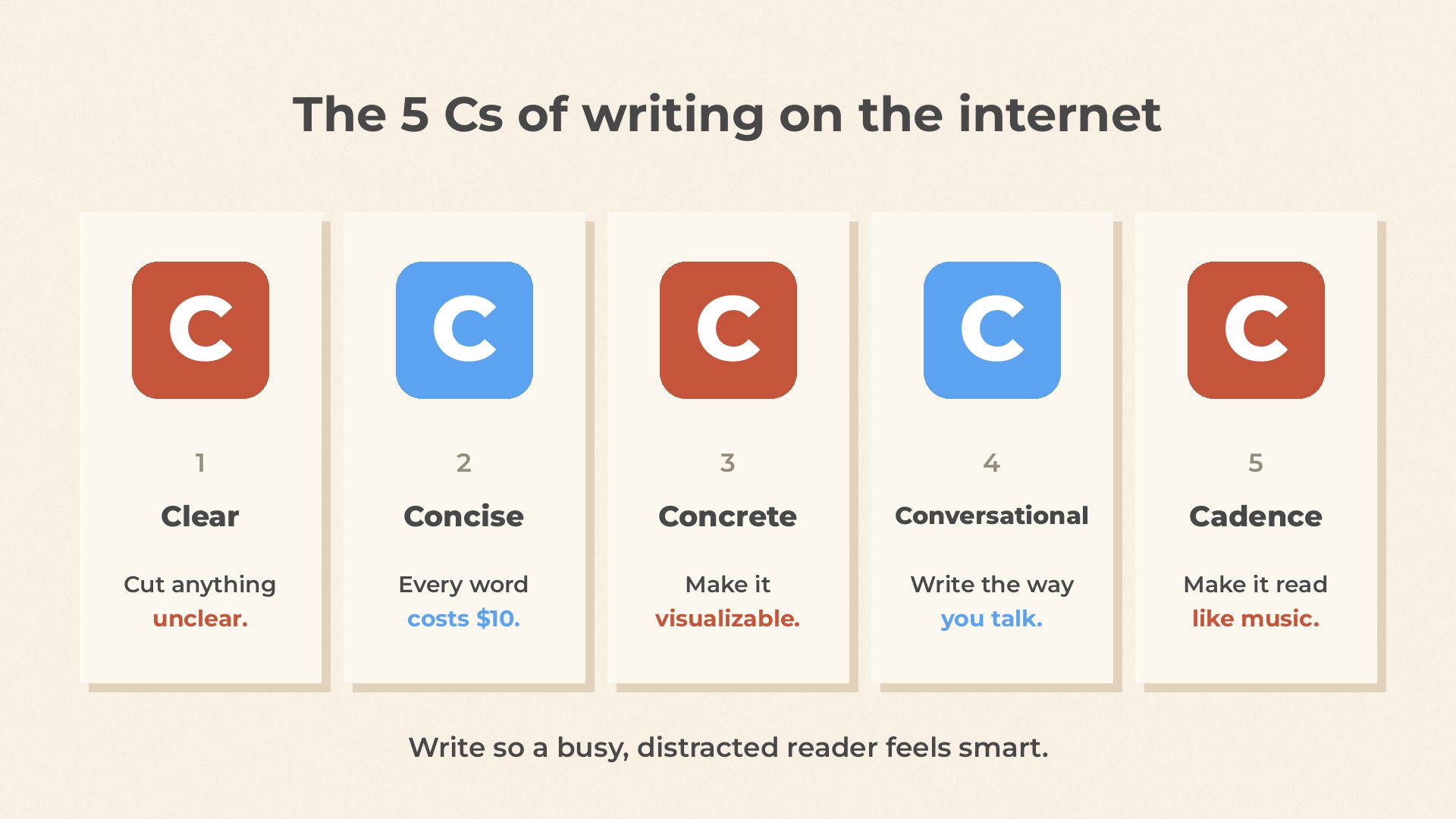
1. Clear
People can't be persuaded by something they don't understand. My favorite way to write more clearly is to remove anything that's unclear instead of trying to add clarity. I start from the end and work my way to the front.
I use what I call the firefighter test. Imagine there's a fire downstairs and you run up to warn the people on the second floor. You say, "Hey guys, there's a situation going down downstairs that we may need to think about, and we kind of have to act quickly. Are you guys listening?" That's horrible. Now imagine you run up and say, "There's a fire downstairs. I need you to open the window and jump out." Much clearer.
Pro tip: use the Hemingway app. It's a free tool (I'm not affiliated with it), and it grades your writing level and shows you which sentences and words to cut or rewrite.
2. Concise
I pretend every word I write costs $10, and before I publish anything I ask myself what I can cut without removing quality or understanding.
The best way I know to practice is writing tweets. At the start of my career I wrote 10+ tweets a day for 6 months straight, and the 280-character limit forces you to be concise. It's also why Twitter is my idea playground, the same one from the content multiplication system. You can test ideas there without being penalized, then turn the winners into ad hooks, YouTube points, and short scripts.
3. Concrete
Make your writing visualizable, so your reader can picture it. Instead of "we help business owners grow," say "we took a roofing company from 14 leads a month to 70 leads a month."
When you're describing something big and amorphous, like love, it makes sense to zoom in. "I love you" is hard to picture. "Sometimes I wake up, put my hand out next to the bed, and you're not there. I roll over and sniff your pillow because it smells like you" is easy to picture.
Not all of your writing has to be visualizable. When you're describing something meaningful, like an emotion, zoom in.
4. Conversational
One of the biggest mistakes I see on social media is people taking habits they learned in school and applying them to LinkedIn or Twitter posts. It reads corporate and robotic. If you read it out loud, it's just not how anyone talks.
Match your writing to your reader's in-group. If you're talking to 20-year-old college students, "please don't hesitate to reach out" becomes "just text me if you need anything." If you're talking to 50-year-old lawyers, you'd use different language. This is why understanding your people matters so much.
5. Cadence
You want your writing to read almost like music. If every sentence has the same droning rhythm, your reader will be bored out of their mind, and people who are bored usually don't buy.
My favorite example is Gary Provost's: "This sentence has five words. Here are five more words. Five-word sentences are fine, but several together become monotonous. Listen to what is happening. The writing is getting boring. The sound of it drones. It's like a stuck record. The ear demands some variety. Now listen. I vary the sentence length, and I create music. Music. The writing sings."
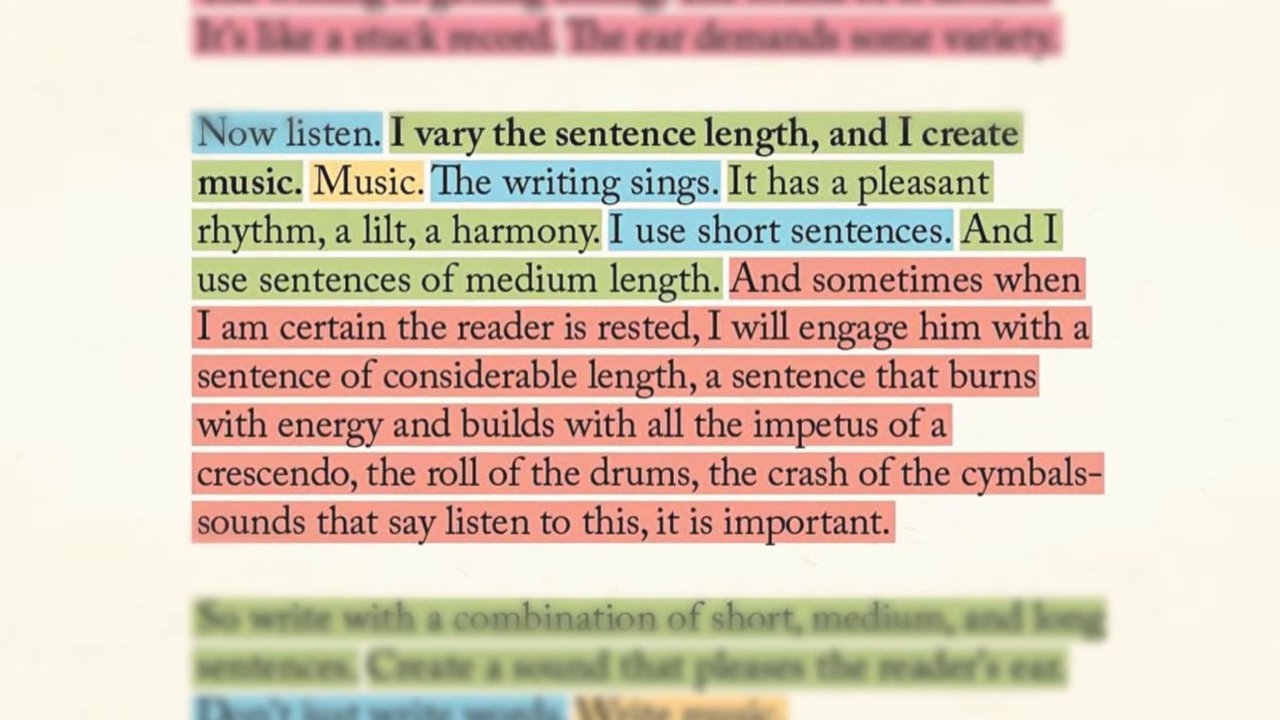
Two quick tests. First, read your writing out loud, and rewrite anywhere you stumble or it sounds unclear. Second, squint your eyes and look only at the outline of your writing. Does the shape of the sentences vary, or is everything in one straight line?
The best copywriting is like the windows in a mall: it's see-through, so the reader sees the stuff in the store and forgets the glass.
How do you write the hook, the body, and the CTA?
The advertiser David Ogilvy wrote, "The average person reads five times as many headlines as they do bodies of copy." Once you've written your headline, you've spent 80 cents out of your dollar in advertising. It's not an exaggeration to say your hook determines probably 90% of your post's performance.
The hook
There are many ways to write a hook, and I won't pretend I can cover them all here. This is the formula that's worked best for me: virality equals benefit times relevance times credibility, divided by perceived effort.
- Benefit: why people should care. What do they get from reading this?
- Relevance: how many people it applies to.
- Credibility: why they should listen to you.
- Perceived effort: how much effort it takes to read the piece and to implement it.
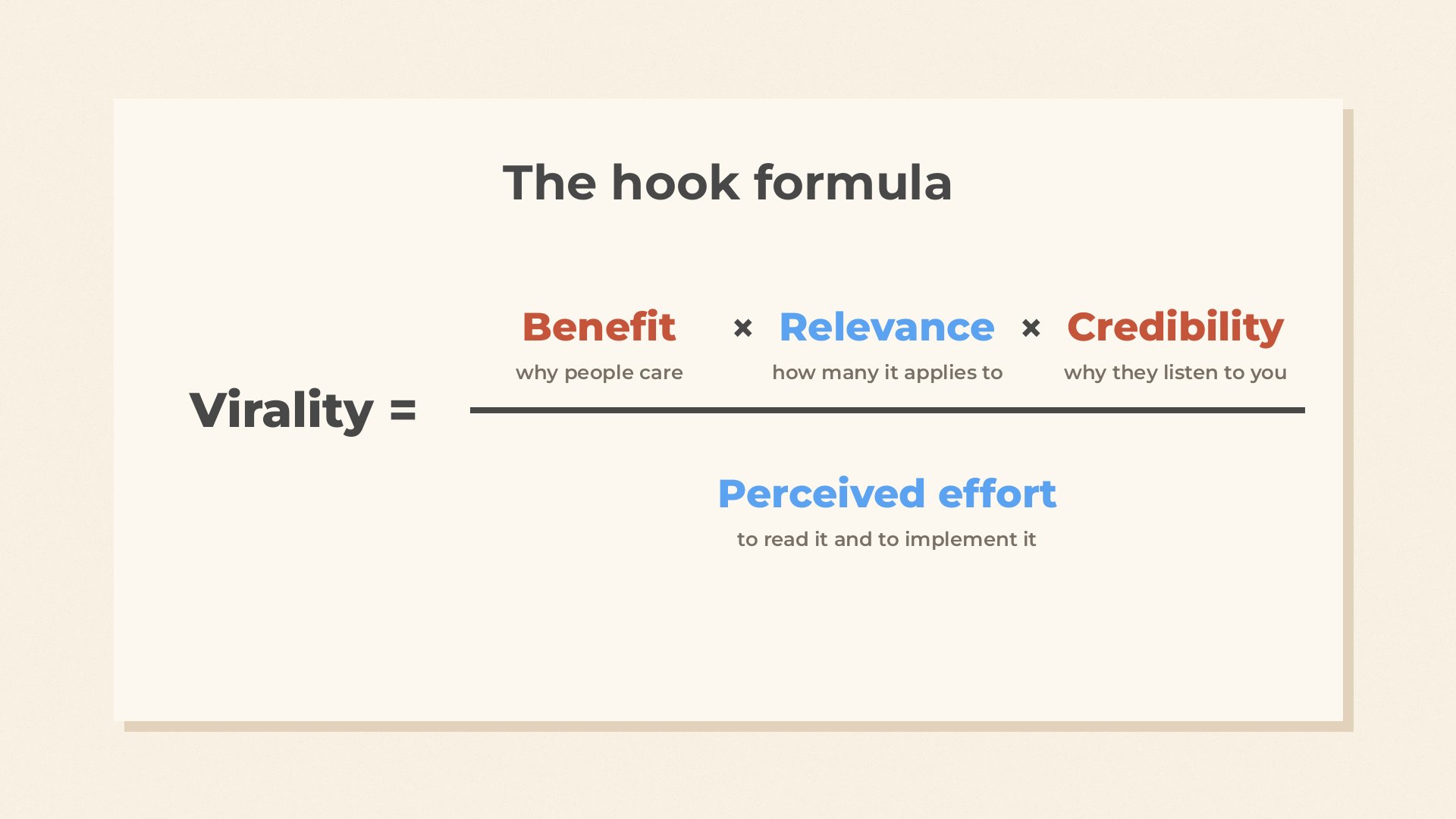
One of my favorite examples is a Twitter thread I wrote for Noah Kagan a few years ago.
"I was employee number 30 at Facebook. Then I got fired. For a long time, I was bitter that they let me go. But the lessons I learned from Mark and Facebook helped me build a $100 million a year company. 10 lessons I learned from working directly under Mark Zuckerberg."
The credibility is that he was employee number 30 at Facebook. The benefit is that you get the 10 lessons he learned. The relevance is that 10 lessons can apply to pretty much anyone. And for perceived effort, you almost never get access to Mark Zuckerberg, so reading the thread is the easy way in.
The body
There are many ways to write a body, and it depends on what you're writing. I keep coming back to 2 frameworks.
What, Why, How is for educational content.
- What: the point you're trying to make.
- Why: why people should care.
- How: how they implement it.
For example: you should drink more water (what). It helps you think more clearly, speak more articulately, makes your skin glow, and gives you more energy (why). Before every meal, drink an 8 oz glass of water, which adds up to 24 ounces a day and is more than enough to get started (how). I use this to structure the chapters in my books.
But, Therefore is for storytelling. When most people tell stories, they tell them in a straight line: I woke up, and then I brushed my teeth, and then I changed my clothes, and then I went to the grocery store, and then I forgot my keys at home. There's no tension and no story arc.
With but and therefore, you create tension and surprise. I woke up and went to the grocery store, but I forgot my keys at home. Therefore, I went back home, but I realized someone was in my kitchen. Flipping back and forth gives you the arc.
The call to action
Our goal with content is to grow a business or get something out of it, so the CTA matters. What do we want people to do next? I use a who, what, when, how framework:
- Who you're looking for
- What they need to do
- When they need to do it by
- How they should do it
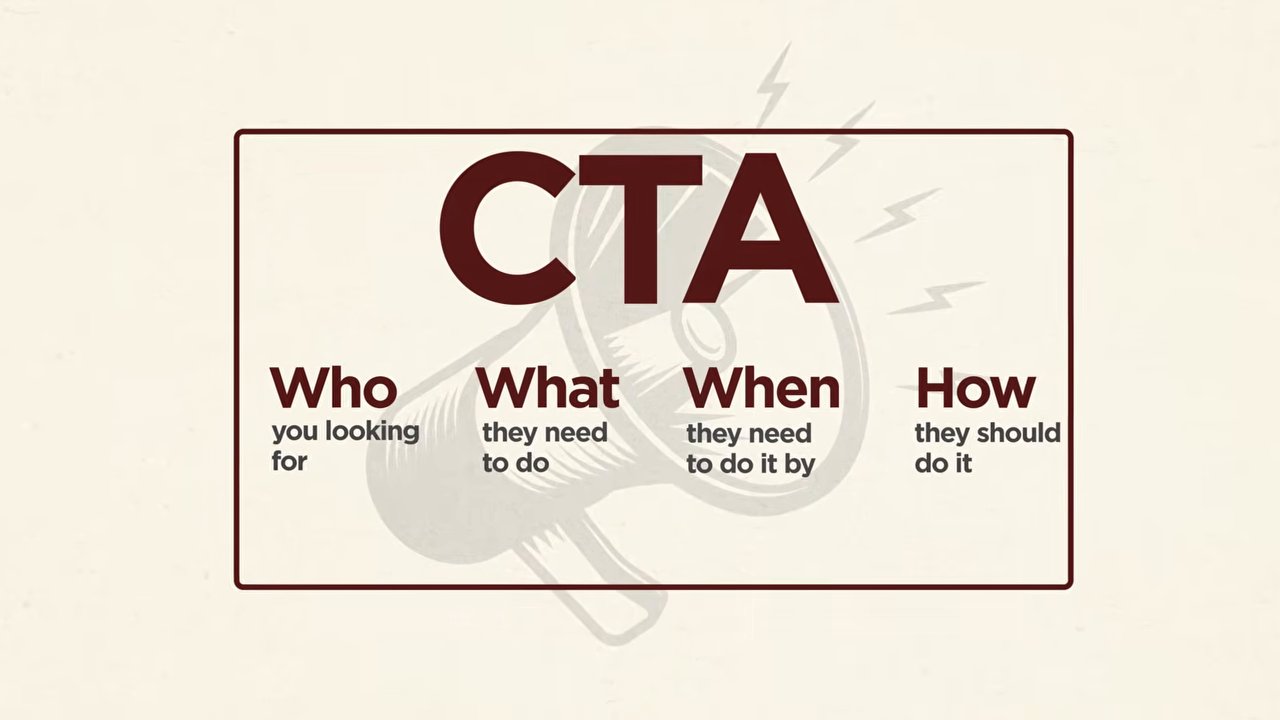
For example: "If you're a woman who wants to break into high ticket sales, then I want you to register for my free Zoom masterclass this Tuesday at 8 p.m. Eastern. I'm going to cover what this career is, how it works, and how you can get started even with no experience, so click below and save your spot."
The worst mistake is giving people multiple options, because that decreases the likelihood they do anything. One CTA, one avatar, one offer.
When should you run paid ads, and what actually targets your audience now?
Everything so far builds demand that shows up later. Now I want to talk about capturing the people who want what you sell right now.
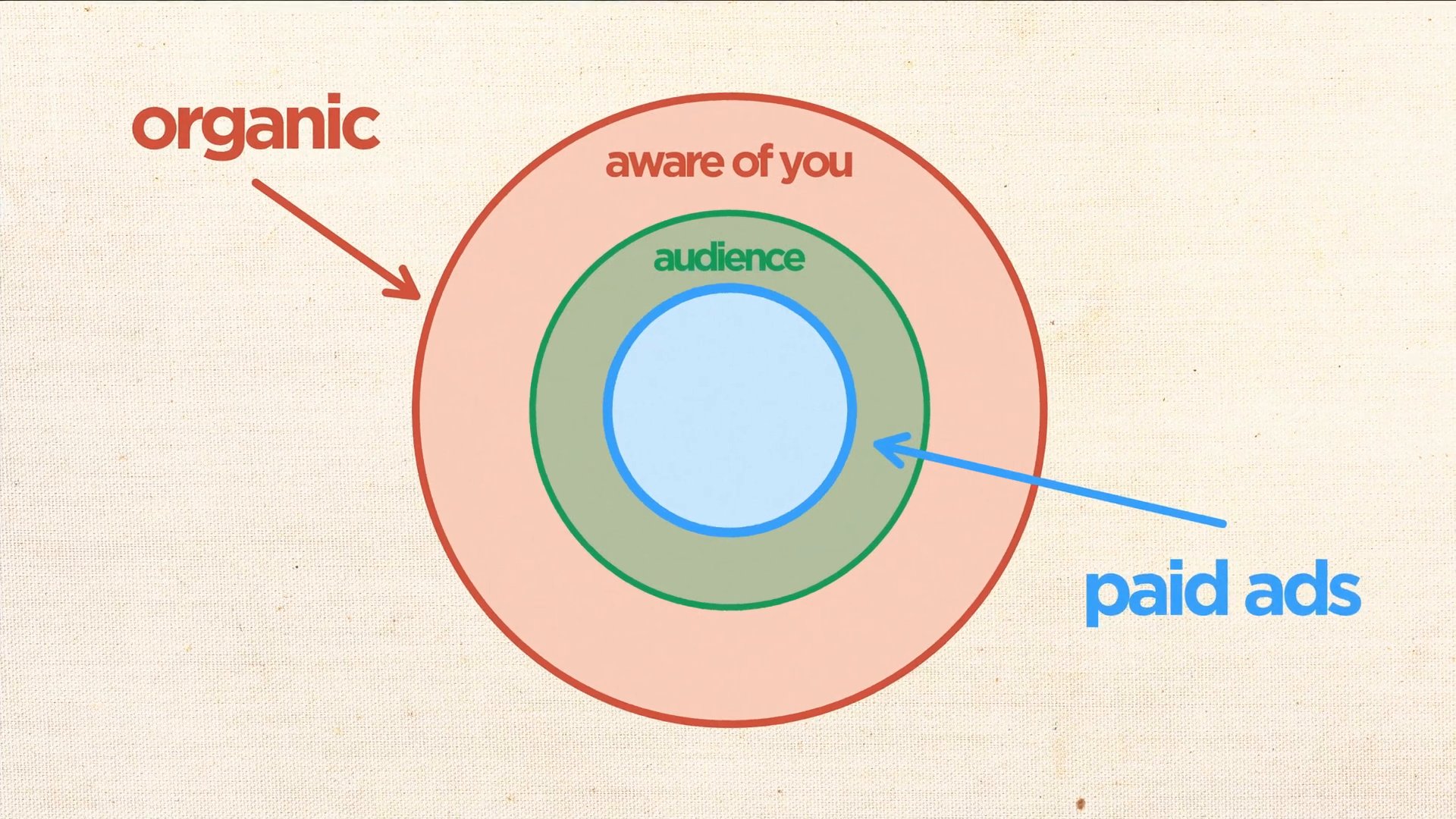
A lot of people talk about the power of organic. You've got to build a personal brand, put out free content, and the money will come. I'm a huge proponent of organic social content, and I've built my career off of it. The problem is that while organic is free to post, it also gets you variable results. You can upload content online, but you can't guarantee you get in front of your customers.
That's where paid ads come in. Yes, you have to spend money to put an ad up on Meta, but you can reasonably guarantee you'll reach the type of people you want to reach. If you can guarantee your message gets in front of the right people, then the message needs to be written really well.
My rule is to explore with organic and exploit with paid. Organic is free to post, so you test angles there. Once you know which ones resonate with your customer base, you put money behind them. If you start running paid ads from the get-go, you don't know what you don't know, and you burn a lot of money figuring out what works. Feel like you're burning money? You are.
That's why the first thing we do with clients at Revenue Media Lab is install the organic content system. When we turn paid ads on, it's like pouring gasoline on the fire.
What does targeting look like now?
Before, you needed crazy targeting to figure out who you were reaching, where they lived, and what their demographics were. Now Meta has an update called Andromeda, which is basically Meta's AI system that does a lot of the targeting for you. It's an algorithm.
The targeting is actually the copy you write. If you say "I'm looking for healthcare business owners," Meta starts sending your ad to healthcare business owners. About 70 to 80 percent of our spend is broad targeting, and we let Meta figure out where the ad should be placed. It reads the text you write and the visuals and verbal stuff you include, shows the ad to the people it thinks will respond, and then, based on their impressions and engagement, sends it to more of those people or to other people.
You can think of paid ads like organic content, where Meta's goal is to keep people on the platform. If your ad looks and sounds like an ad and turns people away from the platform, Meta's not going to push it to a lot of people. If you have an organic piece that people watch all the way through and share, you can say that in an ad, use the same format, and it has a higher likelihood of keeping people on the platform.
What can you change about the offer?
Copywriting can only communicate the value your offer already has. We can't make things up. If you control the offer, there are 3 vectors of value you can tweak: speed, risk, and ease.
- Speed: how quickly you can get your customer a result.
- Ease: how easy it is for them to get it, without a lot of time or effort.
- Risk: how you reduce their risk, or their perceived likelihood of risk.
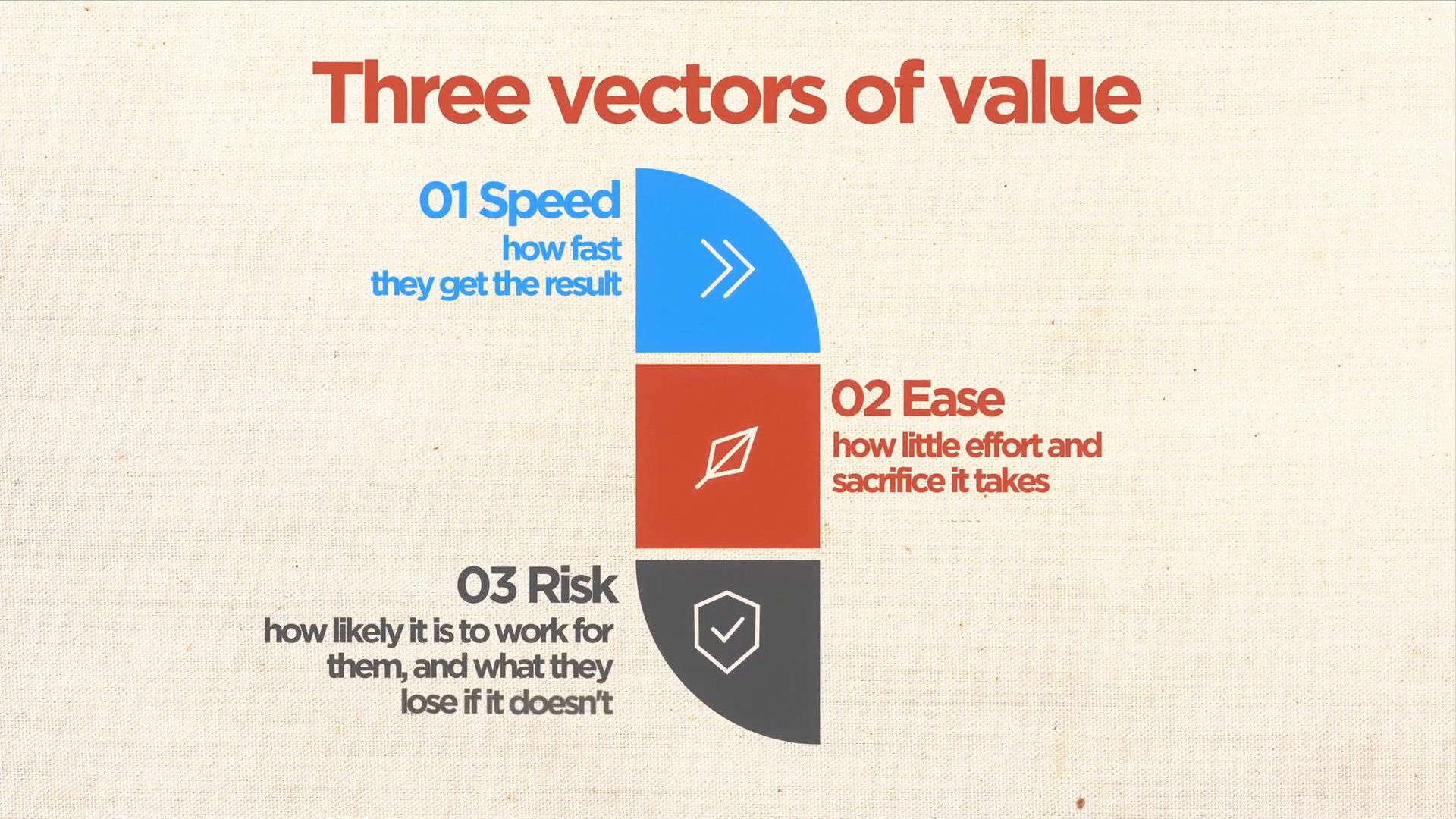
Say I sold a fitness program that was 6 months long, cost $10,000, and had you showing up at the gym every single morning. That's a lot of money, a lot of work on your end, and a lot of time, and how would you even know I can help you get fit? Now say I had a magical drug prescribed and studied by hundreds of doctors, you don't have to stick to a strict diet, and all you have to do is take this pill. That's probably a more convincing offer. Find the weakest of the 3 vectors and tweak that one first.
The market outweighs any piece of copy you can write. You can have amazing copy, but if it's pointed at the wrong market, or a market that doesn't buy, it doesn't matter.
Who should you write for? A starving crowd
If I told you that you could have any advantage in the world to make your burger stand the most successful in the world, what would you pick? Delicious meat, the best location, the lowest prices? The advantage the copywriters I work with choose is a starving crowd. If you have the right market, it honestly doesn't matter what you sell, because they're hungry and they want to buy.
Here are the 3 filters I look through to decide if a market is worth writing copy for:
- Are people already paying for your solution? Go to the Facebook Ad Library and search your category. If competitors have been running the same ads for months, there's probably money in that market.
- Is there a group inside that market that no one is talking to? Look for a subset or subgroup that no one is really marketing to.
- Do they know they have a problem? We want to market to people who already know, so we don't have to educate them on what their problem is.
What do you research before you write a single ad?
I wish I could give you a magical silver bullet that lets you skip this part, because it's a lot of work. But this is the magic sauce. It's the difference between okay copywriters and great ones.
Eugene Schwartz, one of the best advertisers in history, used to say that copy can't create desire. It can only channel existing desire. It took me so long to wrap my head around that. When you think about creating desire, you think, "If I just have a unique angle, or a clever hook, or some kind of trick, I can get people to buy." That's just not the case. We already have existing desires in our hands and in our minds, whether that's love, meaning, money, fulfillment, joy, or happiness. A copywriter's job is to identify who that person is and what they want, then position the product or service as the bridge between where they are and where they want to go.
Step 1: Build a story bible
A story bible is a universal source of truth. It's a living, breathing document we pull from any time we write an ad or create a piece of content, because we know it's everything about the client. It includes:
- Who the client is and their entire life story
- Who their customers are, what the offer is, and what the funnel looks like
- The credibility bank: what the client has done that's impressive, and results they've helped students achieve
- Any frameworks or concepts the client talks about
- Their avatar's top objections, plus a full diagnosis of who they are and where they hang out
- Any required links, approved or banned words, and any guarantees or claims they can or can't make
- A bunch of examples of how the client sounds, so we know we're writing in their voice
The reason we start here is that we update it in real time. Each time we write a new batch, we get better.
Where do you find all this? You can interview the client, or interview yourself. I also love looking at YouTube videos and podcasts. In a 60-second reel you can hide behind a script, but in a long video there's no hiding. You either know what you're talking about or you don't, and you either sound like you or you're reading off a script. If a client only makes videos on Instagram, you can use Claude to download and transcribe all of them, then create a voice skill off of that.
Step 2: Build the why they buy sheet
This is one of those tactics that's so juicy I feel uncomfortable giving it away in free content, because it absolutely crushes. You download your client's sales calls, transcribe them, and pull out the key phrasings your customers used, so you can say them back in your ads. Look for why they bought, what their dream outcome is, what pains and frustrations they're going through, and what objections made them hesitate to join.
Then build a perfect client profile (PCP) from your best customers, the ones who pay the most, stay the longest, and who you enjoy helping the most. Find the messaging that got those people in the door and align it across the rest of your funnel, so you get more of the people you want and fewer of the people you don't. It's the 20 percent that gets 80 percent of the returns, and you do 100 percent of that with the next thing.
No sales calls? Look at competitor accounts and their comment sections. Go to Reddit and see what people are talking about. Go to Amazon, find books or products in your niche, and read the 3-star reviews. Those are typically the most truthful.
Some of the best ads I've ever written came from downloading our customers' sales calls and transcribing them. Here's a hill I'm willing to die on: if you can describe your customers' pain better than they can articulate it, they'll subconsciously believe you have the solution. The pain is the pitch.
Step 3: Know your customer's level of awareness
Awareness levels are more conceptual than something we use on every ad, but they determine the language you use. There are 5: unaware, problem aware, solution aware, product aware, and most aware.
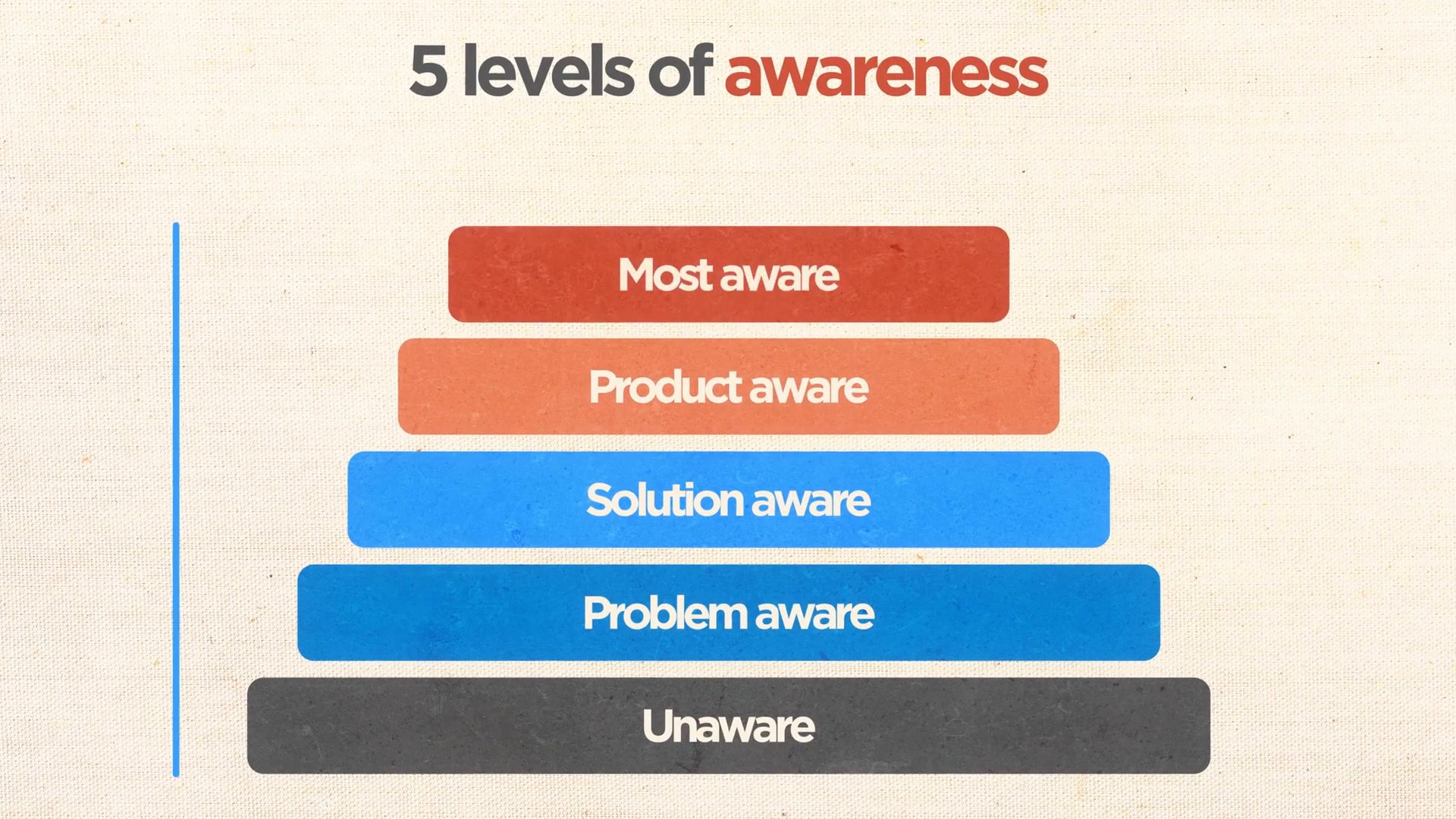
Say you tweaked your back a few weeks ago and it's still hurting, but you're not sure if it's a one-off or something ongoing. You're unaware. To reach you, I'd name the problem: "If you're over the age of 45 and your back's been hurting for a few weeks, you might have what we call misplaced disk syndrome."
Once you know that, you're problem aware, and my ad explains the options and what we recommend instead of an ice pack or lying on the couch with your legs up. That takes you to solution aware: you know you have a problem, and you know there are several solutions out there. Now my job is to explain why my product is different and better. Maybe you only show up once a week, or you get a personalized coach you can text with questions, or you do all the exercises at home.
Most aware means you know the problem, you know my product, and you're ready to buy. All I have to do is show up and present a compelling offer. I put out a ton of free value in organic content so I can run ads to most aware people and skim off the top of the goodwill we've created.
Step 4: Know how sophisticated your market is
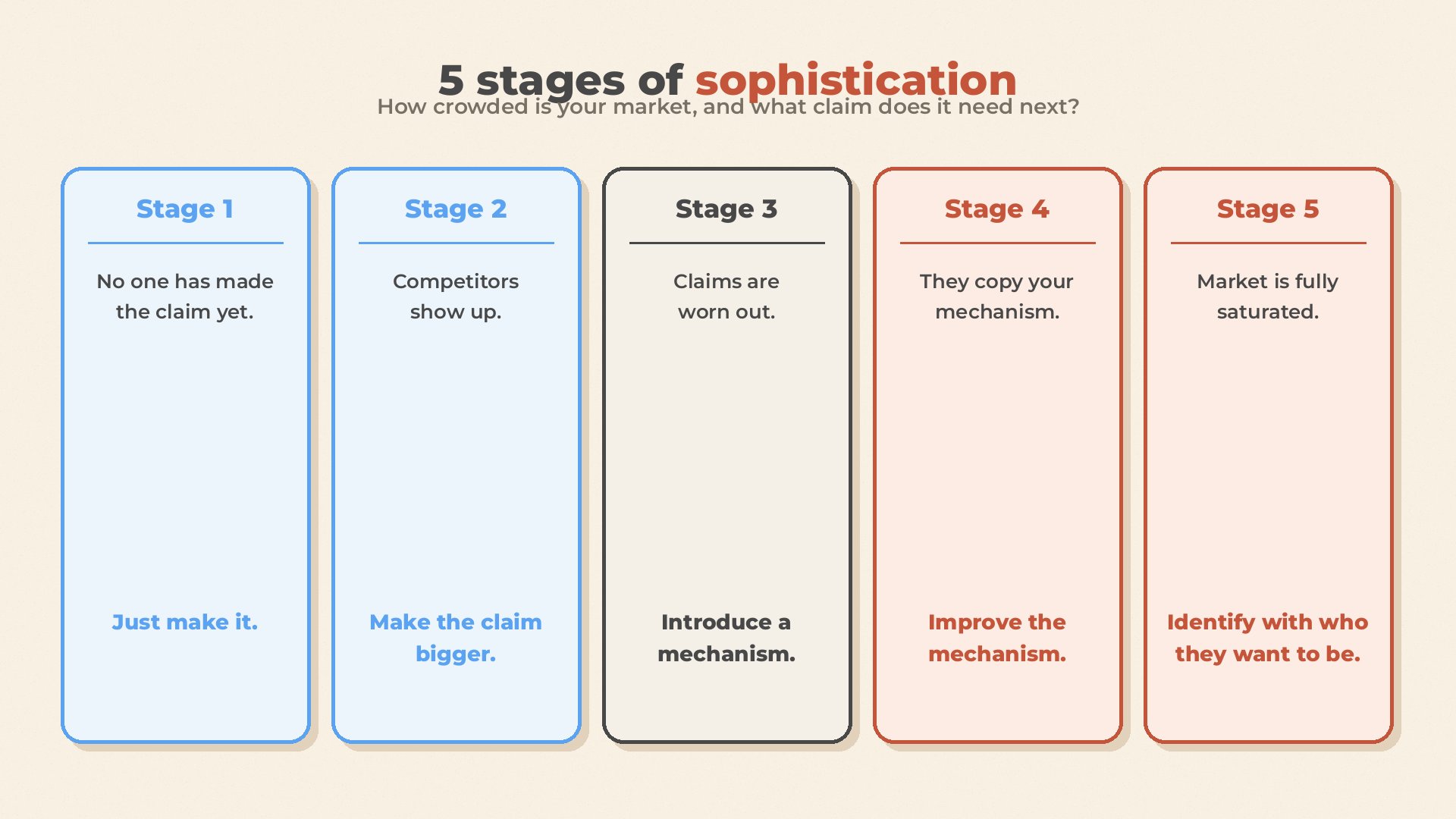
Awareness is about your customer and what they understand. Sophistication is about the market: how many competitors you have, or whether you have any. There are 5 stages:
- Stage 1: No one has made the claim yet, so you can just make it.
- Stage 2: Competitors show up, so you make the claim bigger. "If you do push-ups, you'll lose 50 pounds by tomorrow."
- Stage 3: The claims are worn out, so you introduce a mechanism. "Use the corkscrew push-up and lose 50 pounds."
- Stage 4: Competitors copy your mechanism, so you improve it. "Use the corkscrew method combined with our proprietary pills, prescribed and trusted by doctors, to lose 50 pounds in 2 weeks."
- Stage 5: The market is so saturated that people don't trust the claims at all, so you identify with the person your customer wants to become. This is where you lean into personal brands: "I grew up as a really fat kid, and I struggled with that." (That's a made-up story, by the way.)
Ideally you're a first mover in a market, because then you don't have to compete with a lot of competitors. To find out which stage you're in, go to the Meta Ad Library, find 20 of your competitors' ads, and write down the claim each one is making. If they're all making the same claim, you're in stage 3 or later, and you need to introduce a mechanism.
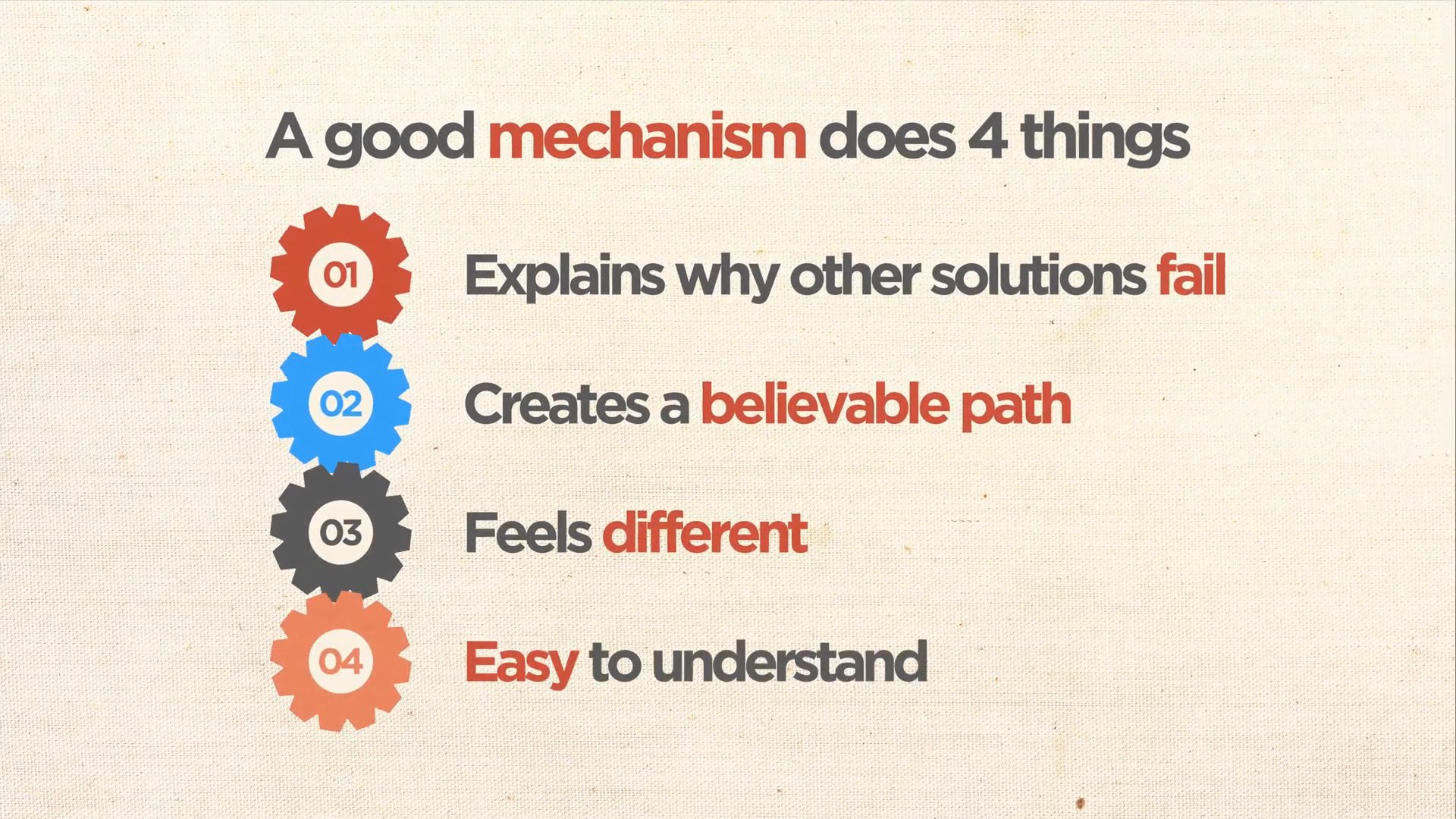
A unique mechanism is really just an explanation for why other solutions fail and why yours is better. The quickest way to find yours is to finish this sentence: most people believe X, it's wrong because Y, and the answer is actually Z.
Let's say we're targeting business owners whose business isn't growing. Most people would think it's probably a leads problem, a marketing issue. But if we say it's actually not that you lack customers, it's that you don't know how to monetize them, you don't have a money model, now we've created a frame for our customers to believe. When the problem keeps persisting, they'll probably think, "I actually have a money model issue. I need to buy this book or join this program."
One of my former clients ran a 7-figure fitness business. His premise was that most people think they stop showing up to the gym and stop getting results because they lack discipline, but it's actually because they don't have an accountability buddy. He partnered every student with a coach who texted them every morning and every evening to make sure they showed up to the gym, did their exercises, and watched their diet. He built the entire business on that frame.
Step 5: Find the big idea
If you look at the top creators and marketers in the space, they all have a big idea they use in their marketing. David Ogilvy said that if your advertising doesn't have a big idea, it will pass like a ship in the night. A big idea has to be new, easy, feel safe, and feel big.
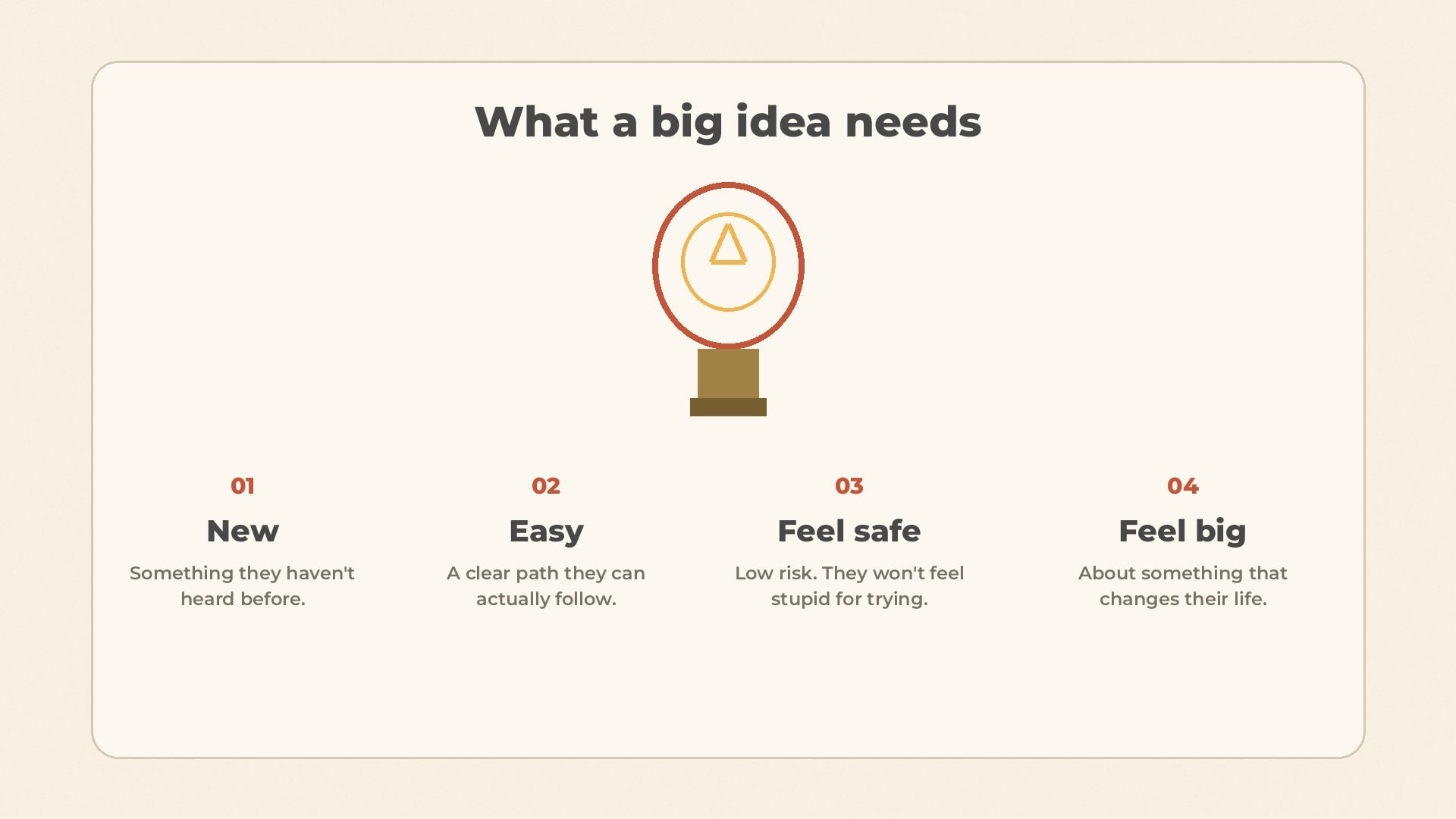
The most famous big idea in advertising was from a diamond company: "diamonds are forever." It completely changed culture. The reason people are so obsessed with buying big diamond rings to display their love is because of that campaign. It was new, because diamond rings weren't that important before it. It was easy, because one purchase demonstrates your love. It was safe, because once you buy it, it lasts forever. And it was big, because it was about the love of your life.
For Shelby Sapp, the big idea is the Porsche Pilates lifestyle. She put a name to a feeling that a lot of the women she markets to feel but couldn't quite articulate, and she made it a desirable thing. It was new because no one had talked about it before. It was easy because you learn one skill, high ticket sales, and you can get that life. It was safe because you can learn how to get sales on the side of your job, so you don't have to quit anything. And it was big because it was about changing the trajectory of your life.
Step 6: Address the beliefs
Every consumer needs to believe 3 things before they buy:
- The vehicle: does this process or mechanism work? (Will 3 Pilates classes a week get me my dream body?)
- Internal: do I believe I have the capacity to do this and change my life?
- External: will this work in the outside world, like when my kids are at home and need to be taken care of?
In our ads, we rotate between these 3 beliefs, so by the time people book a sales call or reach the checkout page, those objections are already handled. With clients, we list every belief our customer has that we haven't addressed yet, then turn each belief into an ad angle.
How do you actually write and run the ad?
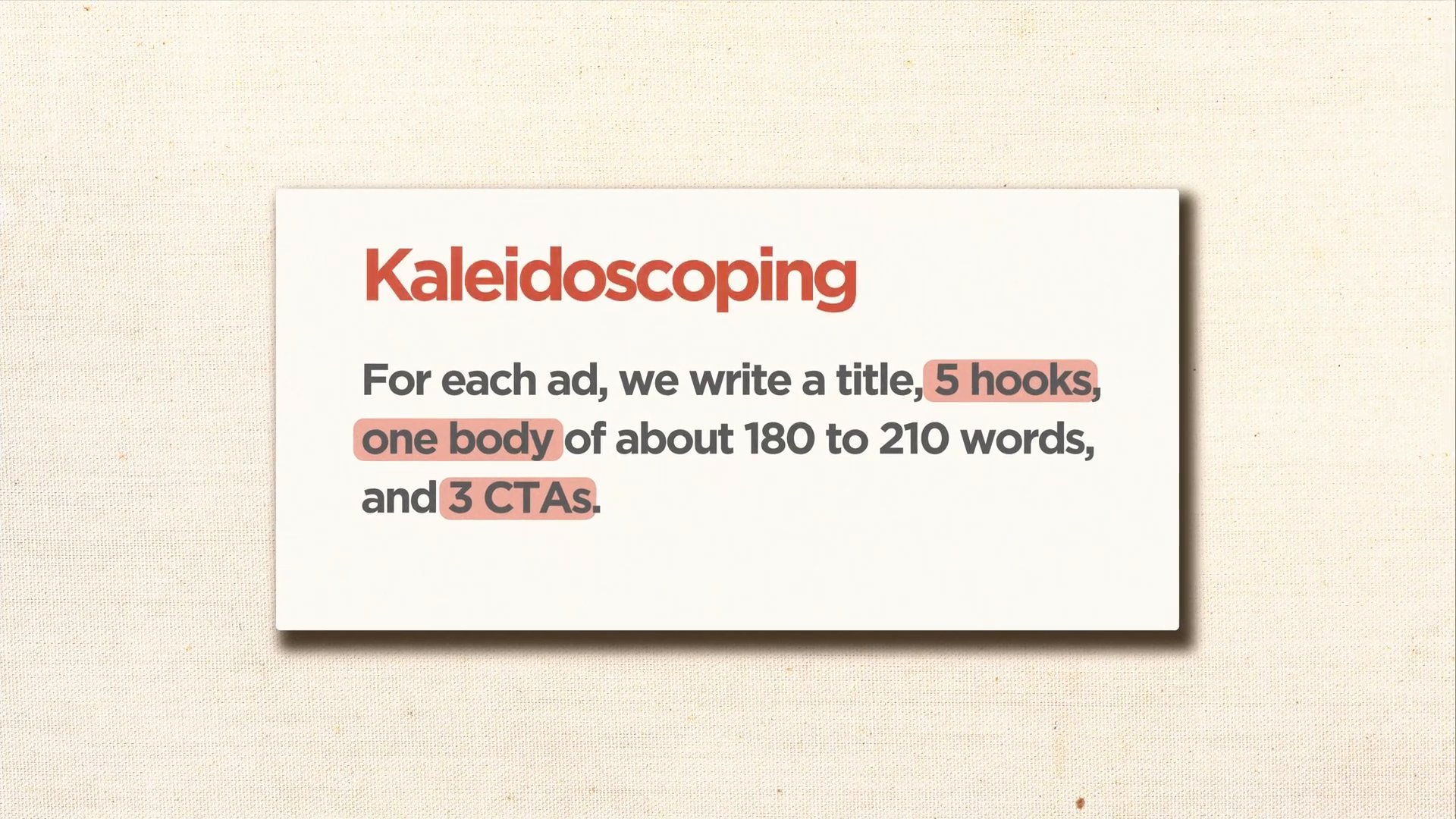
Once the research is done, the ads kind of write themselves. For each ad, we write a title, 5 hooks, 1 body of about 180 to 210 words, and 3 CTAs. We call this kaleidoscoping, which lets you test a bunch of angles in one ad set before you have to move on to a new one.
Say you use hook 1, body 1, and CTA 1, then hook 2, body 1, and CTA 1, then hook 3, body 1, and CTA 2. You can create a bunch of variations, and when one of them doesn't work but another one does, you double down on that branch. You don't have to build a whole new ad.
Most of my time goes into the hooks.
Where do hooks come from?
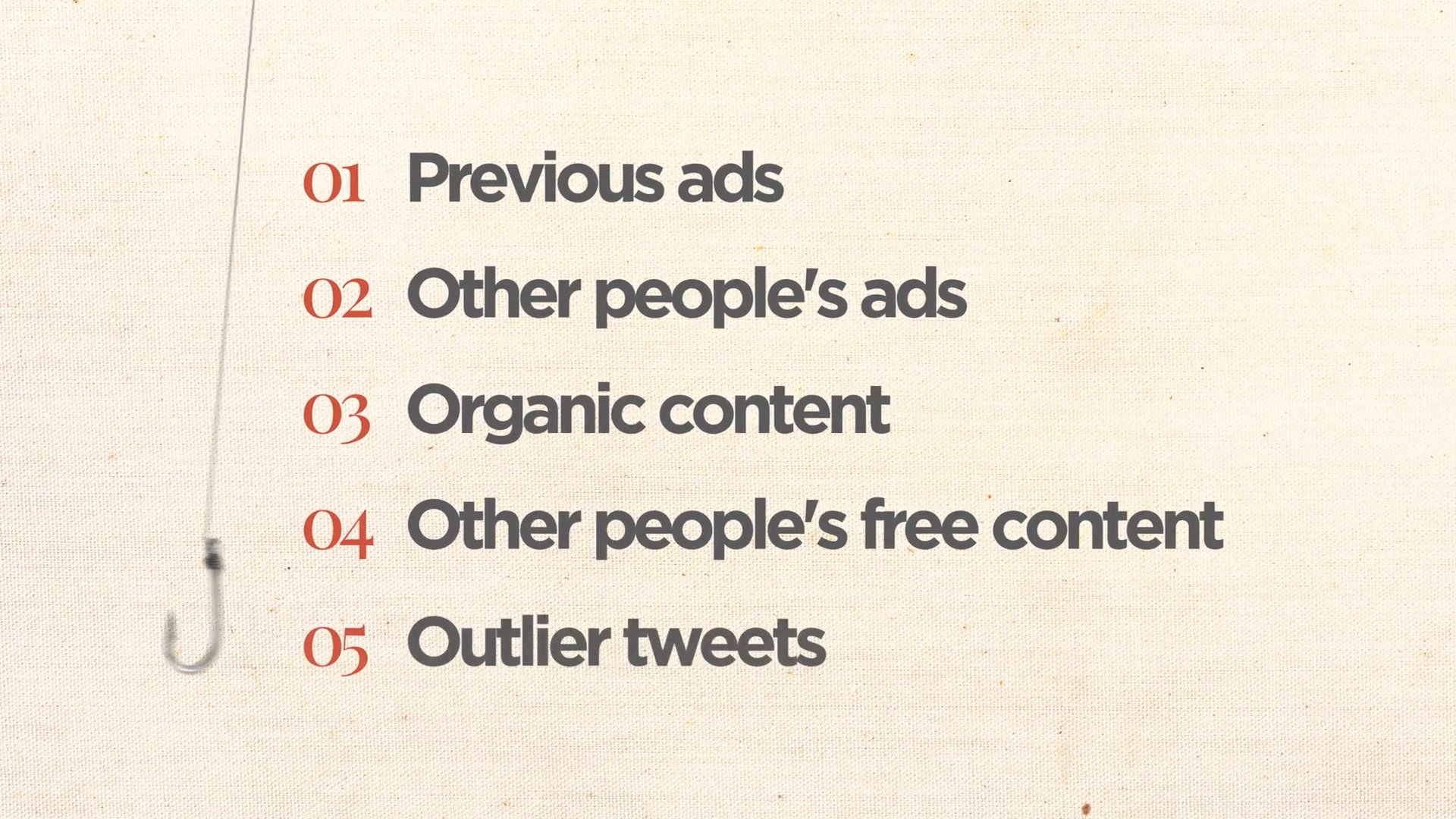
I look in 5 main places:
- Your previous ads. Go into the Meta Ad Library and figure out which ones are doing well.
- Other people's ads. Look at competitor offers in the Meta Ad Library and see which angles are working for them that we can modify for our hooks.
- Your organic content. This is honestly my favorite, and it's why we start with organic. You can explore a bunch of angles on social media. If you trial reel a bunch of things on Instagram, you can see which hooks resonate and turn them into an ad.
- Other people's free content. I'm a huge proponent of scrolling Instagram and noting anything that captures my attention, even if it's unrelated.
- Outlier tweets. This is one of the most underrated sources, because not many people are on Twitter, and most of the people who are think it's just for sports, news, and politics. There's a pocket of Twitter I call money Twitter: entrepreneurs, operators, builders, people sharing ideas. When Elon Musk takes a bathroom break and opens his phone, he's not scrolling Instagram.
Here's an example. A tweet asked, "Have you ever had a job where you thought, I really don't care about any of this, none of this feels purposeful or meaningful, none of this actually matters?" It got 400,000 views, so I wrote an ad hook for one of my clients: "If you've ever sat at your desk and thought none of this matters, this video is for you."
What makes a hook work?
Specificity sells. Claude Hopkins said that platitudes and generalities roll off the human understanding like water off a duck's back. So instead of "Are you broke?", try "Do you turn the brightness down on your phone when you open your bank app because you don't want other people to see your balance?" Or "Do you feel guilty when you say no to going out to eat with your friends because you really can't afford it?"
One of the biggest mistakes I see beginner copywriters make, and this goes for organic content too, is writing statements that aren't a promise and don't open a curiosity gap. "Your salary went up 3% and your rent went up more than that" isn't a hook. It's just a random statement. Describe a moment instead, so your customer thinks, "That's exactly me."
The same goes for the outcome you promise. "Take this pill and you'll sleep better at night" is hard to visualize, and it feels like a random marketing claim. "On average, our customers have fallen asleep in under 10 minutes" is more believable.
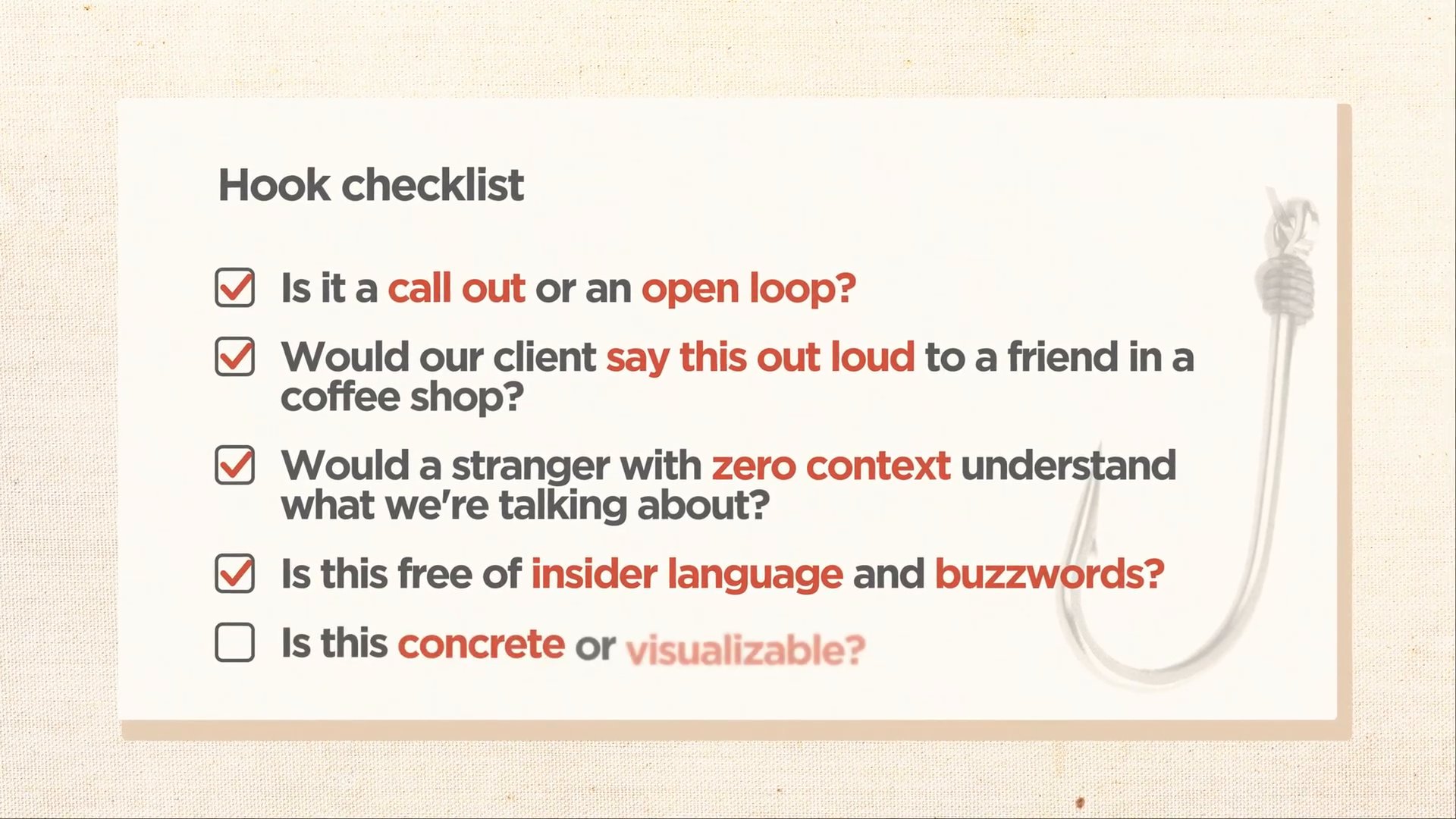
Before we ship any hook, we run it through 5 questions:
- Is it a callout or an open loop?
- Would our client say this out loud to a friend in a coffee shop?
- Would a stranger with zero context understand what we're talking about?
- Is it free of insider language and buzzwords?
- Is it concrete or visualizable?
What goes in the body?
Ask yourself the best way to explain the concept. Think about your teachers in school. What do you actually remember? I don't remember a ton of what I learned, but I remember my science teacher telling stories about his first date. These are the body formats we use:
- Story: "I went from making $8 an hour as a barista to becoming a millionaire at 24."
- Analogy: "The middlemen make most of the profit. Airbnb owns no homes, Uber owns no cars. Similarly, in high-ticket sales you don't have to own the product or have an audience. You can sit in the middle and make an income."
- Steps: "If you hate your job and want to quit your 9 to 5, step 1, don't quit your 9 to 5. Step 2, build income on the side. Step 3, once you replace it, then consider quitting."
- Maxim: "If hard work was the only answer, the donkey would own the farm."
- Whiteboard explainer: When my teacher drew a diagram on the whiteboard, for some reason it stuck in my mind, because it was visual.
- Podcast style: Meta rewards ads that keep people on the platform. If your ad feels and looks like organic content and people watch the whole video, Meta will reward it. Instead of talking straight to camera, turn and pretend you're being interviewed about your offer, so it doesn't feel super salesy.
- Qualifiers: Tell Meta who you're looking for, and tell people exactly who you're looking for. "If you're a girl who owns a laptop and has a Wi-Fi connection and has 2 to 3 hours a week, you could be making between $4,000 and $10,000 a month on the side of your job."
What does a CTA need?
The same who, what, when, and how from the copy section. Who we're looking for, what we want them to do, when we want them to do it by, and how. One ad, one CTA, because giving people multiple things to do decreases the likelihood they do anything.
How honest should your ad be?
State the facts and tell the truth. We don't write lies or manipulate the truth to sound better. We manipulate reality so that it is the truth, so we can make our copy better.
Respect the reader. David Ogilvy said your consumer is not a moron, she's your wife. I don't believe in scammy fake urgency, like "only 5 spots" when there are more. Yes, it may get better results in the short term, but if you over-promise and under-deliver, you start a cycle of negative word of mouth that stays on the internet forever. Negative word of mouth is probably even more potent than positive.
When you admit what you aren't good at, you gain a lot more trust. We call this a damaging admission. For me it would be: "I'm 20 years old. I can't dance. I can't golf. I can't even drink yet. I don't know much about the world. But the one thing I do know with 100% confidence is that I'm a dangerous copywriter and I can blow up your brand." You admit you're not good at everything, but you're really good at this one thing.
What are the media buying rules I've learned?
To be clear, I'm not a media buyer. A media buyer is the person who takes the ads you've written and uploads them into Meta so they can run. But here are a few golden BBs we've learned over the years that I hope save you some time.
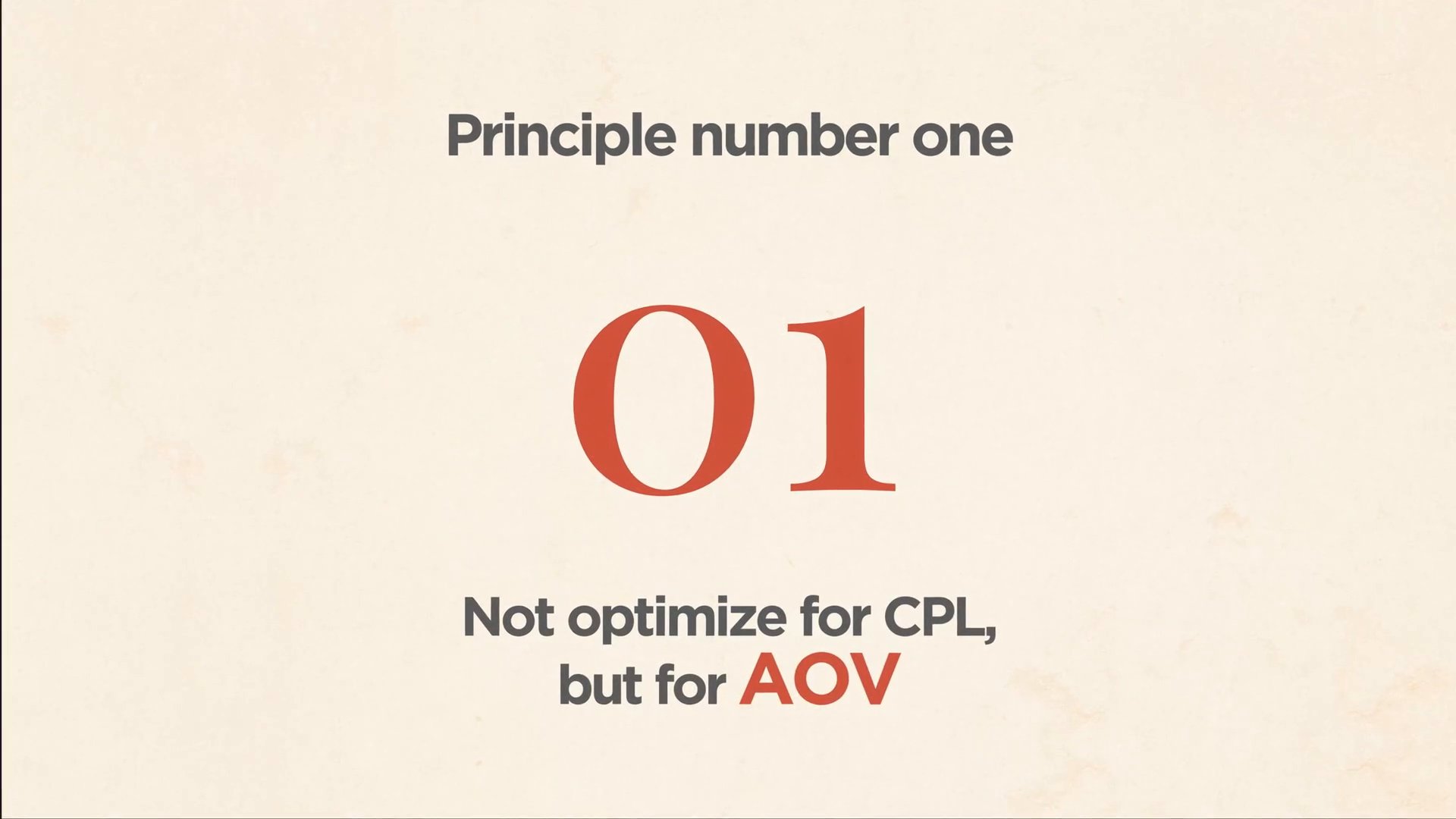
- Don't optimize for cost per lead. Optimize for lifetime gross profit. Cheaper leads seem intuitive, but when you optimize for CPL, you get cheap leads, not necessarily the best ones. When we launched the Money Models book, we tested 2 campaigns. When we optimized for CPL, the average CPL was around $5, but each of those leads averaged only about $20 in lifetime gross profit, because they bought the first book but not the bundles or upsells. When we optimized for ROAS, the CPL was $17, significantly higher than $5, but the average order value was $189, because they bought the book and then a few workbooks. So we don't want to optimize for CPL. We want to optimize for LTGP.
- For every $10k you spend, have 15 to 30 creative variations, so your ads don't fatigue as you scale. This is why kaleidoscoping matters.
- Volume without quality is a waste of time. It's not about recording in a different background, changing the person's shirt, or flipping the camera. The copy is the targeting, and the copy is the messaging. Find a winning angle and iterate on that angle. For example, if we're targeting stay-at-home moms, we'll find different ways to say that being present with your kids matters more than making money so they'll be proud of you.
- Stop rebuilding your campaigns so often. Meta typically wants 50 conversions in a 14-day period, so give your ads some time to breathe and give Andromeda time to figure out who the best person is for your ads.
One last note. I enjoy writing, and I think the easier it is to use AI to do things, the more alpha there is in not using it. Writing is thinking, so I do most of the writing myself. Where I love AI is the upfront research, creating assets, competitor analysis, and editing a batch of ads. Say we wrote 30 ads. Claude will tell me what we're doing too much of, what we're not doing enough of, and that I wrote the same CTA on every single one.
So what does the whole system look like?
Here's the whole thing in 6 steps:
- There are 2 types of demand: current demand and future demand.
- Create future demand by showing power, trust, and likeness over and over in your content.
- Use the content multiplication system: the Hall of Fame and the 3 Rs, so you can become prolific and test angles.
- Write with the 6 Ps of copy thinking and the 5 Cs, so the words carry the thinking.
- Take the angles that work in organic and use them in your ads.
- Run ads to capture current demand, the people who want what you sell today.
Generate future demand, take what's working, and capture current demand. That's how you win.
I also want to make one point about timing. This arbitrage opportunity, generating millions of dollars in revenue with organic content and paid ads together, I don't know if it will be here forever. You probably have a 3-year window to go super hard on organic content and then super hard on paid ads, because like most things in life, arbitrage opportunities go away.
Jay "Future Demand" Yang
P.S. If you want to work with me and my team on designing your content engine, you can learn more here: https://revenuemedialab.com
The marketing workbook is the fill-in companion to the course. Get the workbook