Dedication & Epigraph
To my twin brother Max. My day one (literally). Let’s conquer the world.
“What do you have to lose when nothing in the world belongs to you?”
— Marcus Aurelius
Free to read
How to get the life you want by helping those who have it.
146 min read · 3 hr 41 min audio · Jay Yang
About this bookTo my twin brother Max. My day one (literally). Let’s conquer the world.
“What do you have to lose when nothing in the world belongs to you?”
— Marcus Aurelius
“Is this Jay?”
I didn’t recognize the voice on the other end.
I was sitting on my college dorm bed, half-working on something when my phone buzzed from a number I didn’t know.
“Uh, yeah, who’s this?”
It was the Director of Media at Acquisition.com, the advisory and investment firm founded by Alex and Leila Hormozi.
I don’t remember everything he said after that. Something about a copywriter role, something about joining the team. What I do remember is my brain going numb.
I had been watching Alex’s business YouTube videos since I was a sophomore in high school. I remember sitting in the back of class with one AirPod in, my head turned ever so slightly so my teacher wouldn’t notice, listening to his podcast while pretending to pay attention.
I imagined working with them the way some kids imagine playing in the NBA. And now they were on the phone, asking me to come to Las Vegas.
I told them I was interested but needed to think about it. I hung up.
I sat there on my loft bed, my legs dangling off the edge, staring at the wall of my tiny dorm room while my brain tried to catch up to what had just happened.
Drop out of college. Move to Vegas. Join the team.
I wanted to say yes, but there was a problem…
Saying yes meant shutting down my marketing agency and telling over half a dozen clients that I was leaving. It meant moving across the country to a city where I knew no one, to live alone for the first time in my life.
Most importantly, it meant telling my twin brother Max that the apartment we’d signed together for the following year, the one we’d been looking forward to since the start of college, wasn’t going to happen.
I could feel the weight of the decision on my chest.
What should I do?
At this point, you might be wondering: what’s this book about, and how did we get here? Fair questions.
In my first book, You Can Just Do Things, I wrote about the power of permissionless action. I wanted you to realize that the default path isn’t the only path. That the career (and life) you want is out there, waiting for you to create it.
In this book, I’ll walk you through the exact steps I followed to land dream jobs and clients, and build a profitable business, all as a naive 19-year-old.
Everyone knows that it’s not what you know; it’s who you know. What no one teaches is the how.
This book will teach you how to get what you want by helping those who have it.
Big promise, I know.
If you’ll allow me to boast for a minute, here’s my story:
When I was 15, I googled “how to make money online” and immediately became obsessed. I started Instagram theme pages, YouTube channels, a weekly newsletter, and even tried to launch a clothing brand (I thought I’d be the next Gymshark). While each taught me a valuable lesson, ultimately they all went nowhere.
After a year of coming up empty handed - I realized I had some serious knowledge gaps to fill. So I figured I’d work for my favorite company and see what I could learn.
I had been using beehiiv to send my newsletter, and I loved how fast the team shipped new features. I thought I could learn a ton working inside a fast-growing tech startup.
I checked their website for job postings. No luck. So I decided to get creative. I cold-emailed Tyler Denk, beehiiv’s CEO, with a pitch deck of ideas on how I could help.
He wrote back the next morning, and a few weeks later I landed an internship. (Score!) I spent that summer building beehiiv 101, a tactical educational course for their users.
When I was 17, I learned that Noah Kagan, the founder of AppSumo, was looking for help growing his newsletter. I spent the next 50 hours putting together a 19-slide pitch deck that deconstructed his entire marketing strategy. I also created 9 pieces of social media content for him to test for free.
He loved it and brought me on for a trial. Several months later, I became Head of Content, where I helped launch Million Dollar Weekend, which became a New York Times bestseller.
At 18, I took what I had learned with Noah and started a boutique ghostwriting and marketing agency where I helped CEOs and founders grow their brands on social media.
I didn’t want people to use my age as an excuse to not work with me, so I created pitch decks for my potential clients, just like the ones I’d made for Tyler and Noah. I’d show up to sales calls with a Google Slides deck loaded with research and ideas specific to that person’s business.
Within a year, I was taking home 6-figures as a full-time college student, writing for 7-figure founders and 8-figure CEOs.
I also wrote my first book You Can Just Do Things, which went on to become an Amazon best-seller.
Then at 19, Acquisition.com called.
I took the leap. I became the Written Media Strategist and helped launch Alex Hormozi’s book $100M Money Models, which set a Guinness World Record for fastest-selling nonfiction book in under 24 hours.
All of these opportunities came from the same approach.
I didn’t apply through a job portal. I didn’t wait for someone to post an opening. I didn’t send my resume into a pile of thousands and hope for the best (in fact, I didn’t even have a resume).
I identified the person I wanted to work with, figured out what they needed, did the work before anyone asked me to, and put it in front of them.
Work With The Best is fundamentally how I view the world. It’s a big reason I believe I’ve gotten what I want out of my life so early, and why I’ve been able to accelerate my career and compress timelines that usually take people decades.
This book is split into three parts:
1. Part One is about figuring out what you want.
You can’t get what you want if you don’t know what that is.
In this section you’ll learn:
2. Part Two is about creating value.
The market rewards skills that are both rare and valuable.
In this section, you’ll learn:
3. Part Three is about delivering value.
You can be the most talented person in the world, but if no one knows you exist, it doesn’t matter.
In this section, you’ll learn:
My life isn’t perfect, and I’m still figuring a lot out. But I’ve built a life I would have killed for five years ago. I wake up and work on meaningful projects. I take long walks. I’m at the gym in the afternoons while many are stuck at work. I make magical internet money from my laptop. I spend my evenings with family.
Am I promising that you’ll get rich, fabulous, or fabulously rich by reading this book? Of course not. But maybe an idea or two will help spark some positive change.
As you read this book, my only ask is that you metaphorically empty your cup. Some of these ideas you might disagree with. Some might challenge you. Some you might’ve heard before. That’s fine. Oftentimes we need to be reminded more than we need to be taught.
If this book does anything, I hope it serves as a reminder that most things in life are more achievable than we think. If you decide what you want and go after it with full effort and intensity, the world will bend to your will much more easily than you might expect.
We’ll start with one of my favorite movie scenes about figuring out what you want, because it’s hard to get what you want if you haven’t first defined it.
Let’s begin.
A weekly letter where I share what I’m learning about marketing, strategy, and building.
“If a person knows not to which port he sails, no wind is favorable.” — Seneca.
“Your visions will become clear only when you can look into your own heart. Who looks outside, dreams; who looks inside, awakes.” – Carl Jung
“A man who procrastinates in his choosing will inevitably have his choice made for him by circumstance.” – Hunter S. Thompson

There’s a scene in Alice in Wonderland that haunts me:
Alice is walking down a dirt trail when she hits a fork in the road. She doesn’t know which way to go, so she looks up at the Cheshire cat perched in a tree and asks, “Mr. Cheshire cat, which path should I go down?”
The Cheshire cat responds, “Well, where do you wanna go?”
Alice replies, “I don’t know.”
The Cheshire cat says, “Then it doesn’t matter. If you don’t know where you want to go, any path will take you there.”
And my gosh does that scene live rent-free in my head.
How often do we spend our days rushing around trying to accomplish things that we haven’t clearly defined? We say things like “I want to be happy,” or “I’m chasing freedom,” or “I’m building my career,” but we never stop to ask what those things mean to us.
At the risk of stating the obvious, it’s hard to hit a target you can’t see, yet many people are so busy being “productive” that they never actually get what they want.
But isn’t that the whole point of life? To squeeze it for everything it’s worth, to live intentionally, and to get absolutely everything you want out of the one shot you’ve been given?
So I ask you: what do you want?
Not what sounds good in a LinkedIn post or what your parents would be proud to tell people at dinner. What do you actually want?
If that question is hard to answer, you’re not alone. It’s a paralyzing question no matter what stage of life you’re in, because facing it means confronting the possible reality that you’re not where you want to be. And as long as you keep it vague, you never have to do anything about it.
But that’s exactly why you need to write down what you want. The discomfort you feel when you try to honestly answer it is the same force that will push you to act on it. Once you put it on paper, it stops being an abstract feeling and becomes something you can move toward.
Before I give you the exercise to help you answer that question, I want to set an expectation. The point of defining your North Star is NOT to get the perfect answer. What you write down today will almost certainly change. That’s fine. In fact, that’s the point. The value isn’t in the answer. It’s in the habit of reflecting.
I know, I know. We’re barely into the first chapter and I’m already giving you homework. But this is the most important exercise in the entire book, and everything that comes after it builds on what you write down here. So don’t skip it.
Here’s my answer (for brevity’s sake, I’ve cut it down to its core elements, but it could and should be multiple pages for you):
My North Star (age 20, 3/18/2026):
A perfect Tuesday for me comes down to three things: working on something meaningful, doing something physically hard, and ending the day with the people I care about.
An ideal day right now would be:
Right now, I’d love to live in a city where I’m close to many of my ambitious friends so we can all co-work and level up together.
Eventually, I want to live by the beach so I can hear the ocean waves when I wake up in the morning. One of my aspirations is to eventually move into a beautiful house (with a basketball & pickleball court) and have my close friends live in a cul-de-sac community together, where we can all raise our kids.
I want to feel high energy and athletic. I want to be able to lift heavy, run fast, and play sports at a high level. I want to be proud of my physique when I look in the mirror.
I can’t wait to be a husband and a father. What could possibly be more beautiful and important than building a family and raising healthy children? I want to be the kind of dad that my kids look up to, but also feel safe enough to talk to about anything. High standards with high support.
I want to be the kind of husband who provides, and I mean that in every sense of the word. Financially. Emotionally. I want to be present, not buried in my phone or my work when I’m home. I want to be someone who listens. A safe space. A man of my word. I don’t want a relationship where either of us shrinks to fit the other. I think a great relationship is 1 + 1 = 11, not .5 + .5 = 1. It’s two whole people who are both growing, pursuing things that matter to them, and actively supporting each other in doing it.
My ideal work environment is one where I’m indoors and have long blocks of uninterrupted focus time, but also complete control over my schedule. I want to be able to go for a long, aimless walk at noon. Be in the gym with all the retired old people at 2pm. Take a random Thursday off to hang out with friends, and never feel physically chained to a desk or an office.
Money buys me the freedom to say no to projects that don’t interest me and steal my focus away from the things that I want to do. More importantly, it gives me the ability to create an amazing life for my family and friends.
I want to be rich. I’ll admit it. But not so I can buy a Lamborghini. I’d prefer a Porsche. Kidding. I want to be rich so I can control my time. So I can sit at a cafe and order my wife breakfast without looking at the prices. So my parents don’t have to worry about money. So I can travel freely and show my kids the world. So I can take my friends out to dinner and say, “Don’t worry, it’s on me.” So my kids can get the very best education. That’s my idea of a rich life. Money isn’t the goal; it’s a tool to live a deeper, more fulfilling, adventurous life.
When I was younger, I had this intense desire to make my name known for something, to be one of the best to ever do it. What I’ve realized is I would much rather live a life I’m proud of than chase a legacy. The pursuit of public greatness, at least for me, has always come from a state of lack, a feeling of “I’m not enough.” As I’ve gotten older, I’ve felt that fuel burning out and being replaced by something cleaner. I don’t actually want to go to Mars. I’m more than happy being in orbit and enjoying the view.
The skill I want to master is the craft of writing. The word “inspire” comes from the Latin root “inspirare” which means “to breathe life into.” If my writing can breathe even a little bit of life into someone, give them the push to go after what they want, I’d consider that a success. I think the world will be a better place when more people figure out what they want and get to work on it.
As for what I want people to remember about me, I want to be remembered as someone who gave more than he took. Someone that other people liked having around because he was always looking for ways to make their lives better. I’ll be honest, I’ve had to work hard at thinking about others first and being observant about how people are feeling. I’m still working on it. But if I get it right, I’ll be remembered as someone who was useful.
Exercise: Define Your North Star
Again, please don’t skip past this exercise. If you don’t answer these questions, I will come find you.
I want you to grab a notebook and write down today’s date and your age at the top. Then I want you to answer the bold prompts below (if you’re having trouble, the other questions are there to guide you):
1. If money were no object, what would a perfect ordinary Tuesday look like right now? From the moment you woke up to the moment you went to sleep, be specific about where you are, who you’re with, and what you’re doing.
Note: Why Tuesday and not Friday? Because Friday is the highlight reel. Everyone’s Friday looks good (date night, hanging with friends, the weekend ahead). Tuesday is the most ordinary day of the week. No one romanticizes a Tuesday, and that’s exactly why it’s the right test. If you can only describe a life you’d love on Friday nights and vacations, you haven’t designed a life, you’ve designed an escape.
2. Where do you want to live? What does your environment look and feel like? Do you live in the city, the coast, the mountains, somewhere abroad? Do you live in a house, an apartment? Do you have multiple homes? Do you want to stay in one place or move often?
3. How do you want your body to feel on a daily basis? What does your energy, health, and physical life look like at your best? Do you want to optimize for aesthetics, longevity or flexibility? Maybe all three?
4. What does your inner circle look like? Do you want to build a family, close friendships, a tight community? What kind of person do you want to be to the people closest to you?
5. What does your ideal work environment look like? Are you inside or outside? Alone or surrounded by people? Are you moving around or sitting still? Working with your hands, your mind, or both?
6. What does money do for your life? What do you want money for? What does your life look like when you have “enough”? What is “enough”? What can you do with more money that you can’t do right now? What do the people you love no longer have to worry about?
7. What do you want to get really good at? What is the craft, skill, or domain that you want to spend years mastering? What would it feel like to be world-class at something? (It’s okay if you aren’t sure yet, we will dive deeper into this in chapter 3).
8. What do you want people to say about you at your eulogy? Will they list all of your impressive accomplishments, or will they care about something deeper? Were you someone who showed up? Were you generous, present, honest? Did you inspire them? Did they trust you? Did they feel seen when they were with you?
Pro Tip: Change your physiology to change your psychology. If you feel stuck, write these questions in a notebook, then go for a walk. Bring your pen and notebook. Don’t listen to music or scroll social media. Just walk. Ponder and reflect on these questions.
If you run into a Cheshire cat and don’t have your answers yet, that’s okay. Keep walking. They’ll come to you.
Now that you’ve written your North Star, don’t treat it as a one-time exercise. Come back to it regularly - especially when you’re facing a big decision or notice that your day-to-day life is drifting away from what you wrote. Your North Star is meant to evolve as you do, but it should keep giving you a clear way to ask: am I moving closer to the life I want, or away from it?
What you’ll also notice when you write down your North Star is that it creates a gap between where you are and where you want to be.
Psychologists call this drive theory. When you’re deprived of something, your brain creates an internal pressure to get it. The more deprived you are, the higher the incentive value of the thing you want becomes.
Food tastes better when you’re hungry. Water means more when you’re thirsty. When you’ve written down a vivid picture of the life you want and then look up at the life you currently have, that distance creates a drive that motivates you to take action.
Investor Naval Ravikant once quipped, “Desire is a contract you make with yourself to be unhappy until you get what you want.”
That sounds like a bad thing, but it’s not. Think about what happens when you’re underwater and running out of air. You don’t casually swim to the surface. You kick and claw. You fight your way up with everything you have.
The nuance is that deprivation is incredible fuel for getting started, but it’s not great fuel for sustaining. Eventually you’ll want to transition to cleaner fuel. We’ll talk about finding that in chapter 3 when we cover “finding your unfair advantage.”
But first, now that we have a draft of our North Star, the next thing we need to solve for is how to use it. Because just writing it down and shoving it in the back of a drawer does nothing for our lives.
What comes next is how to take your North Star and integrate it into your daily decision-making.
I had a friend once joke, “The job of the news companies is to make everyone’s problems, your problem.” And I couldn’t agree more. These days, it feels like we’re constantly bombarded by a never-ending onslaught of decisions and dilemmas.
Should I stay at this job or start looking for something new? Should I go to grad school or is that just expensive procrastination? Am I saving enough? Is AI going to replace me? Why does everyone I went to high school with seem like they have their life figured out except me?
The Eisenhower Matrix is a task-management tool that sorts tasks by urgency and importance:
The problem is, social media has a way of making everything feel important and urgent.
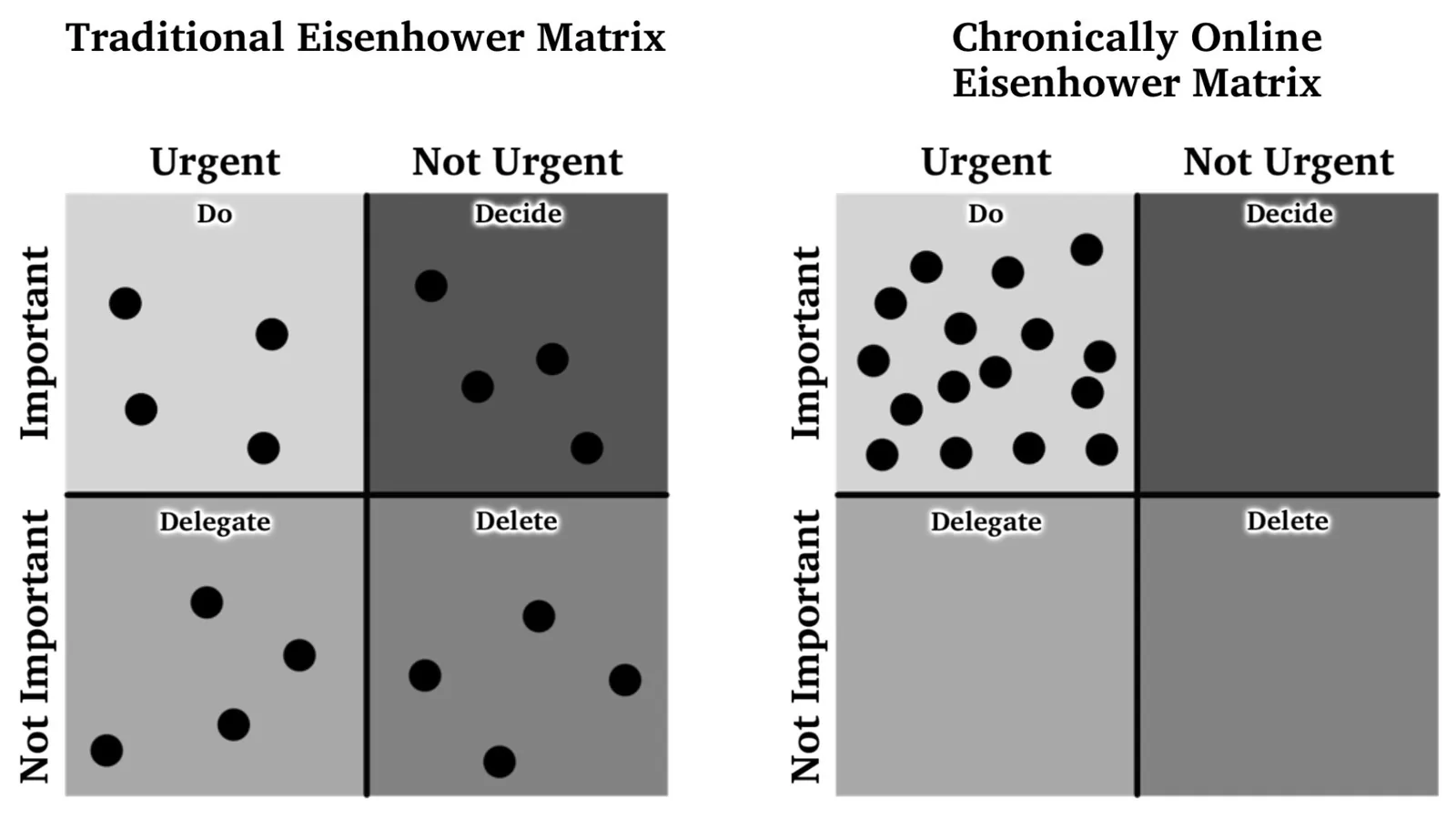
When there’s so much noise, how do you find the signal? The answer lies in a little exercise I asked you to do about 40 seconds ago. I call it the North Star Filter.
A North Star filter is a question or set of questions you ask yourself that allows you to filter every other decision through that lens.
Here’s mine:
I believe that you can get much of what you want out of life if you consistently ask yourself two questions:
I like this frame because it simplifies so many decisions.
Should I go to that party or stay in and study? Should I wake up early and work out or sleep in? Should I take that internship at the big corporation or join that small, “riskier” tech startup?
When you’re faced with a choice, you ask: Does this action increase the likelihood I reach my North Star?
I also like this frame because you can work backwards from it. Once you know what you want, you can ask: What needs to be true for me to achieve this?
A few examples:
You see where I’m going with this?
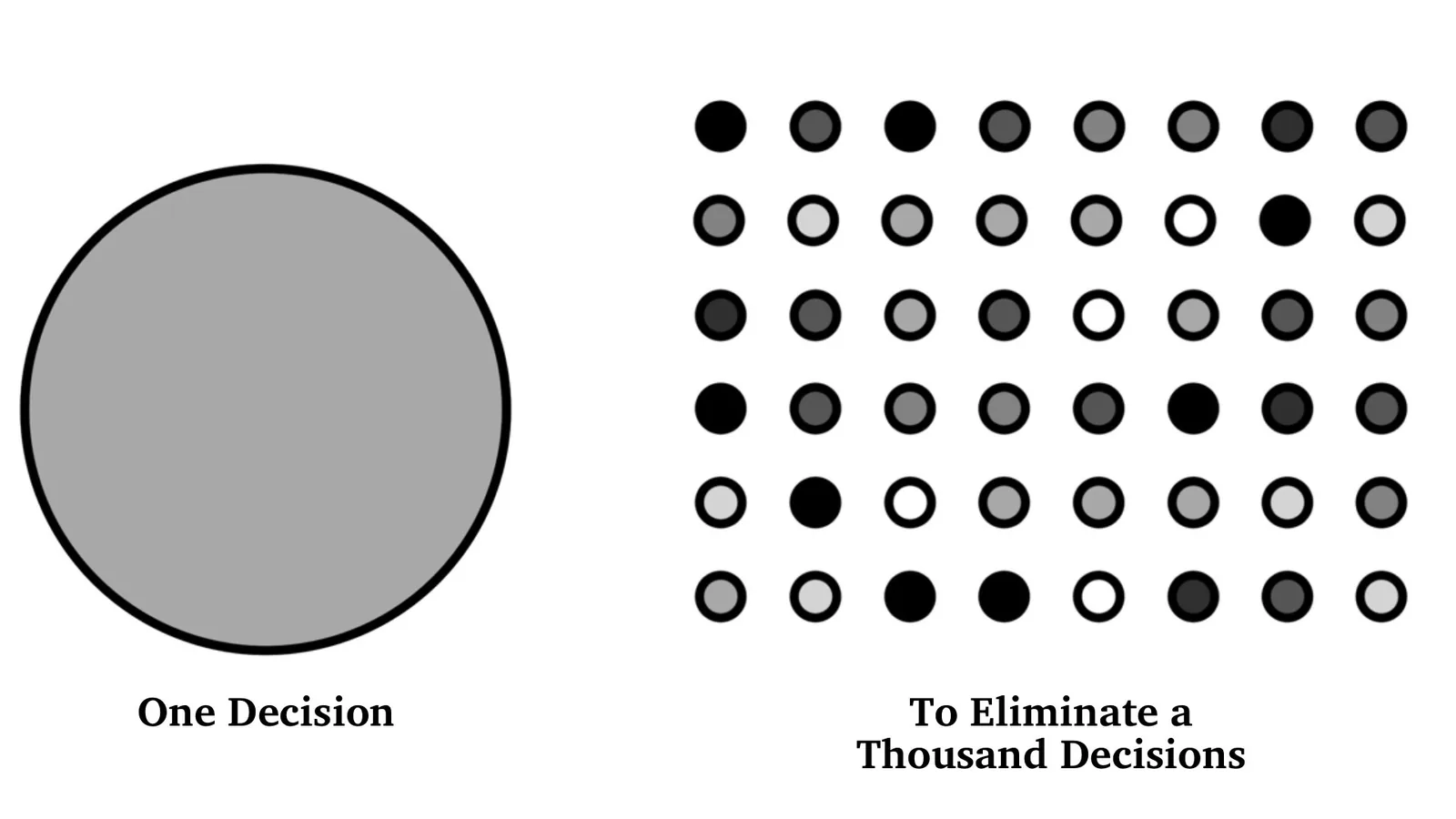
A North Star filter allows you to make one decision to eliminate a thousand decisions.
Sahil Bloom, author of The 5 Types of Wealth, has a small notecard on his desk. It says, I will coach my son’s sports teams.
When an opportunity comes across his desk, he looks at the card.
“If someone sends me an opportunity, and it sounds really interesting financially, but it’s going to require me to be away 300 nights out of the year, I can ask myself: what would the type of person who coaches his son’s sports teams do in this situation?”
Sahil usually says no, or adjusts the opportunity so he can still be present for his son. “When you have clarity on the life you’re trying to build,” Sahil says, “the actions in your days become clear too.”
Note: for more difficult decisions, the ones where both options feel good, we’ll cover that in chapter 8 when we talk about evaluating opportunities.
A few other examples of North Star Filters you can use:
“Will this matter in 10 years?”
Useful when you’re agonizing over something that feels high-stakes in the moment but probably isn’t.
“What would I do if I knew I couldn’t fail?”
If your answer changes dramatically, that’s a signal you’re playing it safe.
“Is this a ‘hell yes’ or a no?” (From Derek Sivers)
If you’re not excited, it’s probably taking space from something more aligned.
“What would the person I want to become do?”
Useful for habit-building because it ties every decision to your identity. You’re not asking “should I work out?” but “would my ideal self work out?”
“What will increase the likelihood my (future) children respect and admire me?”
A forcing function to make more money, help more people, build your body, calm your mind, love deeply, master your craft, and maximize your potential so you can lead by example.
But simply having a North Star isn’t enough. You also have to know what you’re willing to sacrifice to get there, and more importantly, what you’re not.
Keep your notebook close, as we’ll be using it again in this next chapter.
“For what shall it profit a man, if he shall gain the whole world, and lose his own soul?” Mark 8:36
“All I want to know is where I will die so I’ll never go there.” – Charlie Munger

In 279 BC, a Greek king named Pyrrhus of Epirus went to war against Rome. On paper, he won. His army defeated the Romans on the battlefield not once but twice, and the Roman casualties were staggering.
His generals celebrated. His soldiers cheered. But when someone congratulated Pyrrhus on his great victory, he reportedly looked out over the wreckage of his own army and said, “One more victory like this and we are utterly undone.” He had lost so many of his own men winning those two battles that he could not afford to fight another one. He won every fight, but lost the war.
A Pyrrhic victory is what happens when the cost of winning exceeds the value of what you won. And it happens in real life more than most people realize.
Think of the investment banker who made partner at 35, bought the house, earned the title, but came home one night to a note on the kitchen counter from his wife saying she couldn’t do it anymore.
Or the entrepreneur who built a company worth tens of millions but spent so many years missing meals, sacrificing sleep, and skipping the gym that she barely recognized herself in the mirror when she finally sold it.
Or the academic who dedicated 30 years to her research, published papers that changed her field, but raised kids who felt like they grew up with a stranger.
These people hit their targets. They just didn’t realize what they were sacrificing along the way.
Goals without boundaries are not just incomplete, they’re dangerous. As author Edward Abbey once wrote, “Growth for the sake of growth is the ideology of the cancer cell.”
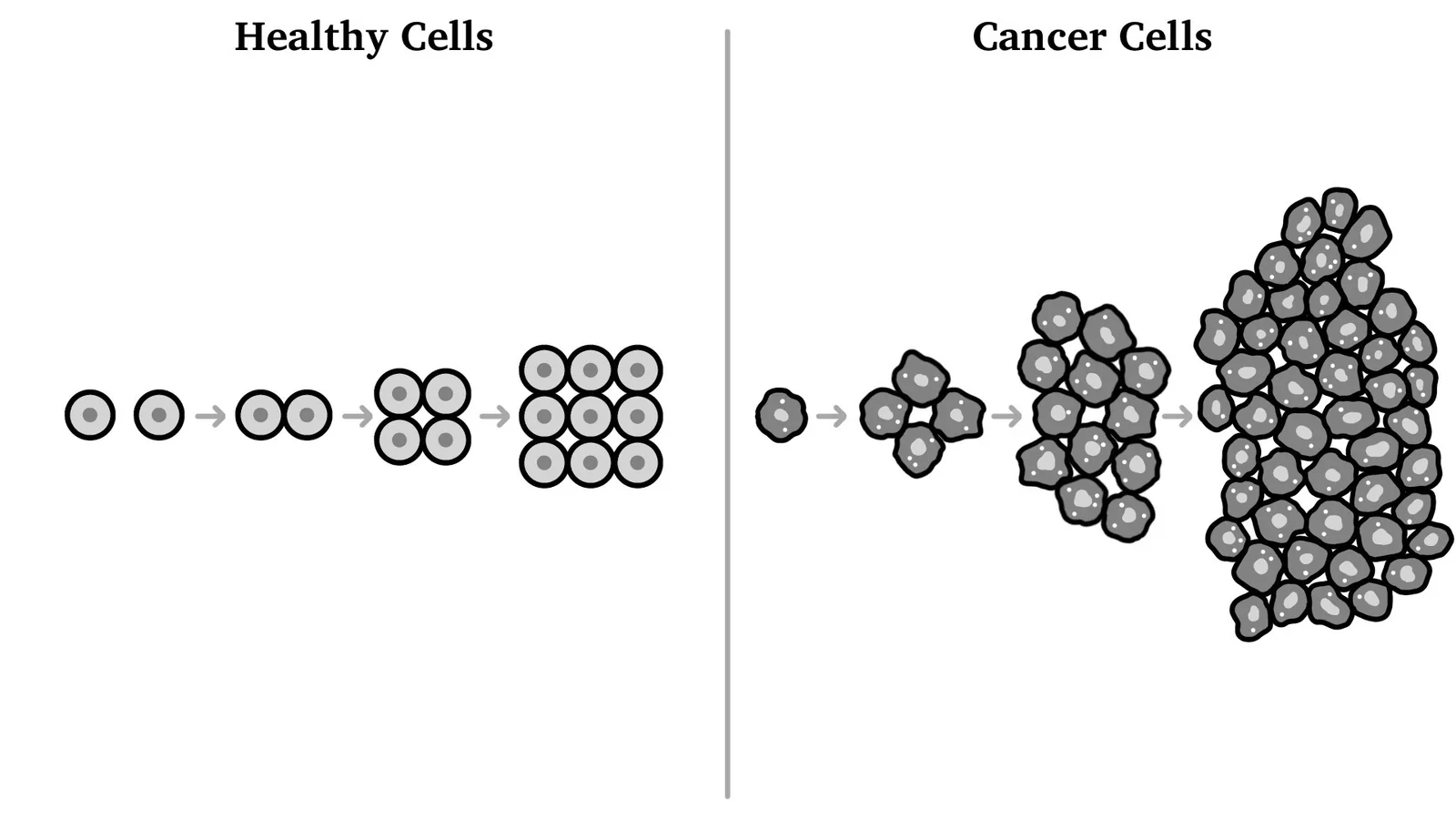
Andrew Wilkinson, the founder of a $300M+ holding company, calls this the ‘Anti-Goal’. Instead of only defining what you want, you define what you’re not willing to sacrifice to get there.
Marc Randolph, the co-founder of Netflix, had a hard rule for over 30 years: every Tuesday at 5pm, he left work and spent the evening with his wife. He never let a meeting, conference call, or last-minute request get in the way.
He once wrote: “I resolved a long time ago to not be one of those entrepreneurs on their 7th start-up and their 7th wife. The thing I’m most proud of in my life is not the companies I started. It’s the fact that I was able to start them while staying married to the same woman, having my kids grow up knowing me and, best as I can tell, liking me.”
Here’s a guy who helped build one of the most successful companies in history, and the thing he leads with isn’t his company. It’s the fact that his company didn’t cost him his family.
Call me soft, but I think defining the limits of your ambition is one of the most ambitious things you can do. Anyone can be reckless in their pursuit of more. It takes wisdom to realize when you’re sacrificing the war to win the battle.
My North Star has always been pretty simple: a fit body, a calm mind, a house full of love, meaningful work, and enough wealth not to worry about it. I still have big financial goals, but I’m not willing to gut the rest of my list to achieve them.
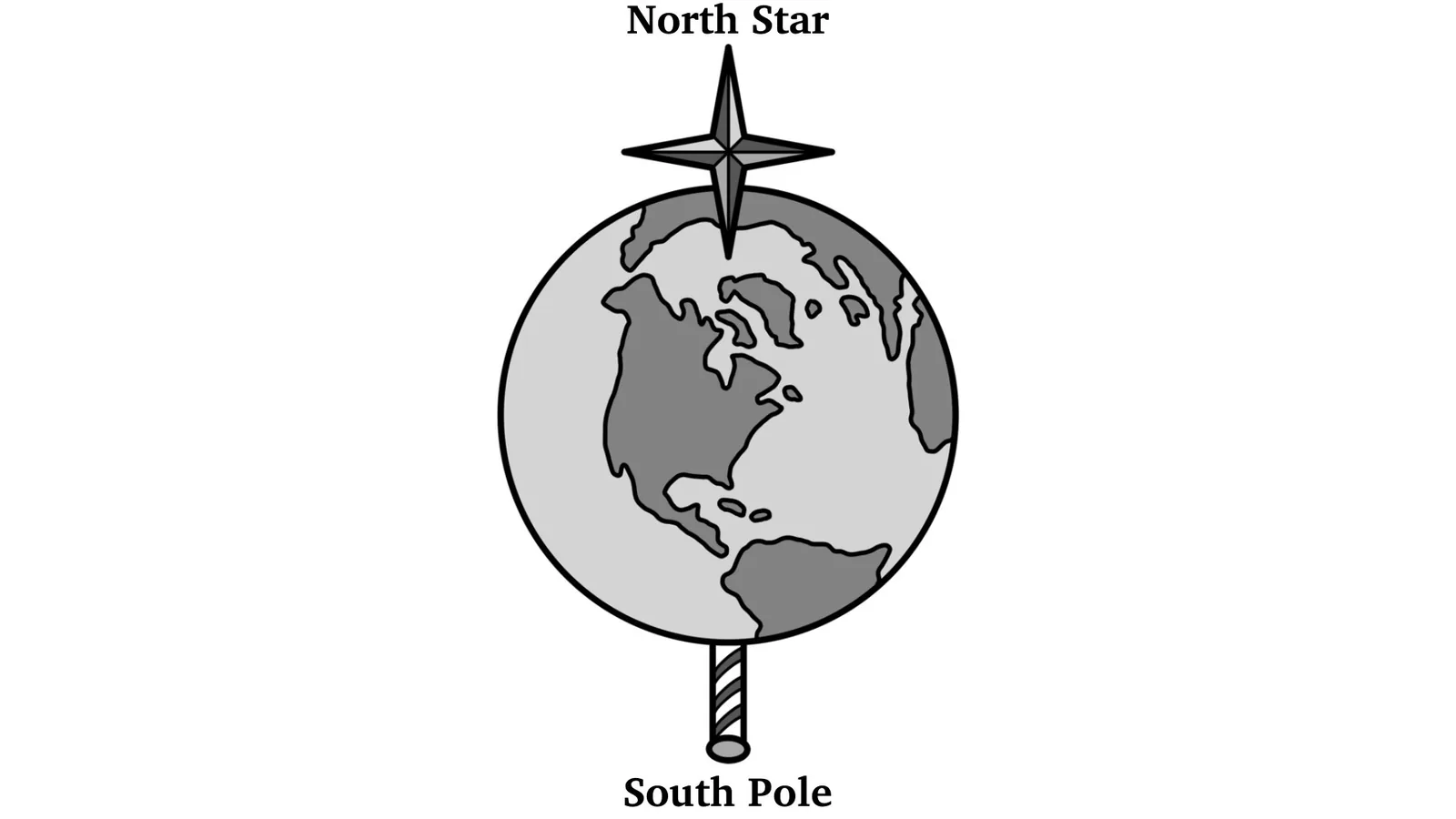
Your North Star tells you where you want to go. But you also need a South Pole, a clear picture of where you refuse to end up. The tension between the two is what helps you filter decisions. Because what’s the point of getting everything you want if you destroy everything you need along the way?
I want you to re-open your notebook and reflect on these 5 questions:
You can apply this same mental model to anything new you’re considering:
It sounds trite, but works wonders. Dangerous is the person who knows what they want and what they’re willing to sacrifice to get it.
Here’s the simple list I wrote before I started college:
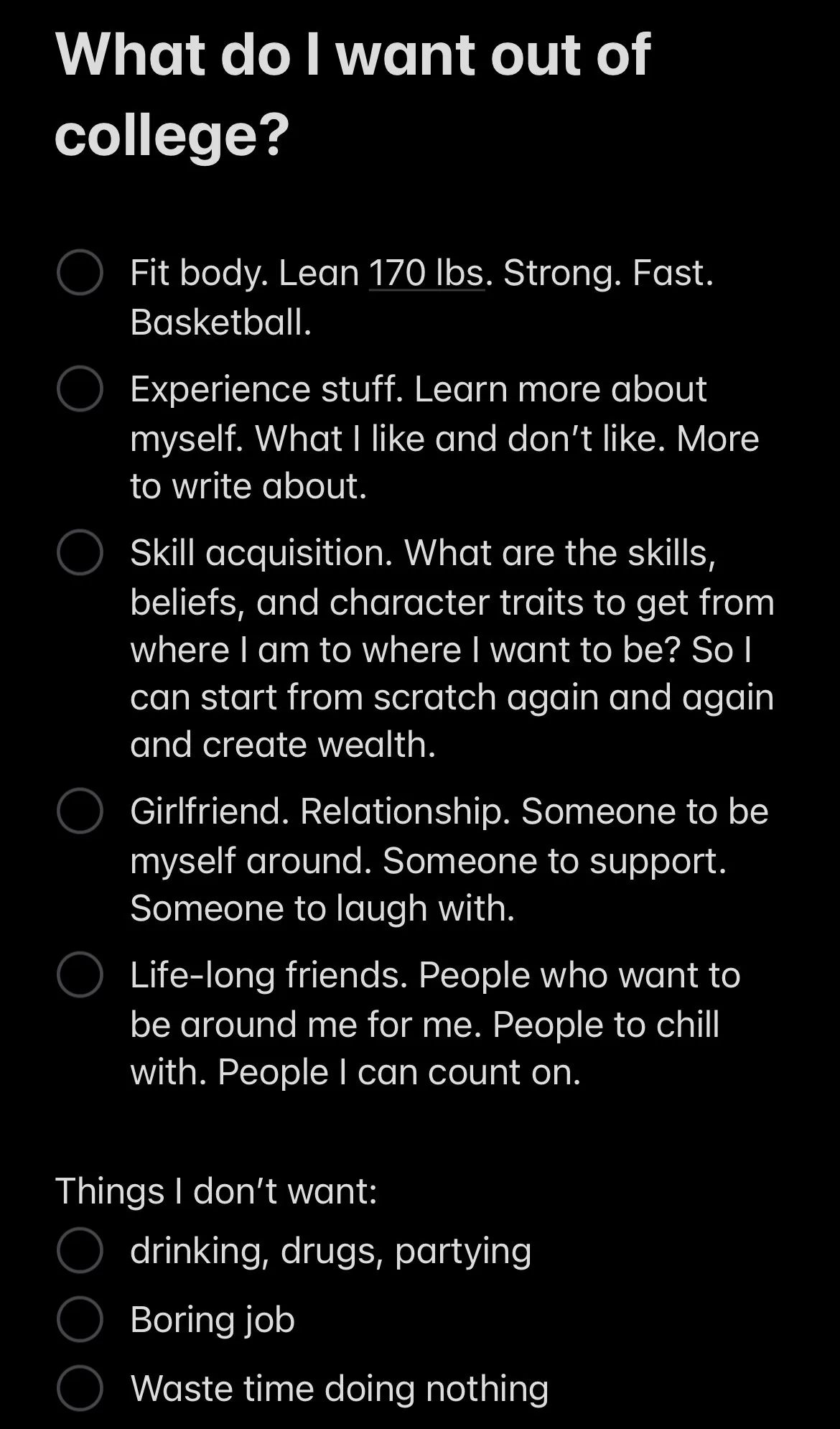
And when I realized I could get what I wanted without college, I dropped out (but that’s a story for chapter 8).
Now that you’ve got your destination and your guardrails, the next thing we need to figure out is your vehicle.
“There’s a point, around the age of twenty, when you have to choose whether to be like everybody else the rest of your life, or to make a virtue of your peculiarities.” – Ursula K. Le Guin
When I was a junior in high school, I landed a role helping grow the social media for Z Fellows, a startup venture fund. One week, they flew me out to San Francisco for a startup incubator event they were hosting.
The cohort was filled with some of the most ambitious people I’d ever met. One person was building an AI personal shopper. Another was working on a robot chef. Someone else was somehow both a magician and a crypto savant.
When I joined their conversations, it felt like they were running mental circles around me. I spent the whole week thinking: I will never be as smart as these people, and I have absolutely no interest in competing with them.
That trip reinforced an idea that I haven’t forgotten since. You can’t beat people at their own game. If you want to win, you have to play yours. Warren Buffett once said, “How do you beat Bobby Fischer? You play him in any game, but chess.”
For me, that meant doubling down on writing and content. The signs had been there for a while, I just hadn’t connected them yet.
I realized that my superpower was synthesizing ideas through the written word, taking complex concepts and making them clear and compelling.
Since that trip to San Francisco, I’ve grown my social media following to over half a million people and worked with many of my business heroes. It wasn’t because I was the smartest person in any of those rooms; I just found the game I could win.
So how do you find your game?
Most people will tell you to “follow your passion.” I think that’s incomplete. On the other end, others will tell you to follow the money and pick the career with the highest earning potential. I think that’s equally bad advice.
If you chase passion first, you might pour years into something you love but have no natural aptitude for, and you’ll get outworked by people who are both passionate and naturally gifted at it.
I loved basketball. I was obsessed with it. But passion alone doesn’t make you an NBA player when you’re an undersized, scrawny Asian kid (Jeremy Lin is the exception). Passion without ability is a hobby. Don’t confuse it with your unfair advantage.
If you chase money first, you might land a high-paying job that you’re not naturally wired for, and you’ll spend your days grinding through work that drains you while getting outperformed by people who actually enjoy it. You’ll be mediocre at something you don’t even like, which is a trap, because the reward for good work is more work.
So if passion and money are both incomplete answers, what’s the right way to think about it?
In recent years, a Japanese concept has become popular in the West called ikigai. Ikigai roughly translates to “a reason for being.” In the Western version of the idea, it’s usually illustrated as four overlapping circles:
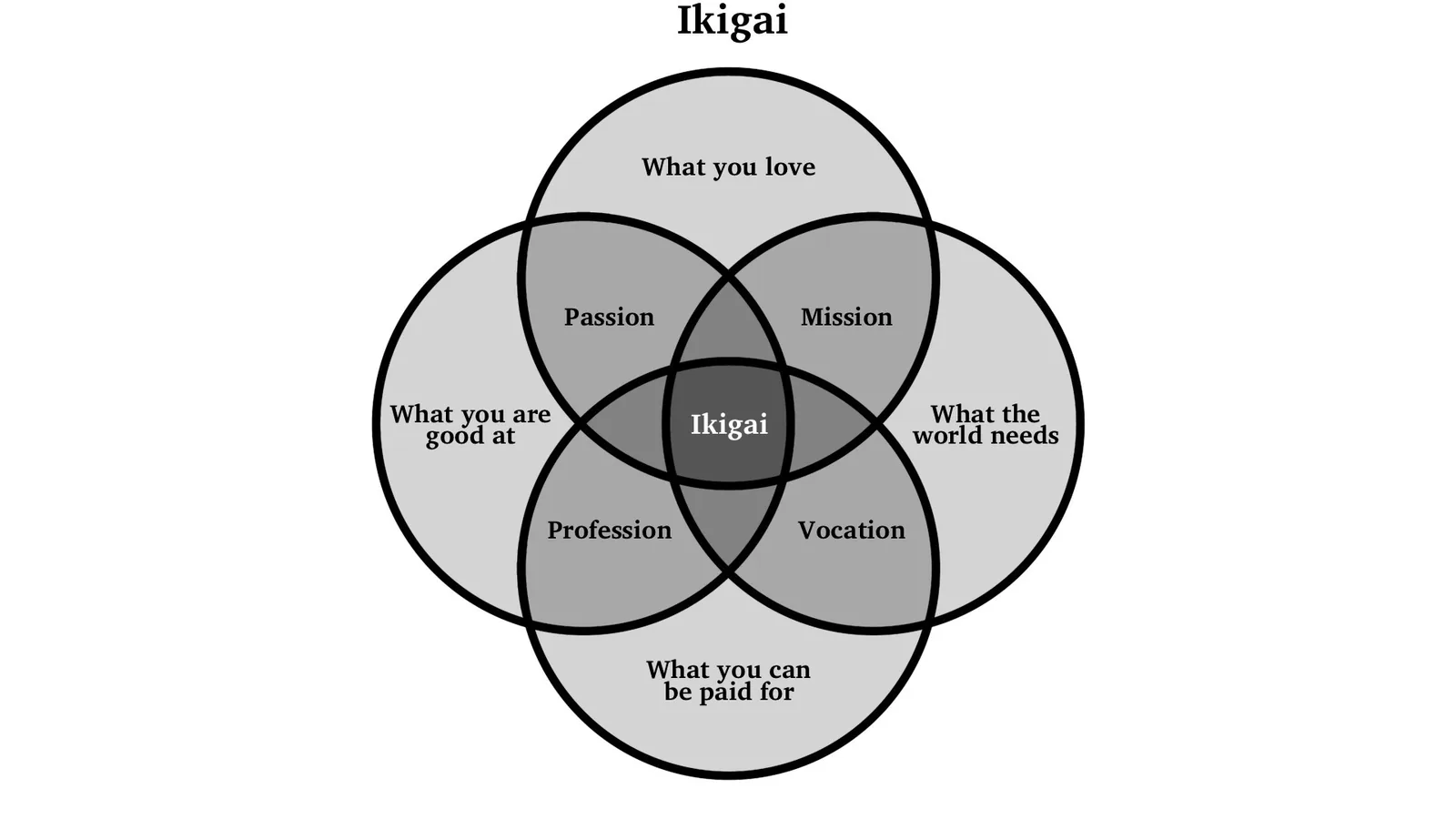
Where all four overlap is supposed to be your life’s purpose. It’s an appealing idea. Who wouldn’t want to find the one thing that satisfies passion, skill, impact, and income all at once?
The problem is that the diagram makes the process look much cleaner than it really is. Most people don’t know what they love yet. They haven’t had enough time to become great at anything. And the world changes too quickly to predict what it will need ten years from now.
Trying to optimize for all four circles at the same time can lead to endless overthinking. People sit around asking themselves questions like:
And instead of moving forward, they stay stuck. In reality, most people don’t start with all four circles. They start with one.
The better path is to begin with what you’re naturally good at.
When you’re naturally good at something, you learn faster.
When you learn faster, you see progress sooner.
When you see progress, you enjoy it more.
When you enjoy it, you stick with it longer.
And when you stick with it long enough, you compound into someone who is hard to compete with.
Said differently:
Skill produces enjoyment.
Enjoyment produces consistency.
Consistency produces mastery.
And mastery eventually produces both money and fulfillment.
Ta da!
Passion isn’t the starting point. It’s the byproduct. You don’t find passion first and then get good. You get good first, and then passion finds you.
But your advantage doesn’t have to come from one single skill. In fact, for most people it doesn’t. It comes from the intersection of a few things you do well.
Scott Adams (author, cartoonist, and creator of Dilbert) once advised young people:
“If you want an average successful life, it doesn’t take much planning. Just stay out of trouble, go to school, and apply for jobs you might like. But if you want something extraordinary, you have two paths:
1. Become the best at one specific thing.
2. Become very good (top 25%) at two or more things.
The first strategy is difficult to the point of near impossibility. Few people will ever play in the NBA or make a platinum album. I don’t recommend anyone even try.
The second strategy is fairly easy. Everyone has at least a few areas in which they could be in the top 25% with some effort. In my case, I can draw better than most people, but I’m hardly an artist. And I’m not any funnier than the average standup comedian who never makes it big, but I’m funnier than most people.
The magic is that few people can draw well and write jokes. It’s the combination of the two that makes what I do so rare. And when you add in my business background, suddenly I had a topic that few cartoonists could hope to understand without living it.”
In my case, I’m not just a writer. I’m a writer who has been deep in the social media marketing world and also dabbled in online business. The combination of all three is what makes me valuable. So don’t put pressure on yourself to find your one thing. Finding a few things is a better strategy, anyway.
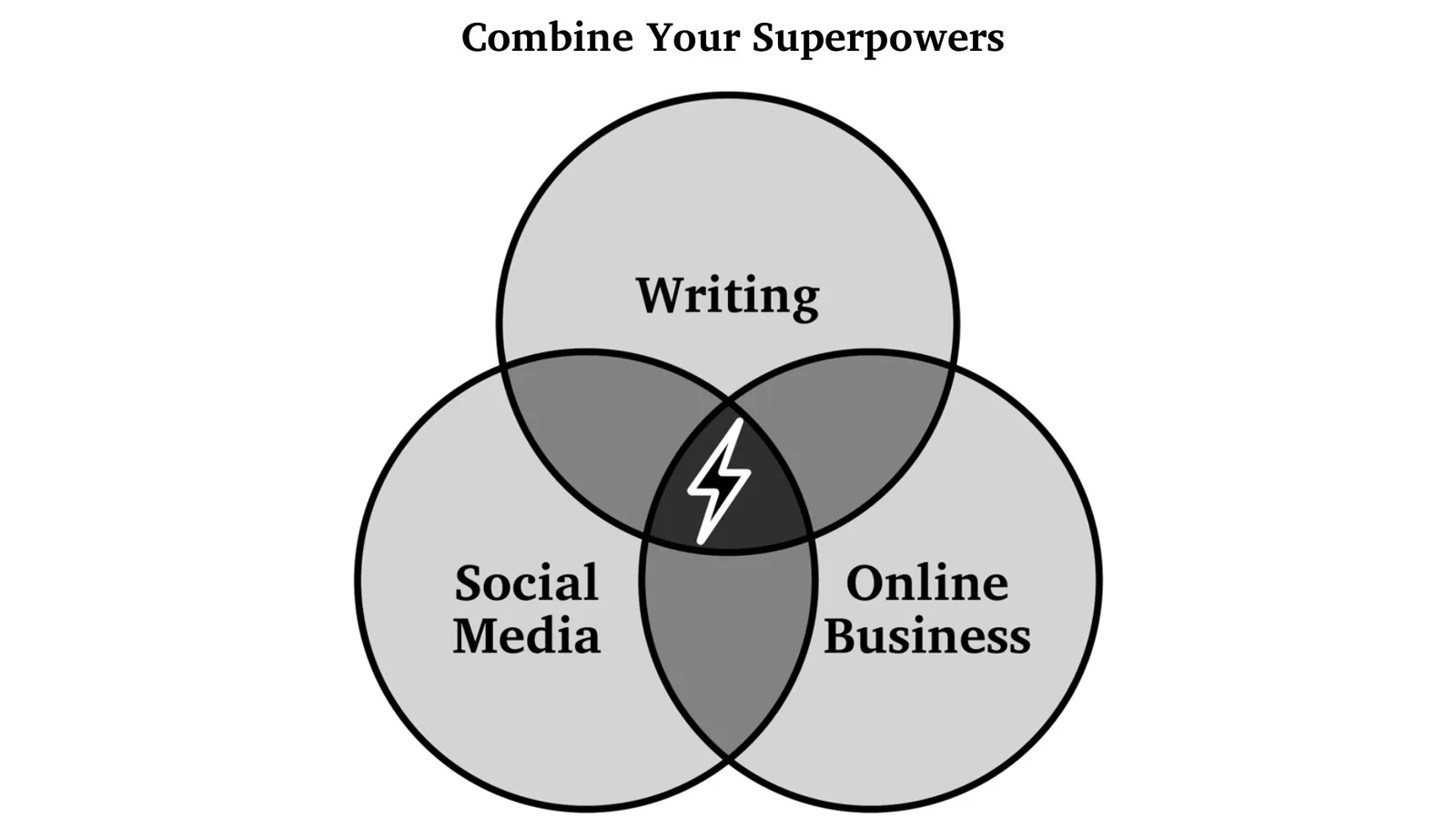
Your goal isn’t to be the best in the world at one thing. It’s to become one of the few people who combine several useful things.
If you don’t know what you’re naturally good at yet, that’s okay. I found my thing relatively early, but not everyone does. In chapter 5, we’ll talk about how to increase the chances that you discover it. For now, the goal is simply to start paying attention.
I want you to pick 3 of these questions, write them down in your notebook, reflect on them, and then write down your answers.
I know the past three chapters asked a lot of you. There was a lot of self-reflection, and I’m not going to pretend any of it is easy. But none of the tactics in the following chapters will matter if you haven’t first:
The good news is you don’t have to figure out all of this alone. Some of the most successful people in history left behind a blueprint for how they did it.
And in the next chapter, I’m going to show you how to find it (and how to use it).
“I cannot remember the books I’ve read any more than the meals I have eaten; even so, they have made me.” ― Ralph Waldo Emerson
The wooden floors of the store creaked under Sam Walton’s boots. He crouched near the shelves, pretending to browse, but his eyes were scanning everything. The layout, the product placement, the flow of customers. Every detail mattered. This wasn’t his store… at least, not yet.
Walton’s leather notebook was open, and his pencil moved quickly. What drew customers’ eyes? Why were certain products placed near the register? How did pricing strategies differ from his own? He talked to employees, bought small items to examine receipts, and took detailed notes on everything he saw.
Sam Walton, the founder of Walmart, built one of the largest companies in the history of the world. And he was remarkably honest about how he did it. “Most everything I’ve done,” he wrote in his autobiography, “I’ve copied from somebody else.”
The man Walton studied more than anyone else was Sol Price, a lawyer turned retailer in San Diego, who had invented the warehouse club model with a company called FedMart. Walton later admitted it plainly: “I guess I’ve stolen, I actually prefer the word ‘borrowed,’ as many ideas from Sol Price as from anybody else in the business.”
But Walton wasn’t alone. In 1954, an 18-year-old kid named Jim Sinegal started working at FedMart. He spent the next three decades under Sol, rising through the ranks, and absorbing everything about how Sol ran the business. Sinegal eventually left and founded Costco, which became one of the largest retailers in the world. When a reporter told Sinegal he must have learned a lot from Sol, he corrected him: “No, that’s inaccurate. I learned everything from Sol Price.”
Two of the biggest companies in the history of retail, both built by people who studied the same person. Yet most people have never heard of Sol Price.
The most successful people I know didn’t figure it out on their own. They studied the people who came before them. They stood on the shoulders of giants, as Isaac Newton famously put it. Instead of banging their head against the wall trying to learn everything from scratch, they found someone who had already solved the problem and reverse-engineered how they did it.
And this isn’t limited to retail, or business, or any one field.
Winston Churchill, who never went to college, spent 4-5 hours a day in the sweltering heat of India reading history, military strategy, and philosophy as a young officer. He described it as building a weapon: “A good knowledge of these would arm me with a sharp sword.” He went on to lead Great Britain through World War II, delivering speeches that held the nation together during its darkest hours.
Napoleon, as a broke young officer, skipped meals so he could afford to buy books. “I lived like a bear, in a little room, with books for my only friends,” he later recalled. “These were the joys and debaucheries of my youth.” When he became a general, he employed a personal librarian and commissioned portable mahogany bookcases so his campaign library of roughly 3,000 books could follow him onto the battlefield.
David Ogilvy, the father of modern advertising, told the young people in his agency: “Set yourself to becoming the best informed person in your agency on the account to which you are assigned.” If it was gasoline, read textbooks on the chemistry of petroleum. Visit refineries. Spend Saturday mornings pumping gas and talking to motorists. Study every competitor’s advertising. Within two years, he said, you’d know more about gasoline than your boss, and you’d be ready to succeed them. “Most of the young people in agencies are too lazy to do this kind of homework,” he said. “They remain permanently superficial.”
Charlie Munger, Warren Buffett’s partner and one of the most successful investors who ever lived, said, “In my whole life, I have known no wise people, over a broad subject matter area, who didn’t read all the time. None. Zero. You’d be amazed at how much Warren reads, and at how much I read. My children laugh at me. They think I’m a book with a couple of legs sticking out.”
Do I need to keep going?
If you truly want to be great at something, if you want to stand out, if you want to accelerate past everyone around you… you have to obsess over your given field.
Where do you start?
Here’s what I like to do: I pick a person who has achieved something I want to achieve. I read their biography, take notes, and implement their ideas in my life. Then I figure out who inspired them, and read that person’s biography. Then I find out who inspired that person, and I keep going.
I call this chain reading. You start with one link and follow it back as far as you can. Jeff Bezos leads you to Sam Walton, who leads you to Sol Price. Reese Witherspoon leads you to Oprah Winfrey, who leads you to Maya Angelou. General James Mattis leads you to Stonewall Jackson, who leads you to Napoleon, who leads you to Alexander the Great. You keep climbing the tree of inspiration until you start to see the branches that connect them all. You build a map.
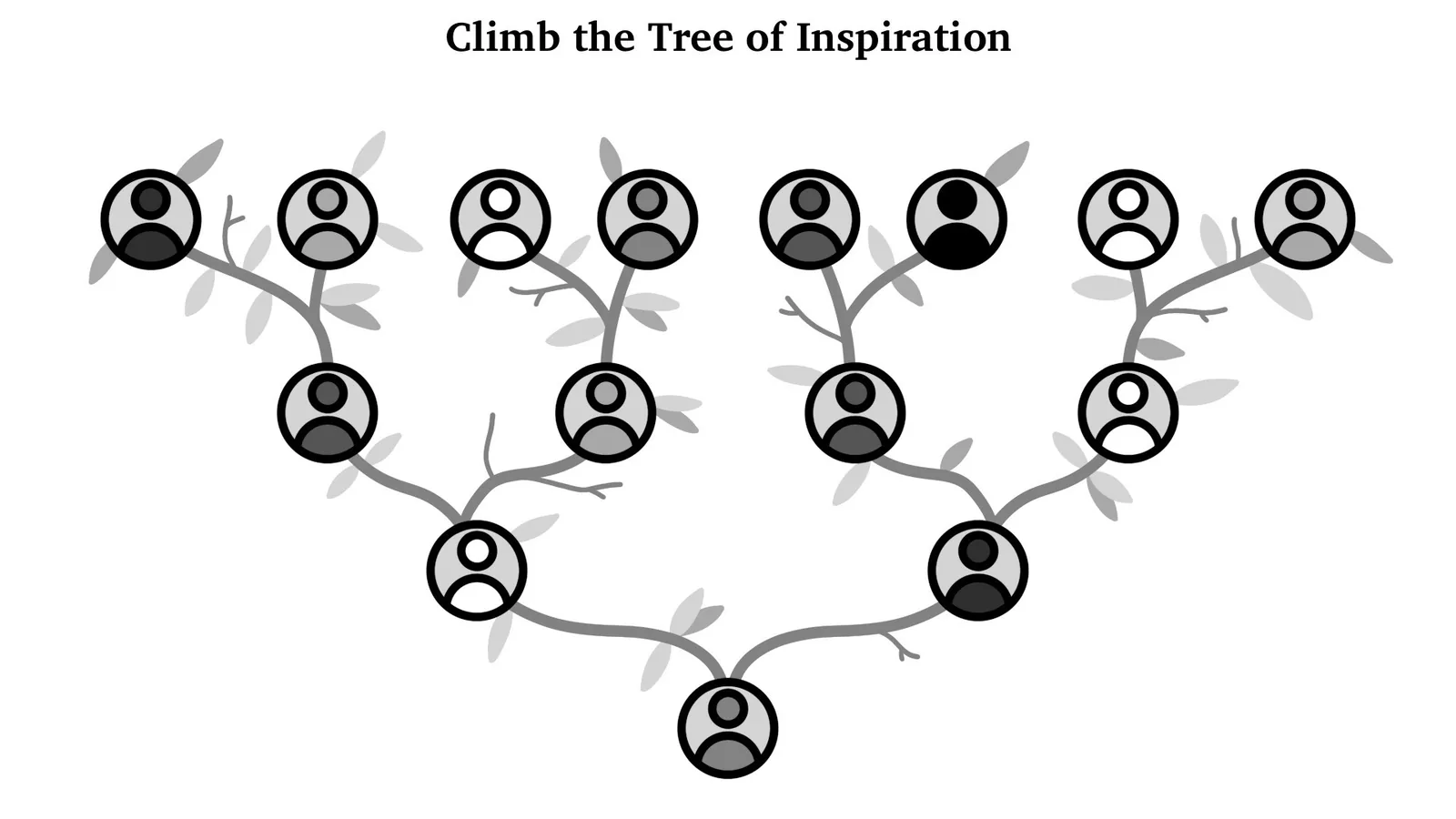
When I dropped out of college to move to Las Vegas at 19, the only things I brought besides clothes were my books. Biographies of Kobe Bryant, Steve Jobs, Elon Musk, Napoleon, Sam Walton, and a handful of others.
They’ve become something like a board of advisors for me. Whenever I’m stuck on a decision or going through something I don’t know how to handle, I reach for one of them and ask “What would X do in this situation?”
My best mentors don’t even know me (and most of them are dead).
Pro Tip: If you don’t want to read biographies, listen to podcasts of people summarizing them.
My two favorite podcasts on this are:
It doesn’t matter what field you’re in, there’s always something you can learn from people who have become exceptional at their craft.
“No matter what discipline you are in, there’s a common denominator in how we approach our craft,” Kobe Bryant said. “The attention to detail. The level of commitment. Those things are the same across the board. That is my message: don’t look at what I did, but how I did it. The how. You can transfer that over to any profession and any discipline.”
In today’s world, there are zero excuses to not be the most knowledgeable about your field. With AI, YouTube, podcasts, and digitized archives, there has never been an easier time to learn from the greats.
You have access to shareholder letters from the world’s greatest CEOs. You can look up the NASA archives on how they went to space. You can watch Ivy League lectures on YouTube for free. You have the Library of Alexandria at your fingertips. Why wouldn’t you take advantage of that?
Now it’s your turn to do what Sam Walton did.
Exercise: Reverse Engineer The Greats
I want you to identify 3-5 people who are living the life you want to live or have traits you admire. Write down their names and what specifically you admire about them.
Here’s my answer:
Sahil Bloom – I admire how Sahil embodies everything he writes about. He doesn’t just write about fitness; he runs marathons and deadlifts 525 lbs. He doesn’t just write about wealth beyond money; he quit his career in finance when he was making the most money of his life to move across the country to be closer to his parents. Anybody can talk about a philosophy, few live it.
Dan Koe – I admire how Dan built a one-person business and designed it around his schedule instead of the other way around. He writes long-form essays that blend philosophy with practical business advice, which I haven’t really seen anywhere else. He coined this phrase a few years back called “multi-dimensionally jacked,” and he lives it. He’s financially well off, extremely fit, has time and location freedom, and is doing work he finds meaningful.
Noah Kagan – I admire how intentional Noah is. He doesn’t let the opinions of others or the entropy of his current path dictate what he does next. When he became a husband and father, he asked, “Does creating YouTube videos serve me in this season of my life?” He couldn’t clearly answer that question, so he decided to pause his YouTube channel and focus on his family. How many people do you know would leave a 1M+ subscriber channel to focus on family? I admire the heck outta that. “Entrepreneurship is NOT just about getting rich,” Noah used to tell me. “It’s about creating your dream life. It’s about finding the right path for YOU.”
If you look at all of these people, they have a lot in common. They figured out how they wanted to live, then designed everything around that. They’re masters at their craft. They’re fit. They’re clear thinkers and great communicators. They’re positive-sum people doing meaningful work. They live life with intention.
“The general who wins the battle makes many calculations in his temple before the battle is fought. The general who loses makes but few calculations beforehand.” – Sun Tzu
As you study the people ahead of you, you’re going to come across a lot of ideas worth remembering. The question is, where do you put all of it? My answer is to build a “second brain”. That sounds super fancy (given that managing just one is a lot), but stick with me. What it means is: save everything that catches your attention.
When I read a biography and something resonates, I write it down on a note card and file it away. I’ve been doing this for years. The Sam Walton story at the top of this chapter came from a note card. The David Ogilvy piece of advice came from a note card. The Napoleon detail about the portable bookcases, the Charlie Munger quote, all of them were sitting in a file long before I knew they’d end up in this book.

I keep folders for everything.
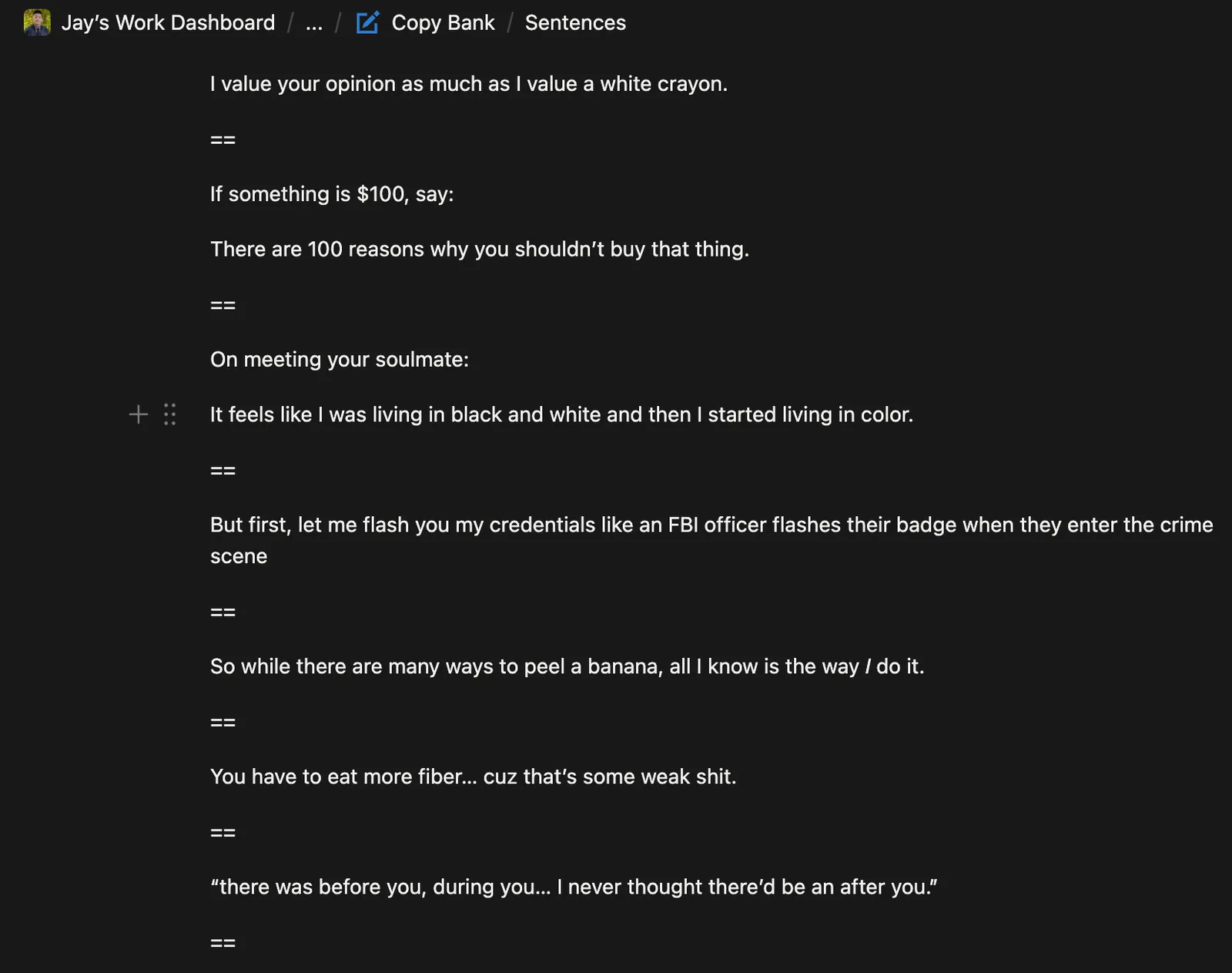
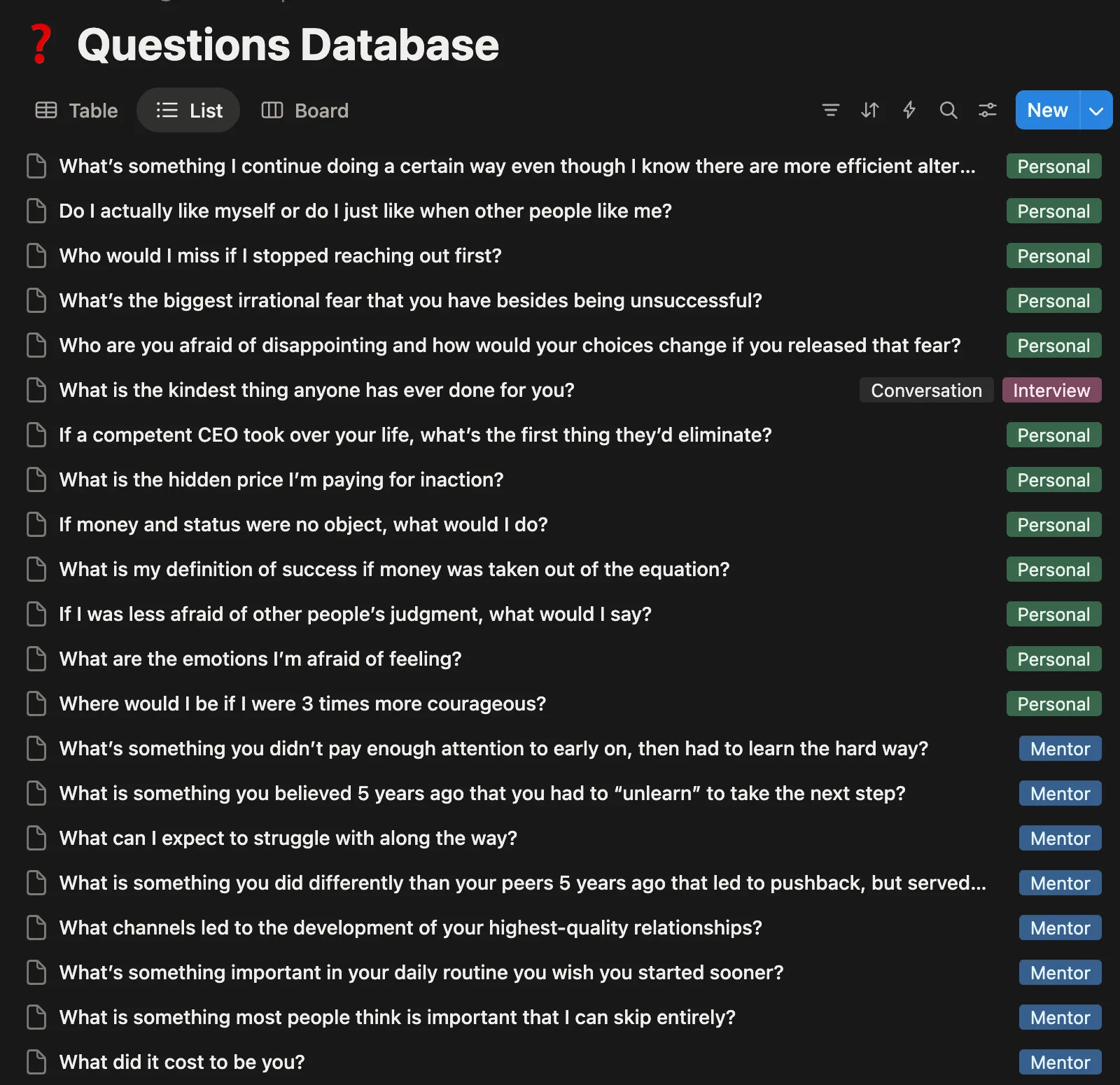
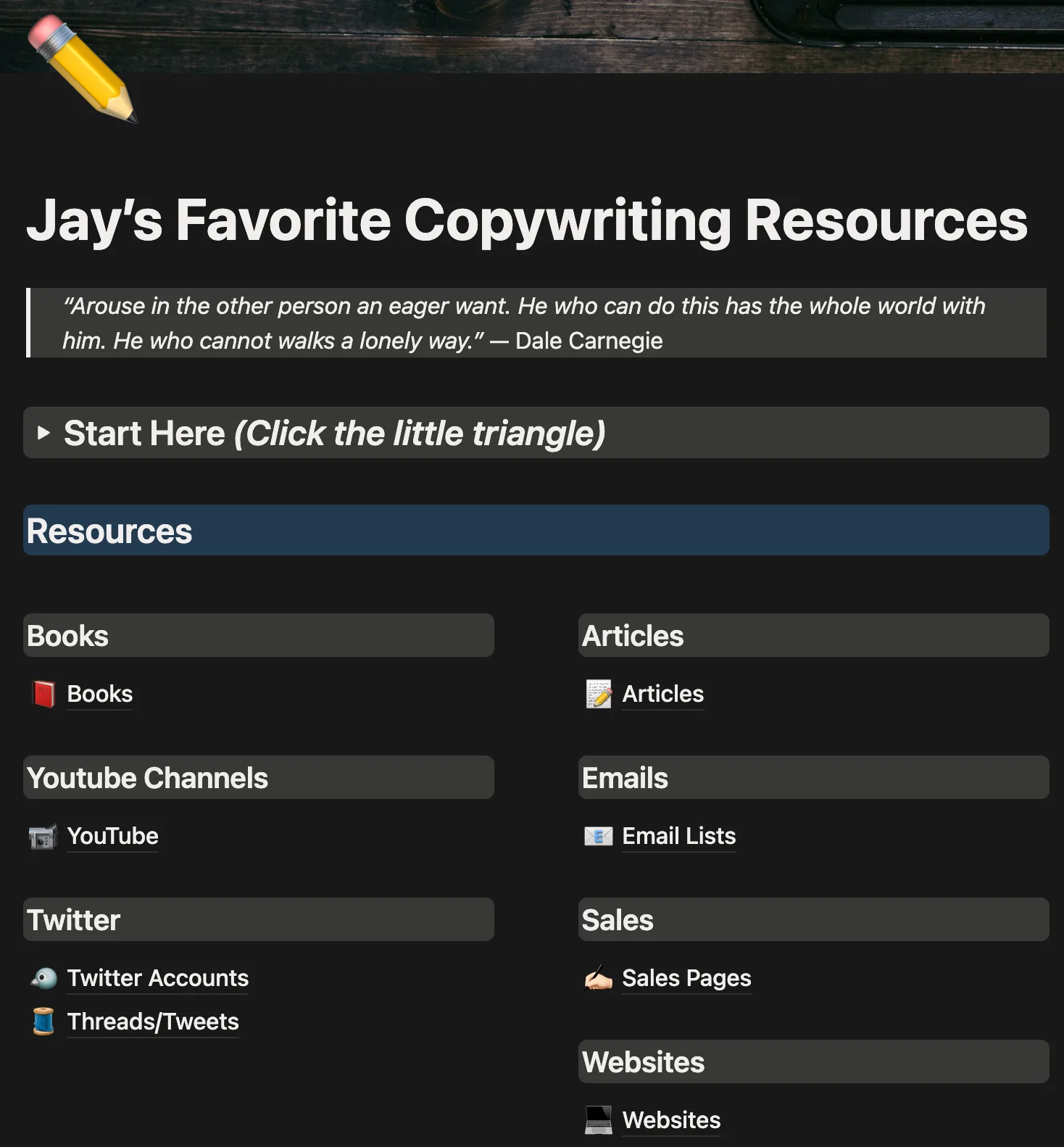
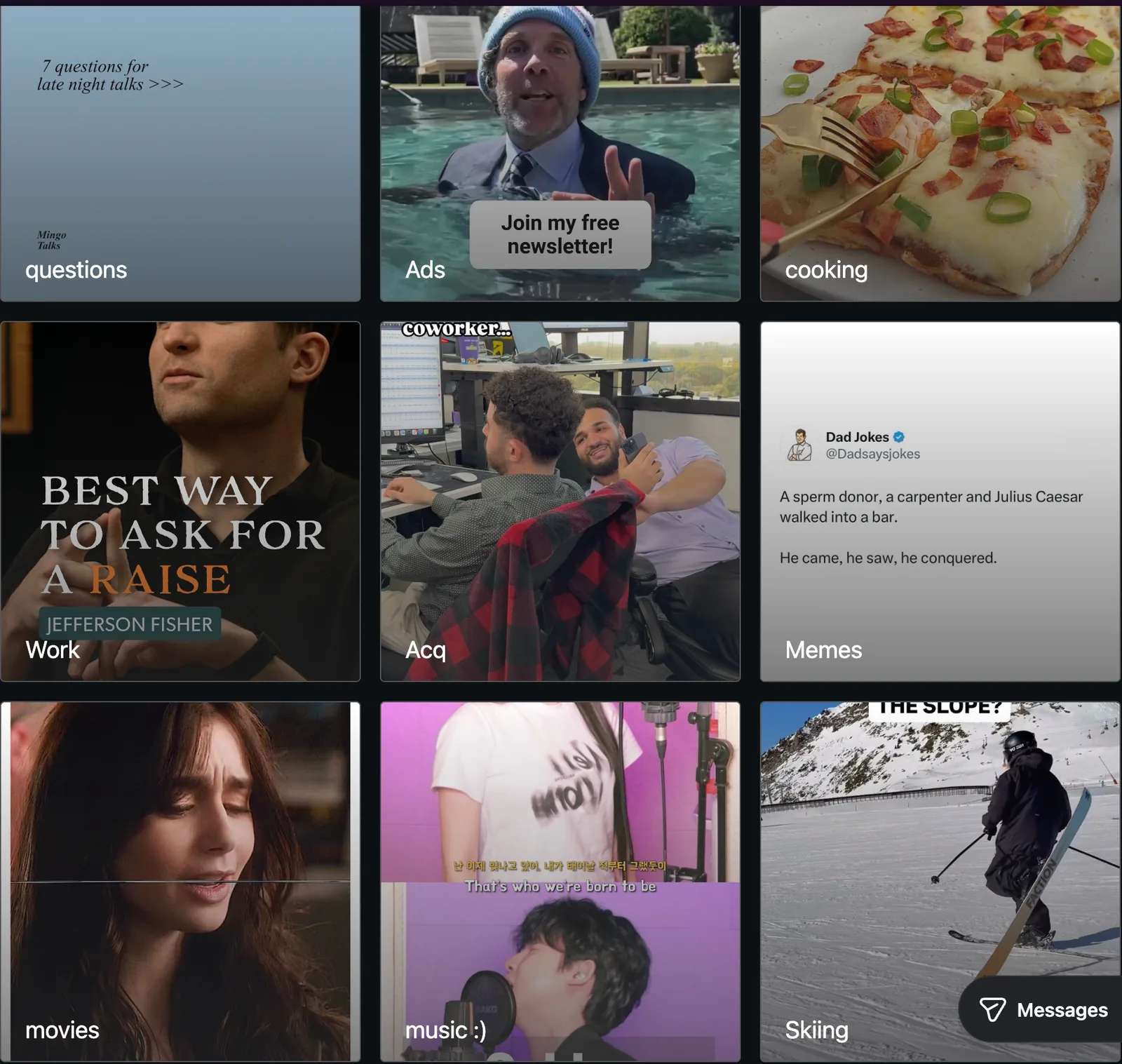
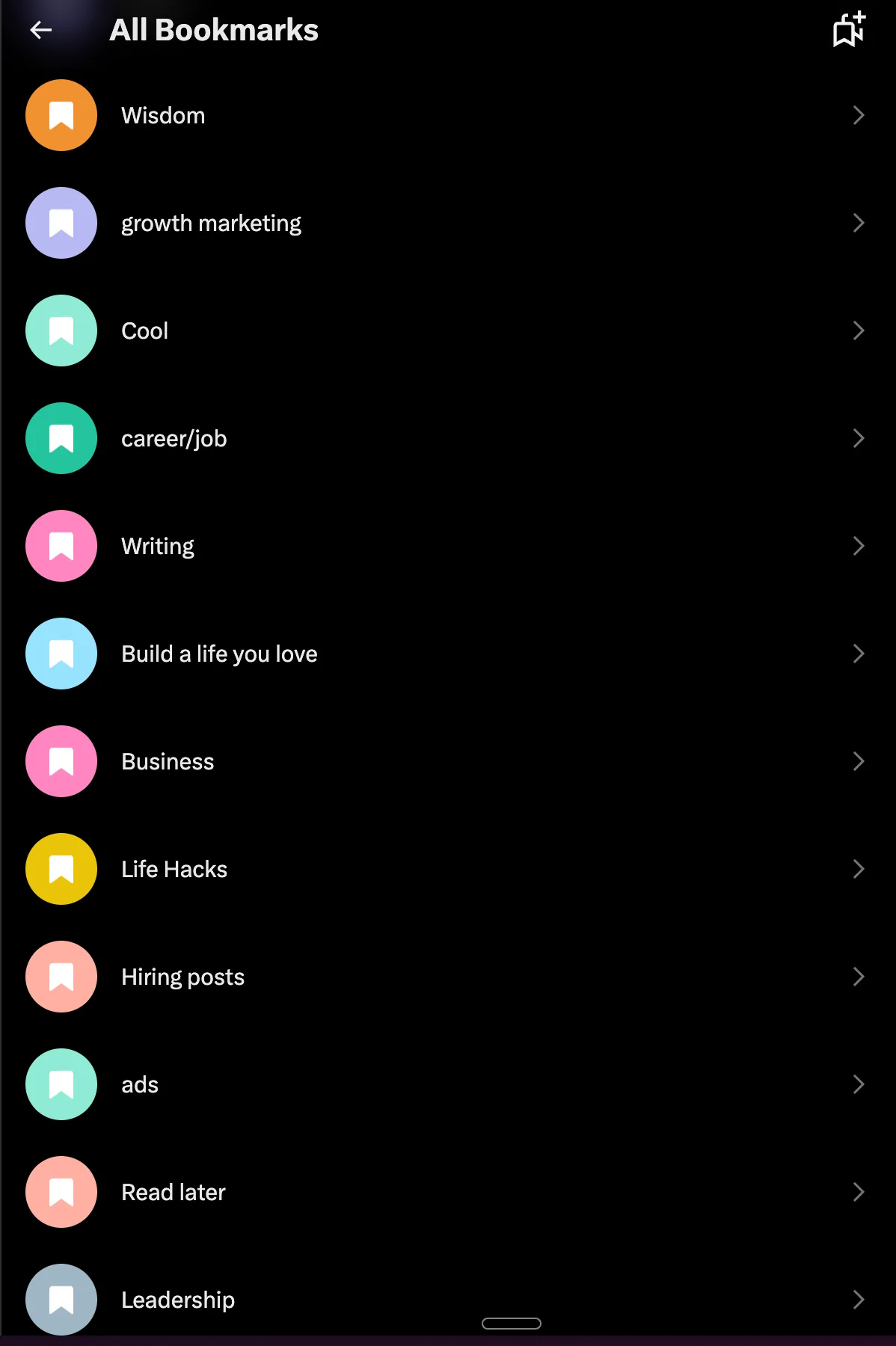
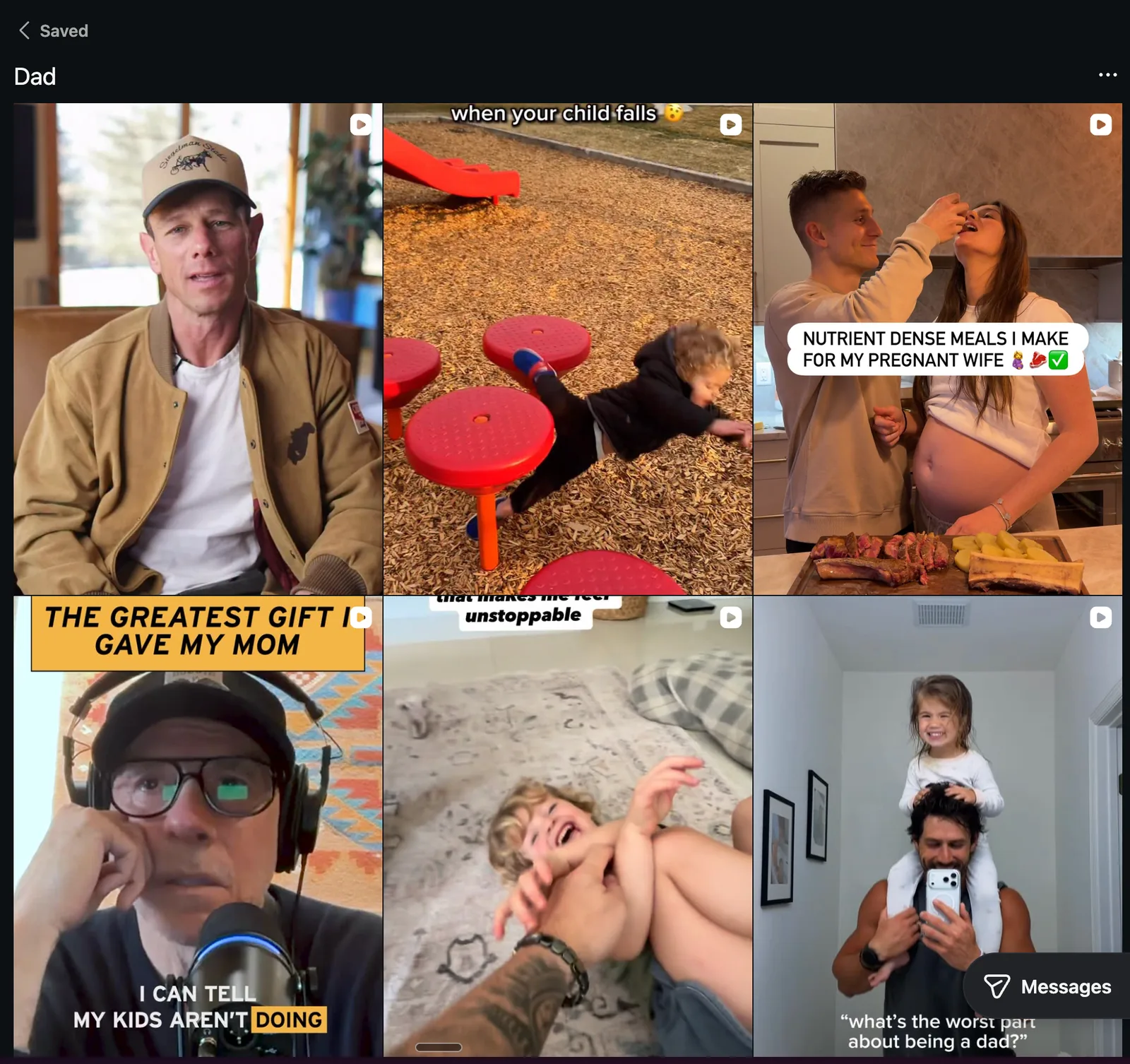
Excessive? Maybe. But there’s a reason I do it.
Before Steve Kerr became head coach of the Golden State Warriors, he was working as a broadcaster for TNT. He knew he wanted to coach, so he started preparing before he had the job.
He opened a Word file and began writing down everything he had learned over his 15 seasons playing under coaches like Phil Jackson and Gregg Popovich. Offensive sets, defensive principles, practice structure, travel, culture. No detail was too small. Some days, he added a few notes. Other days, he filled pages.
By 2014, the file had turned into a full PowerPoint. When the Warriors fired their head coach and called Kerr for an interview, he walked in with two years of material already built. He got the job, and in his first season, he led the Warriors to an NBA championship. The next year, they went 73-9, the best regular season record in NBA history.
“To each, there comes in their lifetime a special moment when they are figuratively tapped on the shoulder & offered the chance to do a very special thing, unique to them and fitted to their talents,” Churchill once said. “What a tragedy if that moment finds them unprepared for that which could have been their finest hour.”
No matter what field you work in, you never want to be caught flat-footed.
How should you start? There’s no perfect system. My Second Brain is spread across Notion, physical note cards, Twitter bookmarks, Instagram, and over 500 notes in my Apple Notes app. It’s messy, and that’s okay. The point isn’t to build a beautiful, organized database. It’s to notice things and save them somewhere you can revisit when you need them.
Bad isn’t the enemy of good; perfect is. The only thing worse than an imperfect system is no system at all.
If you want to keep things simple, open a Google Doc and title it “Things I Don’t Want to Forget.” Next time you read something that makes you stop, hear a line in a podcast that hits, or see an ad that catches your eye, throw it in there. You can migrate it to Notion or note cards or whatever system you want down the road, but the habit of noticing and collecting is what matters most.
There’s a saying: “Smart people learn from their mistakes. Wise people learn from the mistakes of others.” Every problem you have in life has been solved by someone who came before you. You can steal decades of their hard-earned knowledge for the price of a book and a few hours of your time.
The greats left us a map. The only question is: will you use it?
Dr. Watson: “What do you imagine that means?”
Sherlock Holmes: “I have no data yet. It is a capital mistake to theorize before one has data. Insensibly one begins to twist facts to suit theories, instead of theories to suit facts.”
— A Scandal in Bohemia
The other day, I was talking with a friend who was in the middle of trying to decide what he wants his college major to be.
He was throwing out all these different options: accounting, marketing, finance, business analytics. He didn’t know which one to choose and he was stuck in “analysis paralysis.”
I asked him, “Well, have you tried any of them?”
He said no.
This isn’t a knock on my friend. He’s super smart and driven. It’s just that most of us never try things outside of school. We don’t experiment. We don’t go out and test what we like and don’t like. We study hard, do homework, get good grades, and stop there. But how can you expect to know what you like if you’ve never tried anything?
That’s like walking up to a buffet and trying to decide what you’ll enjoy by staring at the trays instead of sampling something.
Philosopher Alan Watts once said, “A person who thinks all the time has nothing to think about except thoughts. So, he loses touch with reality and lives in a world of illusions.”
You need data. And the best way to get data is to try a bunch of stuff. To experiment. To wander. As Brian Armstrong, the CEO of Coinbase, said, “Action produces information. If you’re unsure of what to do, just do anything, even if it’s the wrong thing. This will give you information about what you should actually be doing.”
Look, I get it. Trying something and having it not work out is scary. Nobody likes to fail. Nobody wants to look stupid or waste their time. But I would encourage you to reframe how you think about failure entirely.
Instead of seeing yourself as someone who failed, see yourself as a mad scientist running experiments. Scientists have hypotheses. They test them, then evaluate the results. Then they double down on what works and cut what doesn’t.
When a scientist runs an experiment and the hypothesis is wrong, that’s not a failure. It’s information. A data point. It tells them something they didn’t know before, which makes the next experiment better.
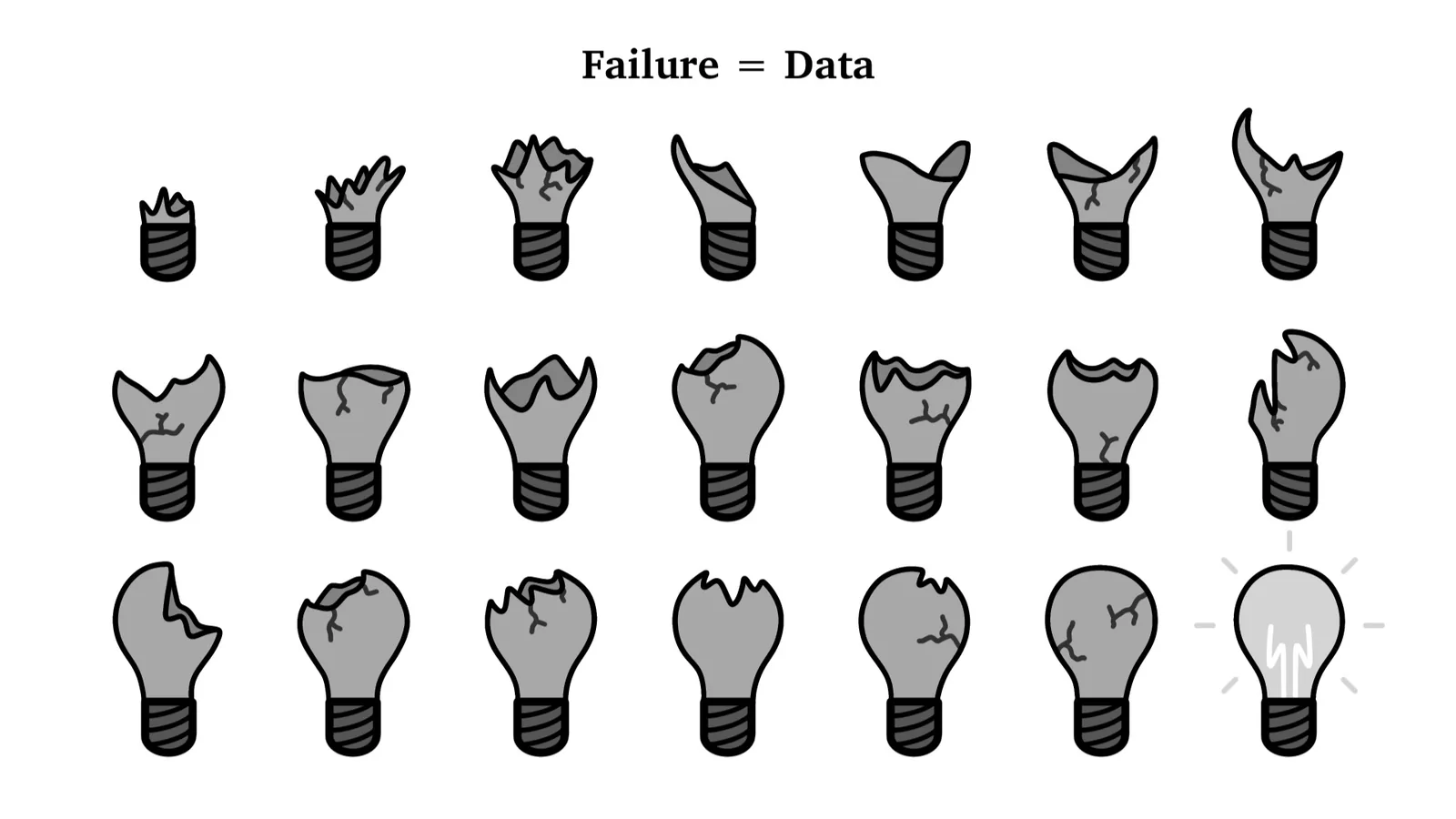
That’s how I want you to approach your life. Every side project, job application, and conversation you have with someone in a field you’re curious about… it’s all an experiment.
Start a podcast. Build a website. Learn to code. Try copywriting. Pick up a camera. Reach out to someone whose work you admire. Volunteer for a project that inspires you. Go to events where you don’t know anyone. Or in my friend’s case, sign up for a finance 101 class. The specific experiment matters less than the act of experimenting.
I heard this analogy from James Clear on decision-making that I love: Hats, haircuts, or tattoos.
Most decisions are like hats. Try them on and if you don’t like it, you can put it back and try another.
Some decisions are like haircuts. You can fix a bad one, but it might take some time, and you’ll feel foolish for a while.
A few decisions are like tattoos. Once you make them, you have to live with them. Some decisions are irreversible.
When you’re stuck with a decision, ask yourself: is this a hat, haircut, or tattoo?
That said, if you’ve tried a bunch of things, and you still don’t know what to work on, the best advice I can give you is this: work on yourself. Do things that will help you succeed regardless of what field you work in.
When I first started out, I had no idea what I wanted to do. I literally googled “how to make money online” and picked the top result. It didn’t work. So I focused on making myself better.
I started working out, reading self-help books, and watching online business videos. I figured getting in shape, increasing my energy levels, and expanding my knowledge couldn’t hurt my chances of becoming successful.
Eventually I found copywriting, went all in, built an audience, and when the beehiiv opportunity showed up, I was ready for it. As the poet Rumi said, “As you start to walk the way, the way appears.”
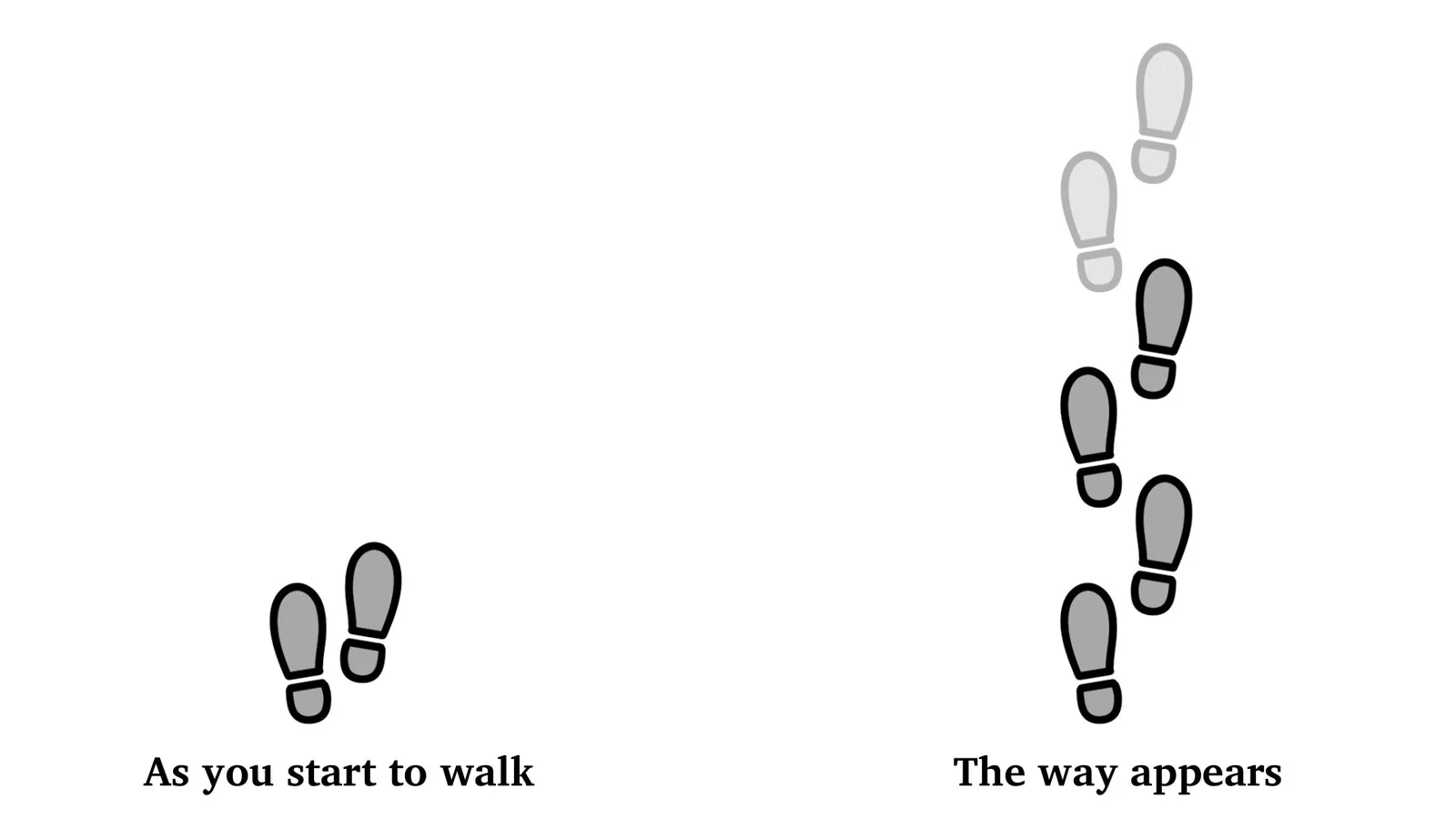
James Floyd, an early beta reader of this book, told me he moved to New York recently (proximity is power!). He didn’t know anyone and didn’t have a job. But instead of waiting around for “inspiration” to strike, he started a street interview podcast.
He’s walking around local parks and interviewing 100 strangers about their life story. He’s already met many cool people (like a billionaire who owns a private jet hangar). When he does start his next thing, he has a network of people who can help him. Build capacity!
Opportunities multiply as they are seized. If you don’t know what to do, do something. Learn a skill. Go to the gym. Read books. Expand your network. Grow an audience. Be at the plate, ready to swing, so that when the right opportunity comes, you’re ready to capitalize on it.
Pro Tip: If you feel like you need motivation to start doing things, pretend there’s a camera crew following you around all day. The Hawthorne Effect states people work harder when they know they’re being watched. Would you be proud if they posted a documentary of your life?
The next section of this book is going to give you specific frameworks and strategies for getting what you want. How to get in the right rooms. How to make yourself valuable. How to reach the people you want to work with.
But none of those tools work if you do nothing about them.
So go try something. Today, not tomorrow. Now, not next week. Run an experiment. Collect a data point. Wander and see where it takes you.
“To get what you want, you have to deserve what you want. The world is not yet a crazy enough place to reward a whole bunch of undeserving people.” — Charlie Munger
“We’re all equal in soul, we’re not all equal in the marketplace.” – Jim Rohn
“Get good at something. Everything else is bullshit.” — Jerry Seinfeld
Humor me for a second. Let’s say you and I got into a tree chopping competition. Whoever can chop down the most trees in 24 hours wins.
You had an axe and were swinging as hard and as fast as you could. Then I showed up with an army of 50 lumberjacks all operating tractors. Who would win? I would beat you every single day of the week and twice on Sunday. It wouldn’t even be close.
But the answer for you isn’t to swing harder or faster. It’s to get more leverage.
The same thing applies to your career. There’s a quote I love: “If hard work was the only answer, then the donkey would own the farm.” We all know hard work matters, but on its own, it’s not enough. The real question is: what are you working hard on, and how valuable is it?
You get paid for the amount of value you create in the marketplace. There’s a reason why AI engineers make a disproportionate amount of income compared to the person bagging groceries at your local grocery store. That’s not saying that if you don’t make a lot of money, you’re not a good person or a valuable person. It just means the market hasn’t rewarded your skills yet.
The market rewards what is both rare and valuable. If you got really, really good at bagging groceries and became the best grocery bagger in the world, that’s undoubtedly impressive. But it’s not a rare skill. Anyone can learn it, many people already do it, and because of that, the market doesn’t pay much for it.
What you need is what the investor Naval Ravikant calls, “specific knowledge.” Knowledge that’s not easily trained and can’t be taught in a classroom.
A question worth asking yourself if you want to get paid more: how easily can you be replaced? The harder you are to replace, the more value you provide, and the more cards you hold when it comes time to negotiate.
I think of skill building like a ladder.
When I started doing client work, I could write a decent tweet and edit a simple video. Clients paid me $500 to $2,000 a month for social media management and content creation. Useful work, but a commodity.
But the better I got, the more I was able to charge for results (not just management). I learned psychology, branding, and how to write high-performing content. That allowed me to charge $3,000 to $5,000 a month.
Then I dove deeper into marketing: building offers, creating funnels, writing email copy, landing pages, and paid ads. I became a “full-stack” copywriter. Now I could charge $20,000 a month because I wasn’t just helping clients grow on social media; I was helping them grow their business.
Each skill on its own was fine. But when the skills got stacked, the gains became exponential. In the span of 4 years, I went from charging $500/month to $20,000/month (a 40x).
This is why I’m a big believer in skill stacking. Your goal isn’t to be the best in the world at one thing; it’s to be great at a few complementary things that, in combination, make you extremely hard to replace.
Are you starting to see how this game gets fun? When you view life as a video game and yourself as the main character, skill stacking becomes a way of leveling up.
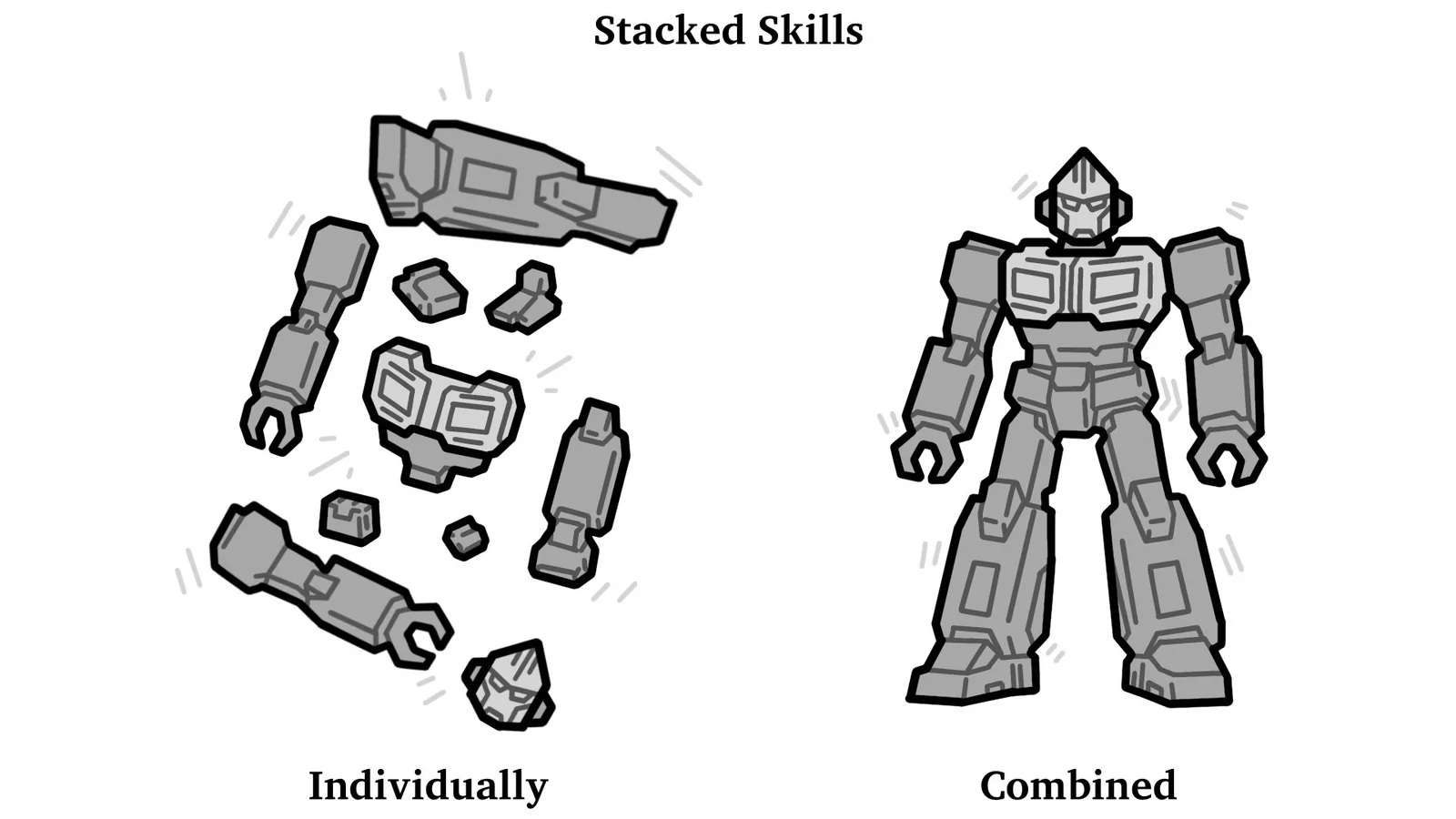
Naturally, this opens up the next question: where do you start? What skill do you choose to begin with?
The good news is you’ve already done most of the work to answer this. In chapter 4, you reverse engineered people you admire. Look at those people and ask: What skills do they have that you don’t have yet? What can they do that you can’t? That gap is your skill list.
When I first started, I tried visual graphic design because I looked up to Jack Butcher. I realized pretty quickly that I don’t think visually like that. I tried being a fitness influencer because I looked up to people posting motivational videos on Instagram. I hated recording myself, despised editing, and knew my energy wasn’t there.
Then I stumbled across copywriting. It aligned with what I was naturally good at, I picked it up pretty quickly, and I enjoyed doing it. Bingo.
Here’s an example of my “reverse engineering process”. I was 17, still in high school, when I wrote this reflection:
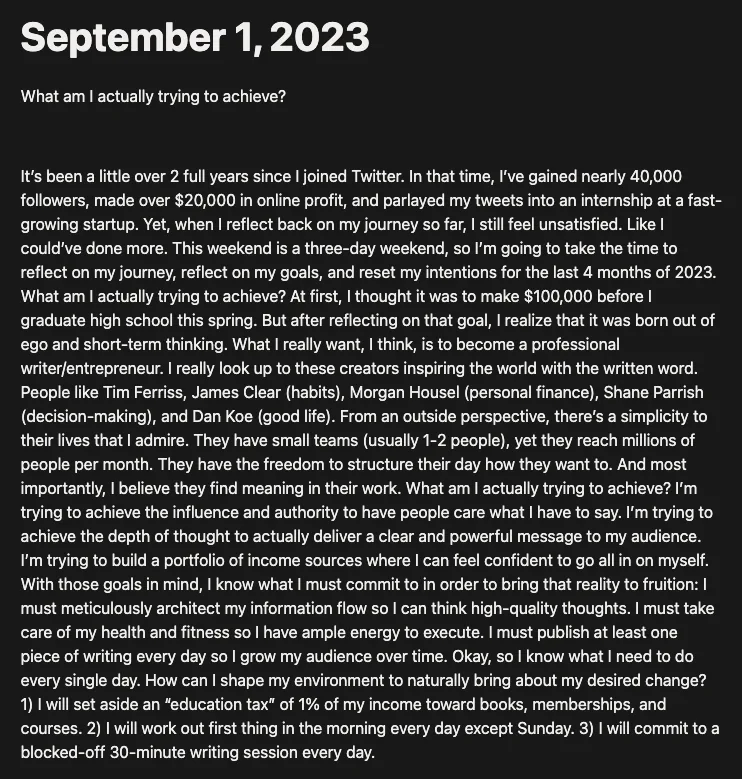
If you don’t admire anyone yet, work backwards from your North Star.
NFL defensive end J.J. Watt was once asked what advice he’d give to someone who wanted to play in the NFL.
“Start with the big dream,” J.J. said. “Let’s say your goal was to get in the NFL. Okay, how do I get there? Well, I should probably get drafted. That would be better than not getting drafted. Getting drafted in the first round is the best option. What numbers did the top defensive end get? What was his 40-yard dash time? How big was he? How fast was he? How strong was he?”
“Then you think, okay, how do I accomplish those numbers? Well, I need to get in the weight room. Okay, what can I do today to improve my speed, strength, and agility? You start with the big dream and break it down to its simplest form. What can I do today to make myself better?”
Do you see why I was so adamant that you write down your North Star in chapter 1? Now the harder question. Of the skills on your list, which one do you commit to?
People message me asking this all the time. Should I do copywriting? Sales? Design? My answer is always the same: try all of them. Just not all at once.
Pick ONE skill from your list. Go all in on it for 30 days. Watch every tutorial you can find, practice obsessively, and get as good at it as you can.
At the end of those 30 days, ask yourself: did I enjoy that? Did I learn it quickly? Would I keep doing this for free?
If the answer is no, move on to the next skill on your list. Run the same 30-day experiment. Keep going until you find one that clicks for you.
But fair warning, at some point you have to decide. The word “decide” comes from the Latin word caedere, meaning to cut. To decide is to cut off every other option. I get that this feels scary. But it’s not a permanent decision. If you pick a skill and realize it’s not for you, you can pick a different one and you’ll know more about your preferences than you did before.
The only real failure is never picking at all. So pick a skill, commit, and see what happens.
Doing more “research” is a smart person’s favorite way to procrastinate.
Once you’ve picked a skill, the next step is: how do you get better? How do you go from where you are now to someone who is more valuable in the marketplace?
Once I committed to copywriting, I went all in. I subscribed to every copywriter’s email list I could find. I read old advertisements. I took courses, read books, and watched YouTube videos about copywriting.
I would listen to podcasts when I worked out, did chores, and waited in the cafeteria line at school. I created a swipe file of every piece of content and headline that stopped me mid-scroll and studied why it worked. I did copywork, which is when you handwrite your favorite writing with pen and paper to internalize the rhythm and structure. And every single day, I wrote at least 10 tweets.
Note: If you’re interested in trying copywork, I first discovered it from Sam Parr. I did this every day for 6 months straight. It dramatically improved my writing. I compiled my favorite writing for you to do copywork on here:
Get the free Work With The Best bonuses →
Pro Tips to get better (faster):
(1) Go to the source. I try as much as possible to learn from the actual expert instead of the people talking about what the expert is talking about. It’s the most complete version of the idea, and you pick up things that get lost in translation.
(2) Learn by building real-world projects. If you just consume tutorials, you’ll forget most of it. But if you’re actively building something and watching tutorials to solve the specific problems you run into along the way, you’ll learn much faster because you’re applying it in real time.
(3) Teach what you learn. Every Sunday I write a newsletter to over 50,000 readers about what I’m learning. That forces me to understand the material well enough to explain it to someone else. If you can’t explain it simply, you don’t understand it yet.
(4) Self-review every week. Noah Kagan taught me a habit he called T3B3: at the end of each week, you look at your top three and bottom three pieces of work. Then the next week, you double down on what worked and cut what didn’t. You can do the same for any other aspect of your life. What’s working and how can we do more? What’s not working and how can we do less? Most people never look back at their own week, which is why most people repeat the same week for years and never grow.
(5) Start peer groups. Start a group chat with 3-5 people working toward a similar goal. I’ve done this for social media, copywriting, and marathon training. If you don’t know anyone yet, find them in the replies under your favorite creators or in Discord and Reddit communities in your space.
If you want to get fancy, have a weekly (or monthly) call where you hold each other accountable and give feedback. Keep these calls short and structured. Give each person 5 minutes to share what they learned that week, what they’re working on, and where they’re stuck. We also keep a shared spreadsheet where we track the inputs we said we’d do against the inputs we actually did.

“Interested people watch obsessed people change the world.” – Tim Grover
People say your 9 to 5 is for your current job and your 5 to 9 is for your future career, and I couldn’t agree more. If you want to become exceptional, you need a season of your life where you’re completely obsessed with your craft. There’s no way around it.
I’m talking about a stretch, maybe six months, maybe a year, maybe longer, where every spare hour goes toward getting better. Before school, after work, on weekends, during your commute. A period where the people around you might think you’re a little crazy because of how locked in you are.
If you want to become world-class at what you do, you need to be spending at least 1-3 hours a day outside of work improving at your craft.
Athletes do this naturally. They work out every day, stick to the same routine, watch film, track their progress, manage their diet, and obsess over marginal improvements. Nobody thinks that’s weird. That’s just what it takes to compete at the highest level.
Michael Phelps didn’t take a day off for five years straight leading up to the 2004 Athens Olympics where he won six gold and two bronze medals. “For five years, from 1998 to 2003, we did not believe in days off. I had one because of a snowstorm, two more due to the removal of wisdom teeth,” he said. “Christmas? See you at the pool. Thanksgiving? Pool. Birthdays? Pool. Sponsor obligations? Work them out around practice time.”
But for some reason, when it comes to writing or comedy or entrepreneurship or really any other field, we don’t hold ourselves to the same standard. We show up when we feel like it, we wing it, then we wonder why we’re not getting better.
If you look at anyone who reached the top of their field, every single one of them will point back to a stretch of their life where they shut everything else out and did nothing but obsess over getting better.
Eminem read the entire dictionary cover to cover. He would take a word, write it out syllable by syllable, and line up rhyming words underneath each one as a drill, doing this for hours every night until he had thousands of words stored away that he could pull out in the middle of a freestyle.
Jerry Seinfeld made a pact with himself when he was starting out to write one joke every single day. He hung a wall calendar in his apartment and marked a red X on every day he wrote. His only rule: don’t break the chain.
Arnold Schwarzenegger wrote in his autobiography, “Whereas most people were satisfied to train two or three times a week, I quickly escalated my program to six workouts a week.” He eventually started training twice a day, burning through multiple training partners because no one could keep up with him for a full week. When the gym was closed on Sundays, he broke in to lift anyway. “My mind was totally locked into working out,” he said, “and I was annoyed if anything took me away from it.”
In the early 1980s, venture capitalist Michael Moritz was visiting Microsoft when Bill Gates offered to drive him to the airport. Moritz got in the car and noticed a big, gaping hole in the dashboard where the radio should have been. He asked Gates if his car had been broken into. Gates said no. He’d had the radio taken out himself. “My commute from home to the office is seven minutes and thirty-two seconds,” Gates said. “If I’ve got the radio, I’m afraid that I’ll switch it on and I won’t be thinking about Microsoft.”
In a 2008 interview, Kobe Bryant explained why he starts training at 4am. “If your job is to be the best basketball player you can be, then you need to train as much as you can, as often as you can.” If you wake up at 10am and start training at noon, you can fit two sessions into your day. But if you wake up at 3am and start at 4am, you can fit four.
“As the years go on, the separation that you have with your competitors and your peers just grows larger and larger and larger,” he said, “and by year five or six, it doesn’t matter what kind of work they’re doing. They’re never going to catch up because they are five years behind.”
Does that not fire you up?
Commit to an Obsession Arc. Pick a skill, then relentlessly hone it until it’s no longer the constraint of your career.
This isn’t some workaholic, screw “work-life balance” dogma. It’s math. If you put in 2 hours a day while everyone else puts in 1, that’s 365 extra hours a year. Do that for 3 years and you’ve built a 1,095-hour head start.
The most successful people I know don’t view work-life balance in days; they view it in decades.
If you want to accelerate your career and compress the amount of time it takes to achieve a goal, then there will be at least a 1-3 year stretch of your life where things feel unbalanced. Where you’re putting in more hours than feel reasonable. Where your friends are going out and you’re working on your craft. Where you feel kind of lonely. Where you second guess yourself and wonder if all this work is really worth it.
But trust me, on the other side of that Obsession Arc is the life and career that you desire.
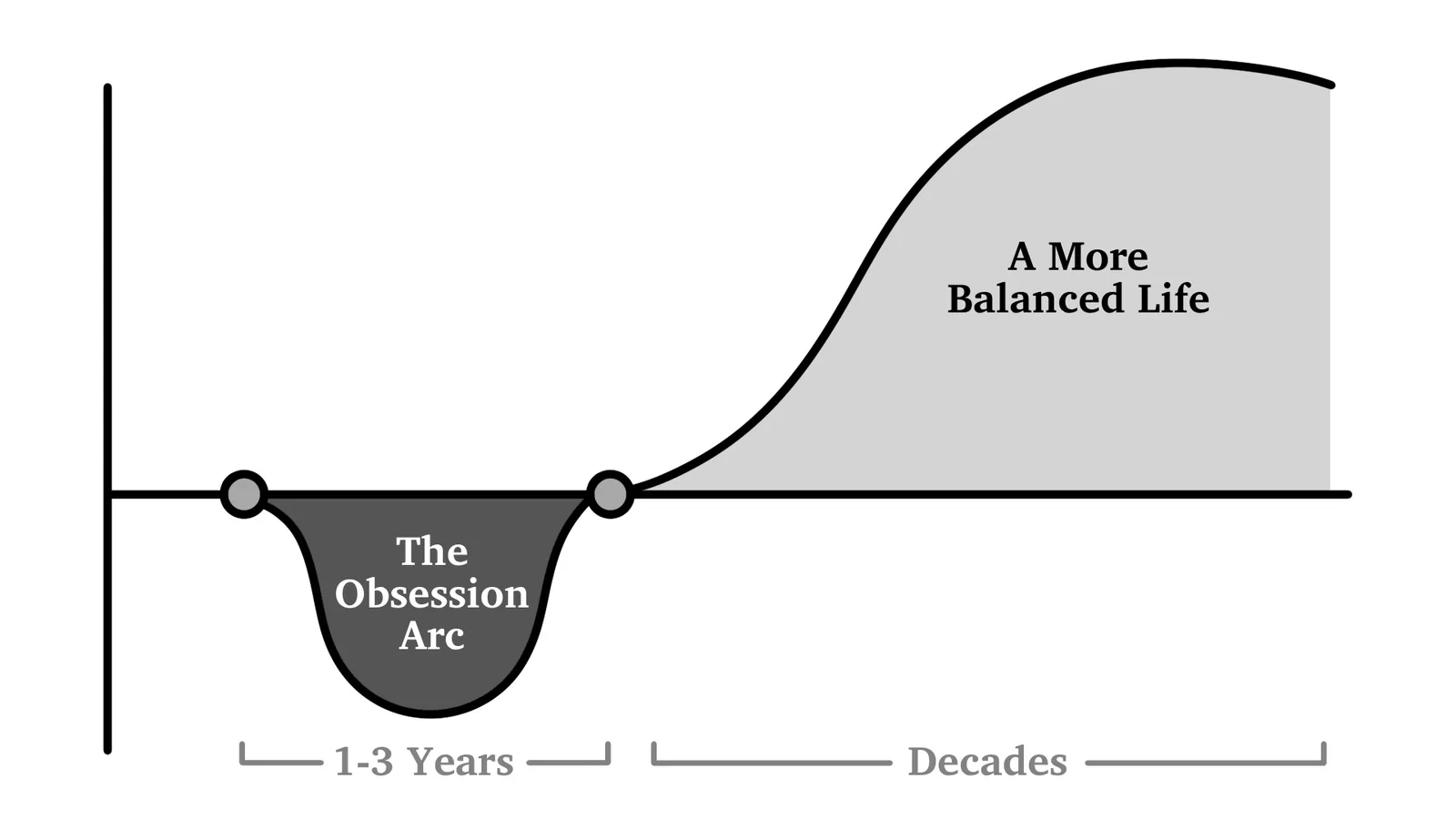
If you can develop the courage to lock in for a few hours every day, in a few years, the world won’t be able to ignore what you create.
“Mastery is the best goal because the rich can’t buy it, the impatient can’t rush it, the privileged can’t inherit it, and nobody can steal it. You can only earn it through hard work.” – Derek Sivers
When I was 16, I made a decision that didn’t feel smart at the time. Instead of trying to make as much money as possible, I tried to develop as many skills as I could and trusted that the money would come.
I learned copywriting, and instead of immediately starting a freelance business, I used that skill to get in the door at beehiiv. At beehiiv, I learned how to grow a newsletter and operate inside a tech startup, but I realized I needed to understand marketing at a much higher level.
So I traded that skill set to work with Noah Kagan. Working with Noah, I learned marketing strategy and audience building, but then people started asking me to do copywriting for them, which meant I needed to learn how to create an offer, set up a landing page, and conduct a sales call.
The agency was going well, but I knew that writing for founders was only one slice of what I wanted to learn. I wanted to understand how to operate and scale a business as a whole, so I took a 50% pay cut to join Acquisition.com.
At every step, it felt like I was leaving money on the table. I could have stayed at beehiiv and pushed for a full-time role. I could have kept the agency and scaled it. But each time I traded a skill I already had for one I didn’t, the next opportunity that opened up was bigger than anything the previous one could have offered.
While each trade felt like a step backwards in the moment, it was a set up to take ten steps forward.
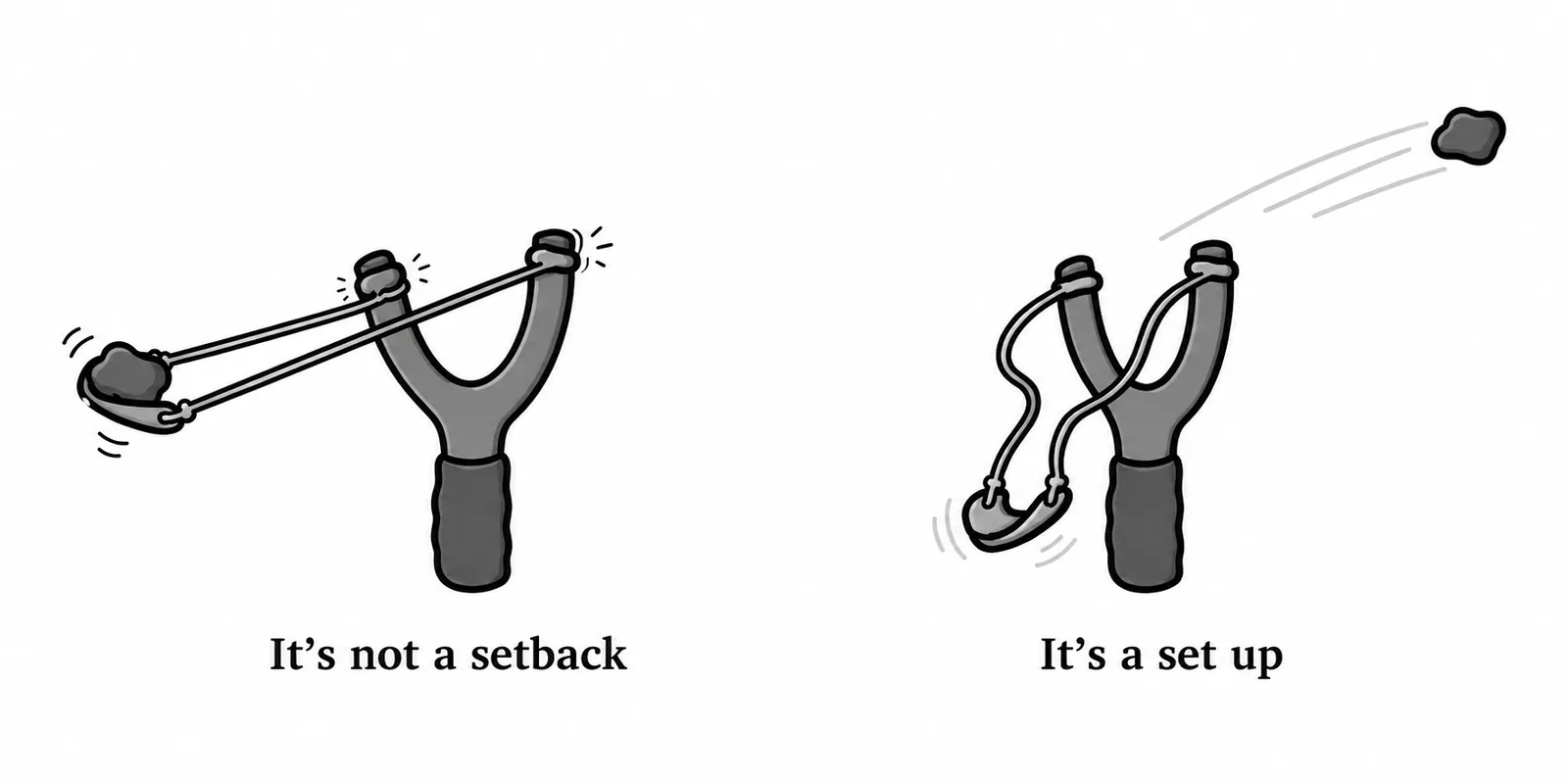
When you’re early in your career, focusing solely on making the most money with your current skills is like trying to max out your bench press two weeks after you started lifting. You’re trying to max out too early. The taller you want to build a building, the deeper the foundation must be.
J. Paul Getty was once the richest man in the world. In his book How to Be Rich, he tells a story about a young man who buys an oil lease for $4,000 on a Monday and sells it to Getty on Tuesday for $8,000. The young man walks away bragging about doubling his money in 24 hours. Getty makes $800,000 on that lease over the next decade.
The smartest people know the big money is in the long term.
Now, I think it’s a false dichotomy to say you should pursue learning instead of earning. Ideally, you do both (and if you need the money right away, that’s a different story).
But if I had to choose one over the other early in my career, I would choose learning 100% of the time… because skills expand your earning power and can’t be easily taken away from you.
Don’t get so caught up chasing the fast money that you miss out on the big money.
As you move through the rest of this book, keep one question in the back of your mind: would you work with you? If a younger version of yourself showed up in your inbox tomorrow with a pitch, would you be impressed? Would you want them on your team?
If the answer is yes, great. The next few chapters are going to help you get in front of the right people.
If the answer is not yet, that’s okay too. You know what to do. Go stack some skills. Trade your way up. You’ll be glad you did.
“One of the only true shortcuts in life is finding an expert and apprenticing under them.” — James Clear
There’s a parable from Anthony De Mello’s book Awareness that I absolutely love. It goes:
A man found an eagle’s egg and placed it in the nest of a barnyard hen. The eaglet hatched with the brood of chicks and grew up with them. All his life, the eagle did what the barnyard chicks did. He scratched the earth for worms and insects. He clucked and cackled. He would thrash his wings and fly a few feet into the air.
Years passed and the eagle grew very old. One day he saw a magnificent bird above him in the cloudless sky, gliding in graceful majesty among the wind currents, with scarcely a beat of its strong golden wings.
The old eagle looked up in awe. “Who’s that?” he asked.
“That’s the eagle, the king of the birds,” said his neighbor. “He belongs to the sky. We belong to the earth. We’re chickens.”
So the eagle lived and died a chicken, for that’s what he thought he was.
Isn’t there so much to learn from that? You can have every ability in the world and still spend your entire life pecking at dirt if nobody around you has ever flown.
There’s a concept in psychology called the Pygmalion Effect, which says that other people’s expectations of you directly influence your performance.
In 1968, researchers conducted a study to show its effects. When teachers were told (falsely) that certain students were gifted, those students performed better. The researchers concluded that the results were caused by subconscious micro-behaviors by the teachers towards the students that were said to be gifted. They gave them:
The teachers’ expectations became their students’ reality.
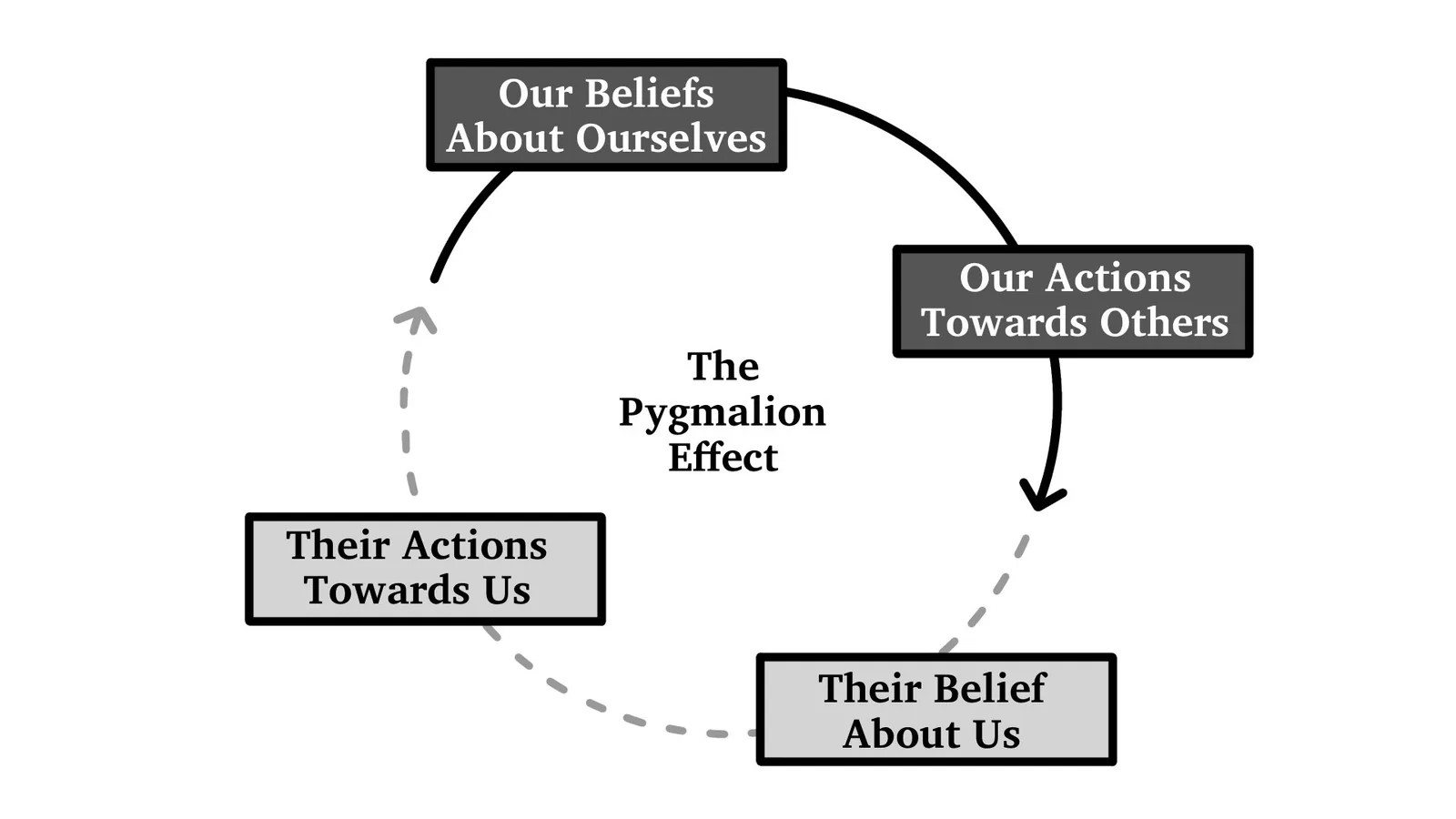
The same thing happens in your career and life. If you surround yourself with people who believe you are capable of more, who encourage you to think bigger and to do more, you will rise to the level of those expectations.
On the other hand, if you surround yourself with people who belittle you, who laugh at your ambitions, who tell you to “be realistic”, you will fall to the level of those expectations.
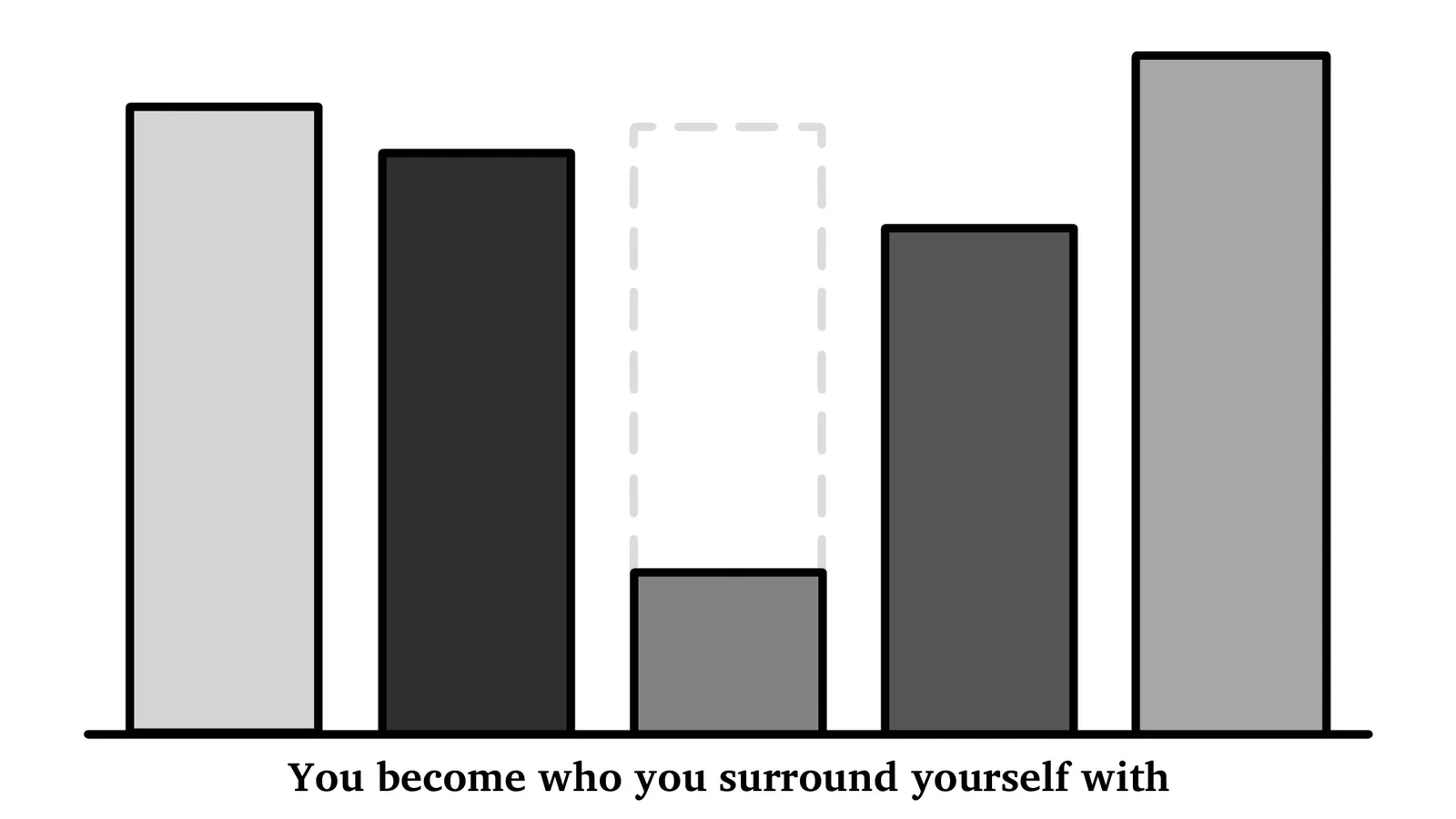
You don’t rise to the level of your potential. You fall to the level of your environment.
When I was in college, I felt myself being pulled to act like everyone else. I watched friends who’d arrived with big dreams start talking themselves out of them. “Maybe I’ll start that business after I get some experience.” “Maybe I’ll move to New York eventually.” “Maybe I’ll start going to the gym when life settles down.”
“Maybe” became the most dangerous word on campus, and I caught myself using it too.
Far too many people underestimate how much their location impacts their life. You can’t live a big life in a small environment. If you stay in the wrong place too long, you start to shrink. You talk like the people around you. You think like them. You want what they want. If no one around you is building something big, taking risks, or pushing for more, neither will you. And it’s not because you aren’t capable, but because you won’t even realize you can.
One of the fastest ways out is to put yourself in a room where you feel like you don’t belong. Where the bar is so high that you’re forced to level up just to keep pace. I like to call this Strategic Stress. Just like you need to put stress on your muscles to grow them, sometimes you need to put stress on yourself to grow yourself.
“Where you live—what city, what country—has more impact on your well being than any other factor. Where you live is one of the few things in your life you can choose and change.” – Kevin Kelly
One pattern I’ve noticed about successful people is that they are obsessive about getting around other ambitious people. People who move fastest in their careers intentionally buy proximity to others who are ahead of them. They understand that proximity is power.
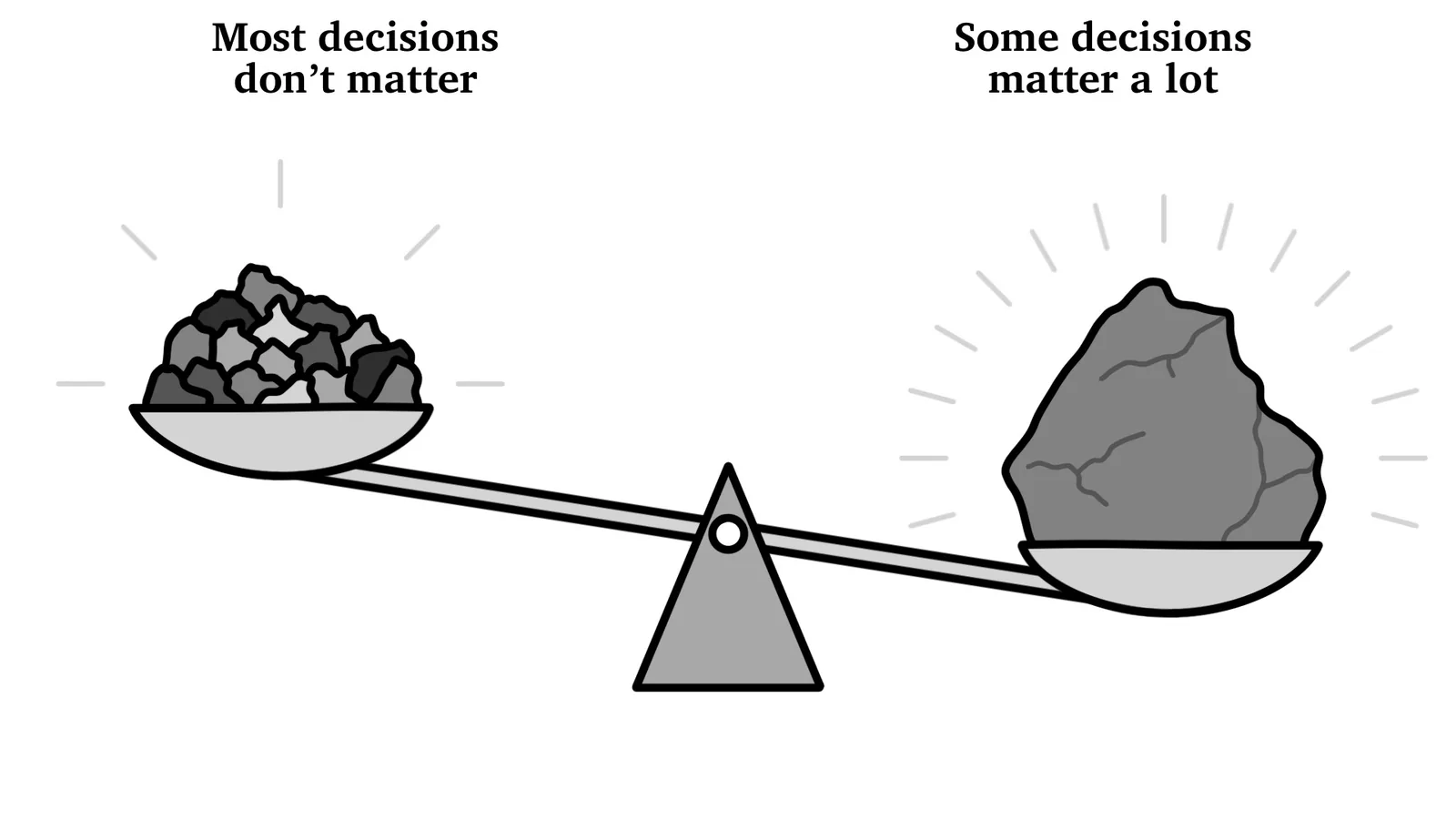
Most of the decisions you make on a daily basis don’t really matter. What you eat for lunch. What flavor toothpaste you choose. Whether to go to the dentist at 2pm or 2:30pm. Tiny stuff that moves the needle maybe 1%.
But every once in a while, you get a decision that acts like a lever. One choice that tilts everything that comes after it. Where you live. Who you work with. What you work on. These are the decisions that change trajectories, and most people don’t treat them with the weight they deserve.
Before Harrison Ford became infamous for his roles as Han Solo and Indiana Jones, he was a college kid from the suburbs of Chicago who took a drama class his last semester to get over his shyness and fell in love with acting. After graduating, he moved to Los Angeles, because if you wanted to make it as an actor, you had to be in Hollywood.
At first, he signed a $150-a-week contract with Columbia Pictures and spent years playing roles so small they weren’t even credited. When the acting roles dried up, Ford taught himself carpentry from books he borrowed from the library to pay rent. He took jobs from people in the entertainment world, building cabinets for Francis Ford Coppola, furniture for Richard Dreyfuss, and a sun deck for Joan Didion. He became known as the “carpenter to the stars.” He couldn’t get acting roles, but he could stay near the people who gave them out.
In 1976, twelve years after Ford first moved to Los Angeles, filmmaker George Lucas was holding auditions for a new science fiction film at Coppola’s office. Lucas had sent a memo to his team saying he would not cast anyone from his previous film, American Graffiti, which Ford had appeared in. But because he was in the building, Lucas asked him to read lines with the actors who were auditioning.
“There was no indication that I might be considered for a part in the film,” Ford said. “I read with about 300 actors, and weeks later, they asked me if I wanted to play Han Solo.”
Opportunity is not evenly distributed. Certain places, industries, and communities act as amplifiers. Silicon Valley for tech. New York for finance. Los Angeles for entertainment. Nashville for country music. These places concentrate talent, energy, and resources in ways that make success significantly more likely. Proximity doesn’t guarantee success, but it puts you in the room where things are happening.
If you can physically move, move. Go where the action is. The discomfort of being the least experienced person in a new room is infinitely more valuable than the comfort of being the most experienced person in the wrong one.
Now, you might be thinking, “Jay, I can’t just pack up and move to Hollywood.” And that’s fair. But here’s the good news: in the digital age, proximity isn’t always physical. You can get in the room through online communities, social media, virtual events, and group chats.
For me, this happened in two phases. When I was in high school, I couldn’t physically move anywhere. I was a teenager living with my parents. So I did the next best thing: I joined digital communities. I got on Money Twitter (and met a ton of entrepreneurs, creators, and people interested in self-improvement). I fought my way into group chats and masterminds (more on how to do this in chapter 9). I surrounded myself with people who were thinking bigger than anyone in my immediate environment, even if it was all through a screen.
Then, when I could move, I did. I dropped out of college and moved to Las Vegas to work with Acquisition.com. Every week, I was exposed to hundreds of business owners. And eventually, I worked my way into our highest level client workshops and dinners.
The jump from digital proximity to physical proximity was like going from watching a game on TV to stepping onto the court. Both are valuable, but nothing compares to being physically in the rooms where things are happening.

In 2001, Jesse Itzler co-founded a private jet card company called Marquis Jet, and he needed his first customer. “I didn’t have a sophisticated way to get leads,” Jesse said. “I had to go where wealthy people were and try to pitch them.” He heard about a conference in Monterey, California called TED, and that a lot of wealthy, qualified people from Silicon Valley would be there. So he booked a flight, connected in Chicago, rented a car, and drove five hours up to Monterey.
When he got there, he realized immediately that they weren’t letting anyone near the conference without a credential. He didn’t have one. So he sat down in a coffee shop across the street and tried to figure out how to sneak into what he called “the room where all the gold is.” Every hour and a half, a wave of people with credentials would come in on break, and they were all ordering the same thing. “Lattes and muffins,” Jesse said. “Lattes and muffins. Lattes and muffins.”
So the next morning, he woke up at 5am, went to the coffee shop, and bought every muffin they had. “I now control all the muffin inventory in Monterey, California,” he said. “And I wait.”
Two hours later, the first wave came in. A guy ordered a latte and a muffin. The cashier told him they were out of muffins. As the guy started walking out, Jesse stopped him. “Excuse me, I overheard you. I happen to have an extra muffin if you want one.”
He looked at the guy’s name tag. Josh Kopelman. Jesse recognized the name from the Wall Street Journal. Josh had just sold his company, Half.com, to eBay. Josh asked what Jesse was doing there. “I have a private jet company called Marquis Jet.”
“You gotta be kidding.” Josh said, “I’m in the market for a private jet. Do you mind if I sit down and learn about your business?”
Josh Kopelman became his first sale. Jesse eventually grew Marquis Jet to over $5 billion in sales and sold it to Warren Buffett’s Berkshire Hathaway.
“That’s not a story about me being a good salesman,” Jesse said. “That’s a story about putting myself in a situation where I could attract luck.”
Opportunity dances with those already on the dance floor. Do everything in your power to get in the rooms where things are happening, whether physical or digital. It’s one of the highest leverage moves you can make early in your career.
People often ask me why I wanted to work with Noah Kagan, and I always tell them: his life resembled the kind of life I wanted to live. He ran a 9-figure company, created content about things that interested him, and seemed to have found a balance between work and fun.
He’d been in the industry for longer than I’d been alive, and I thought that if I could learn from him directly, if I could have some of his operating systems and mental models rub off on me, then that would increase the likelihood that I would be able to live the life I wanted.
In psychology, there’s a concept called Social learning theory that says we learn faster through observation and modeling than through trial and error. By connecting with people who’ve already achieved what you want, you can essentially “download” years of learning in months.
I encourage you to actively seek out opportunities to shadow or apprentice under people who are ahead of you.
Here’s why:
1. Time Compression.
The fastest way to accelerate your career is to get into environments where your dream life is someone else’s reality. They’ve already mapped the terrain and can point out all the poisonous berries and where the fresh water is.
Watching how Noah Kagan prepared for the launch of his book helped me enormously when I launched my own. I saw his process up close: the launch group he built, how he tested the title, subtitle and cover, how he prepared for his podcast tour, the evergreen marketing systems he set up. My first book wouldn’t have become an Amazon best-selling book without the principles I learned working with Noah.
The edge of knowledge can’t be taught in a classroom.
2. Standards.
The quality of your life is the result of the quality of your standards.
When you’re surrounded by people operating at a high level, your standards rise to match. That’s why sports teams keep veterans on the roster even when their playing days are winding down. The standard they set for the younger players is worth more than any play they’d run on the court.
For me, sitting in rooms with people who had built 8- and 9-figure businesses raised my standards in ways I didn’t expect. What once felt like “making it” became the starting line.
3. Access.
Good entrepreneurs and operators are leverage machines. They know people. They see deal flow. They have more ideas than they can execute. A single introduction, profit share, or “Hey, you should run this new thing for us” can completely change your life.
When I worked with Noah, he introduced me to several of his entrepreneur friends. Many of them became my clients when I started my ghostwriting agency.
Apprenticeship is one of the few career slingshots that still exists. An intimate apprenticeship with someone who is living the life you want to live will teach you far more than most classrooms ever will. Even better, they often become a launchpad for future endeavors.
“When the student is ready, the teacher will appear.” – Buddha
Two questions to help you figure out who to apprentice under:
Question 1: Who is living the life I aspire to have?
A wise mentor once told me: “Before you play the game, study the winners. If you don’t want their life, don’t play their game.”
If they don’t have the life you want, be wary of taking their advice. How can they give you a roadmap to a destination they haven’t been to themselves?
Notice that I said life, not income or job title. You want to find someone who’s not only successful by the numbers, but also aligned in how they work, spend their time, and live.
Before writing 12 bestselling books, Ryan Holiday dropped out of college at 19, moved to Los Angeles, and landed a job at a Hollywood talent agency. But instead of climbing that ladder, he left to become a research assistant for Robert Greene, author of The 48 Laws of Power. The work wasn’t glamorous. Most days were spent reading, researching, and organizing thousands of notecards.
Many years later, Ryan’s own research assistant Billy Oppenheimer asked why he decided to give up the more conventional and lucrative path. He replied, “Robert’s life resembled the life that I wanted to live.”
Robert’s day, Ryan said, is spent reading, researching, thinking, making notecards, and engaging with ideas. That, he said, is what he wanted his typical day to look like too.
“So look at the people five to ten years ahead of you in whatever career you’re considering,” Ryan told Billy. “Does their life look like one you’d want for yourself? Are they who you want to be? Because that’s the trajectory you would be on.”
Question 2: Can they teach well?
Albert Einstein won the Nobel Prize in Physics. He gave us the theory of relativity and reshaped how we understand space, time, and the universe. And yet, for as brilliant a man as he was, he was notoriously known as a terrible teacher.
His lectures were supposedly so bad that when a professor traveled to evaluate him for a teaching appointment in Zurich, the lecture he sat in on was, in his words, a complete disaster. The professor wrote a report saying Einstein was unfit to teach.
How could someone so brilliant be so bad at teaching?
There’s a concept called the Curse of Knowledge, which says that the best experts are often the worst guides because the more they know, the harder it becomes to remember what it was like to not know.
Doing something and teaching something are two very different skills. When you’re evaluating a potential mentor, look for someone who is five to ten steps ahead of you, not five hundred. Someone who remembers what it was like to be where you are. Someone who’s in the game right now, not someone who played it twenty years ago.
That said, there is no perfect mentor. Rarely is anyone able to teach you everything about everything. Plus, a bad mentor or manager can teach you a lot about what not to do. Finding the perfect mentor matters less than your ability to learn from anything and anyone.
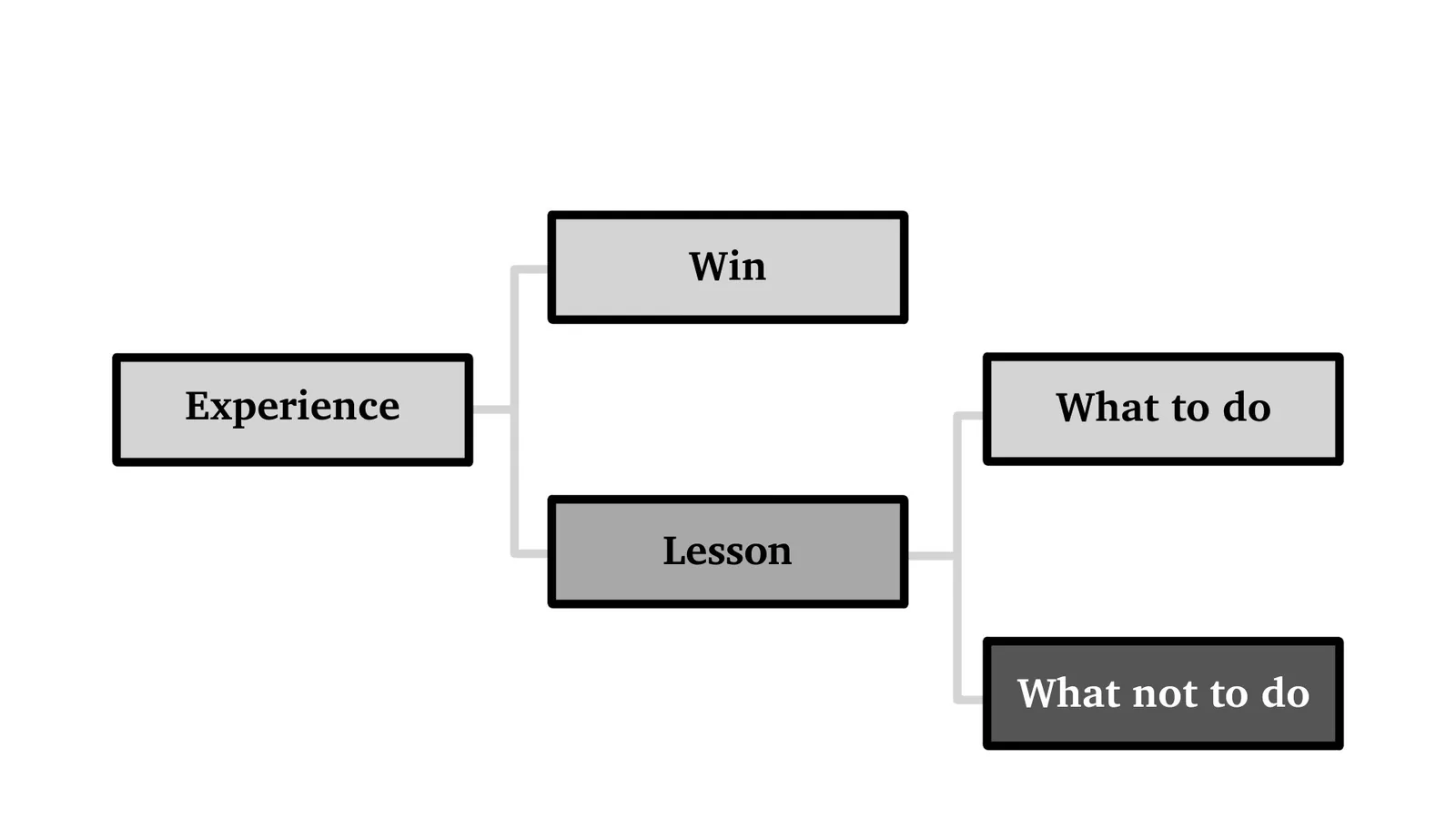
Once you start putting yourself out there, opportunities will come. The question then becomes: which ones do you take?
I weigh career opportunities across four categories: Learning, Earning, Network, & Story.
I rank each one out of ten and add them up. The opportunity with the highest total out of 40 wins.
Learning is about the skills and knowledge you’ll gain.
What are the constraints currently preventing you from getting to your North Star? Does this opportunity help you close those gaps?
Be honest with yourself about what you’re going to learn. It’s easy to tell your parents and friends that you’re joining a company because you’re going to “learn a lot.” But what specifically are you going to learn, and is the role going to give you reps in the thing that’s holding your career back?
For example, say you’re a marketer who’s great at organic and social but has never run a paid media campaign, and you know that’s your missing skill. If you join a company that’s world-class at marketing, but you come in as a salesperson, then you’re getting reps in sales every day, but zero reps in paid media. Not great.
That doesn’t mean it’s a bad opportunity. Maybe it’s the right foot in the door, maybe the network is incredible, maybe the earning is great. But the learning score isn’t an 8. It’s a 3.
Another important caveat is who you will be directly working under. A good company with a bad boss stifles your growth. One factor that led me to scoring Acquisition.com high in the learning category was that I would be working directly under Michael Lim, the Director of Media, who previously worked with MrBeast and was someone that I looked up to as a “career older brother.”
Earning is straightforward. How much money will you make?
Note: this matters much less when you’re early in your career. Money is the byproduct of the value you create in the marketplace, and the best way to create more value is to stack more skills and make yourself more valuable.
Rather than asking “how much money will I make immediately?” I like to ask, “how much will this opportunity increase my future earning capacity?”
That said, don’t sell yourself short. You still need to make enough to not be drowning. If you’re stressed about rent every month, you’re not going to be in a position to learn or do your best work.
Network is the people you’ll work with AND the people you’ll meet because of the opportunity.
Network, other than learning, is the single greatest thing to optimize for when you’re early in your career, because those people will eventually become your future investors, co-founders, employees, customers, and partners.
It’s hard to calculate the benefits of compounding relationships, but I tend to score this one generously.
Story is how well you can leverage this experience to get future opportunities.
For example, working at a prestigious company or on a high-profile project creates credibility that opens doors you can’t see yet.
John D. Rockefeller became the richest man in history (over $400 billion in today’s dollars). But at 25, when he was building Standard Oil in Cleveland, nobody knew who he was.
The oil refining industry was a mess. Dozens of refiners were undercutting each other into the ground, and Rockefeller knew someone was going to consolidate the market. He wanted it to be him. The problem was that he was just another small refiner asking established refiners to sell their life’s work to him.
So instead of going after the small refineries, he went straight for the biggest competitor in Cleveland: Clark, Payne & Co. And he overpaid for it on purpose. The seller laughed and walked away thinking he’d fleeced an ambitious kid who didn’t know what things were worth.
But the day the deal closed, Rockefeller was now the largest oil refiner in Cleveland, and over the next twelve months, 22 more refineries sold to him.
Your personal narrative and story are one of the most undervalued assets you have. People make decisions about you before they ever meet you, and your story creates ripples in the room even when you’re not there.
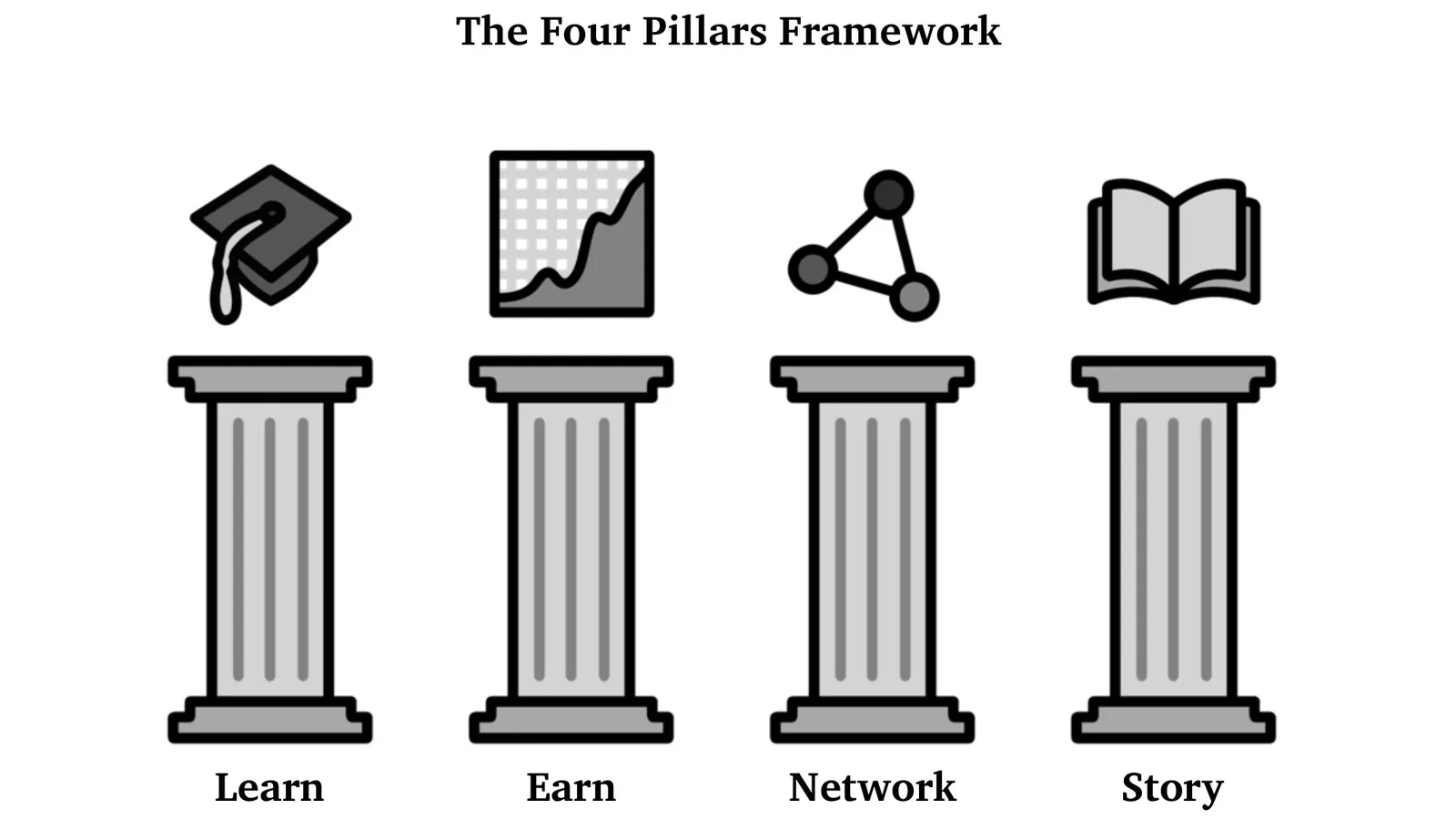
How I used The Four Pillar Framework for my life:
When I was deciding whether to drop out of college and join Acquisition.com or stay in school and continue running my ghostwriting agency, I sat down with a notebook and wrote out these four columns.
My current path looked like this:
Total: 17.
Acquisition.com looked like this:
Total: 30.
I added up the scores and compared them to my current path. Acquisition.com won.
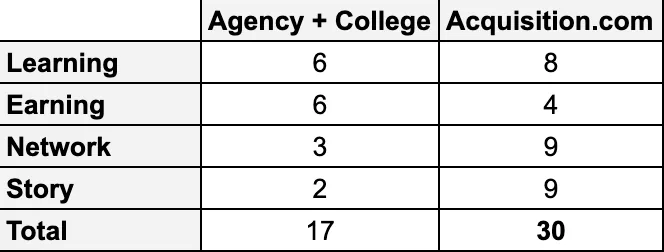
What I liked about that process was that it was black and white. I had a lot of emotions pulling me in different directions. I looked up to Alex and Leila and didn’t want to disappoint them. I was also terrified to drop out of college and leave my friends.
A few caveats before you start scoring your own opportunities:
These four categories are what matter most to me at this stage of my career, given my North Star. They don’t have to be yours.
Maybe proximity to family matters more right now because you’re caring for someone at home. Maybe values alignment is high on your list because you need to believe in the mission to do your best work. Maybe you’re about to have a kid and you want to make as much money as possible beforehand. The exact categories matter less than defining them for yourself.
Pro Tip: If you need help defining your categories, go back to your North Star. Whatever you wrote down in that exercise is telling you what to optimize for.
Here are 8 example categories that you might prioritize (shoutout Andrew Yeung for curating this list):
The categories also don’t have to count equally. When you’re early in your career, learning and networking probably deserve more weight than earning, because the skills and relationships you build now are what drive your earning later.
Does that mean you should completely ignore your emotions and intuitive sense? Of course not. Making a decision that looks good on paper but feels bad in your body often leads to regret. But if you don’t know how you feel (or feel too many emotions), this is a great starting point.
Note: When evaluating a new opportunity, don’t forget to evaluate your current path.
We humans have a tendency to get Shiny Object Syndrome: a tendency to chase new ideas while abandoning current, worthwhile, but less “shiny” endeavors.
We believe “the grass is greener elsewhere” because going from 0-1 on a new path feels easier than going from 1-10. But as the essayist David Perell once wrote, “A life without commitment is a life spent hugging the X-Axis.”
If you commit to nothing, you’ll be distracted by everything.
Harsh truth: Your inability to focus on one thing for an extended amount of time will hurt you far greater than your lack of intellect.

Pro Tip: If you’re struggling to make a decision, write an objective memo of the pros and cons of an opportunity as if you were updating the board members in your life.
Kidlan’s Law states that a problem written down is half solved. Before dropping out of college to work at Acquisition.com, I wrote a 5-page memo to my parents explaining why I thought it was a good decision.
Side tangent: If you want to “convince” your parents that they should let you drop out, focus less on rhetoric (stories and emotion) or even logic (reasoning and frameworks) and more on evidence (past results).
When people have emotional investments in their beliefs (like your parents wanting you to take the “safe” path), logical arguments often backfire because it’s all theoretical. Evidence, however, bypasses these issues and offers concrete proof that it’s a viable path.
For me, rather than arguing with my parents about why entrepreneurship was viable, I made $100,000 in personal profit before I graduated high school. That showed them the default path wasn’t the only one.
Your loved ones don’t want to control you. They want to protect you. If you can show them your “risky” path is viable by demonstrating competence over time, you remove the perceived risk of dropping out.
Again, do the work upfront so you can show instead of tell.
If you want a template of how to structure your memo, grab it below:
Get the free Work With The Best bonuses →
One of my friends wanted to be a surgeon. She loved everything about the idea: the prestige, title, and respect. But when she shadowed a surgeon, she threw up because she couldn’t stand looking at all the blood. She liked the idea of being called a doctor, but didn’t like the day-to-day reality of being one.
I call this: Title Work vs. Actual Work. A lot of people, myself included, fall in love with the idea of a career more than the career itself. But the day-to-day work is what makes up your career, not your title.
That’s another reason why I love apprenticeships and shadowing. They let you experience what the actual day-to-day work looks like before you commit to it. You get to see the unglamorous parts. The late nights, tedious tasks, and parts nobody posts about on social media. And if you see all of that and STILL want in, then you’re in the right place.
A few questions to figure out if you love the work or just the idea of it:
A young man once asked Mozart how to write a symphony.
Mozart replied, “You’re too young to write a symphony.”
Frustrated, the man shot back, “But you were writing symphonies when you were 10, and I am 21!”
Mozart smiled and said, “but I didn’t run around asking people how to do it.”
When most people think of getting a mentor, they picture a formal relationship. You ask someone, “Hey, will you be my mentor?” They say yes, then you meet once a month for coffee and talk about your career. But that’s not how the best mentorships often work.
The best mentors I’ve had weren’t people I asked to mentor me. They were people who saw me trying something in public, offered feedback, and watched what I did with it. I took action on their advice, came back with results, and asked for feedback again. They saw that I was serious, so they kept helping.
The majority of the successful people I know are extremely willing to help those around them (especially underdogs). But they’ve also learned that not everyone is worth their time and energy.
If someone gives you advice and you never act on it, why would they give you more?
I heard a good analogy for this from Sam Parr. Not many people would stop for someone whose car broke down on the highway, standing around doing nothing. But more people would stop for someone pushing their car. People love people who are working hard and taking initiative, even if they’re struggling.
So how do you show momentum?
Don’t ask for advice. Ask for feedback on your attempts.
X “How do I start learning copywriting?”
✓ “I’ve been doing copywork for the last 6 months, but I’m still struggling to nail my headlines. Do you have any good resources to learn how to write attention-grabbing headlines?”
X “How do I get in shape?”
✓“I’ve been running push-pull-legs for the last year but I can feel myself plateauing. How would you tweak my programming to break through?”
X “How do I grow on social media?”
✓“I’ve been posting every day for three months and I’m stuck at 500 followers. Here are the hooks from my last 3 posts. What would you change to improve them?”
See the difference? The first version of each question tells the other person you haven’t started yet. The second version tells them you’re already in the game and just need a nudge in the right direction.
The formula for finding a mentor:
1) Ask for specific feedback
2) Actually follow the feedback
3) Report back on the result
4) Repeat
Remember: Don’t ask for advice. Ask for feedback on your attempts.
Speaking of asking for feedback… if you’ve made it to this part of the book, I’m going to take a wild guess: you don’t hate it. In fact, you might even be enjoying it?
Modern books live and die by one thing - Amazon reviews. According to research from Northwestern University, just 5 reviews can make a book 270% more likely to be found by readers.
So, if this book made you pause, think, or hopefully (please say yes, please say yes) take action, I’d be thrilled if you’d leave a review.
It only takes a minute, and I’d be eternally grateful. Here’s how:
Here are some kind things beta readers have said about the book:
“I recommend Jay’s first book so often, I keep it on my desk at all times. This book will be right next to it. The value-to-word ratio of what Jay shares is insane. Equal parts insightful, quotable, and tactical. It feels like you’re sitting down with Jay at a cafe–having a deep conversation with a friend.”
– Dr. Corey Wilks (Executive Coach)
“This gave me goosebumps. It’s fantastic. I know you’re going to want to make a million little tweaks - that’s just who you are - but just know that this book is going to change lives in a big way. Every time I have logged into this Google Doc to read, you’ve been in here editing. It’s been a pleasure to see you be so obsessed.”
– Stetson Stallworth (Media Strategist)
“I keep reading it, journaling, then going for walks. I’ve done that a few times today. It’s so good. I’m absolutely loving it so far. You should be sooooo proud of yourself. This is going to impact so many people.”
– Brooke LeBlanc (Head of Community at Corgi)
Your support means the world… and it means more ambitious people will read these ideas… thank you for reading!
“It had long since come to my attention that people of accomplishment rarely sat back and let things happen to them. They went out and happened to things.” –- Leonardo da Vinci
In 2023, Andrew Fine and Jimmy Johnson were trying to land their first client for a new social media agency. They made a list of dream clients, and near the top was Jesse Itzler (remember him from chapter 7?).
Jesse is a billionaire who co-founded Marquis Jet, owns part of the Atlanta Hawks, and is married to Sara Blakely (the founder of Spanx). He gets pitched constantly, which meant email likely wasn’t going to work.
So Andrew and Jimmy committed to doing something different. They spent over 30 hours studying everything they could about Jesse. They read both of his books, listened to his podcasts, and watched his talks. They noticed two messages came up repeatedly: urgency, and maxing out your life.
So they cut a short video with clips of Jesse, in his own words, talking about those values, followed by Andrew and Jimmy saying: “You can be impacting millions more people, but your social media isn’t doing that. We want to help you.”
They bought an iPhone, loaded the video onto it, and put it in a custom wooden box. Then they flew to Minneapolis, where Jesse was speaking at an event, and handed him the box on stage in front of the audience.
At first, Jesse thought it was a bomb.
His creative director reached out the next day. Andrew and Jimmy landed their first client. Over the next two years, they ran the same playbook for Scott Galloway, David Senra, Mark Manson, and many others.
“There’s a lot of alpha in doing more than other people are willing to do,” they later said. “Once a year, we try to do one thing so crazy it could change the whole business if it lands.”
In The Third Door, author Alex Banayan eloquently wrote:
“Life, business, success… it’s just like a nightclub.
There are always three ways in.
There’s the First Door: the main entrance, where the line curves around the block; where 99 percent of people wait around, hoping to get in.
There’s the Second Door: the VIP entrance, where the billionaires, celebrities, and the people born into it slip through.
But what no one tells you is that there is always, always… the Third Door. It’s the entrance where you have to jump out of line, run down the alley, bang on the door a hundred times, crack open the window, sneak through the kitchen–there’s always a way.”
The traditional approach to getting an opportunity is outdated. You go to college, get good grades, earn your degree, apply to a company through their website, fill out the application, hope they respond, attend an interview, try to sell yourself, and pray that you get an offer. It’s slow, unguaranteed, and honestly, not that effective.
On the other hand, there’s another approach that nobody tells you about. The one I’ve used for my entire career to get what I want.
I call it The Permissionless Approach.
Instead of applying through the front door and waiting in line with everyone else, you take the side door.
You identify the person or company you want to work with, figure out what they need, and create proof that you can deliver it (without asking for permission or approval). Then you hand it to them and say, “Here. I already did the work. If you love it, let’s talk. If not, no harm, no foul.”
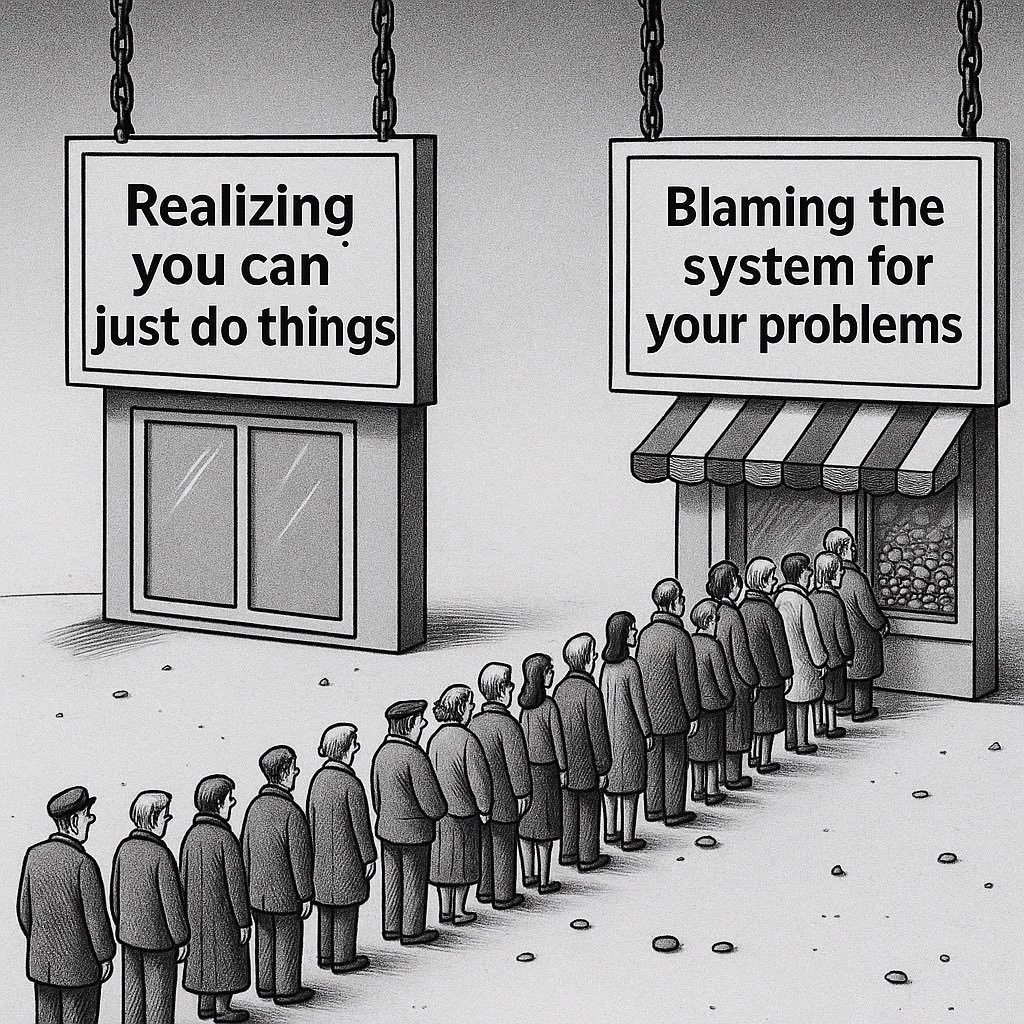
See how there’s no one in the other line? That’s because they’ve already gone through the side door ;)
This framework comes from Charlie Hoehn, who used this exact strategy to become the director of special projects and right-hand man to bestselling author Tim Ferriss.
TAG stands for: Target, Audit, Gift.
Target. The first step is to pick your target. Choose a company or individual whose work excites you, whose values align with yours, and whose success you want to amplify. If you don’t care about what they’re building, it’s going to show.
We talked in earlier chapters about how to identify who you want to work with and what kind of opportunities to chase. This is where that clarity pays off.
Quick summary:
Audit. Next, audit their work. Spend hours (if not days) diving deep into what they’re doing. Figure out where they’re falling short.
Here are 5 places to do your research:
1- Dive into past conversations. Search for podcast appearances, interviews, and articles featuring your target person or company. Pay attention to moments where their energy spikes. Look for gaps in the conversation, places where the interviewer moved on too quickly but there was clearly more to say.
2- Use Twitter (X) like a pro. Twitter is a goldmine for raw, unfiltered thoughts, especially from entrepreneurs. Use advanced search tools or search parameters like “from:@handle min_faves:100” to surface their most significant tweets.
3- Go beyond the first page of Google. Most people never do this. But the juiciest insights come from where most people don’t bother to look. Use creative searches like “[name] + college” or “[name] + early career” to uncover hidden connections and unique angles for your pitch.
Here are a few more creative searches that I like:
4- Explore the archives. Platforms like YouTube have filters that let you watch someone’s oldest videos first. Their early work often reveals their original vision, unpolished experiments, or forgotten priorities. These insights can give you a fresh perspective that others may miss.
5- Leverage your network. Reach out to someone in their orbit, a former colleague, a friend, or a past collaborator. Ask thoughtful questions like, “What’s something they’re passionate about that doesn’t come up often?”
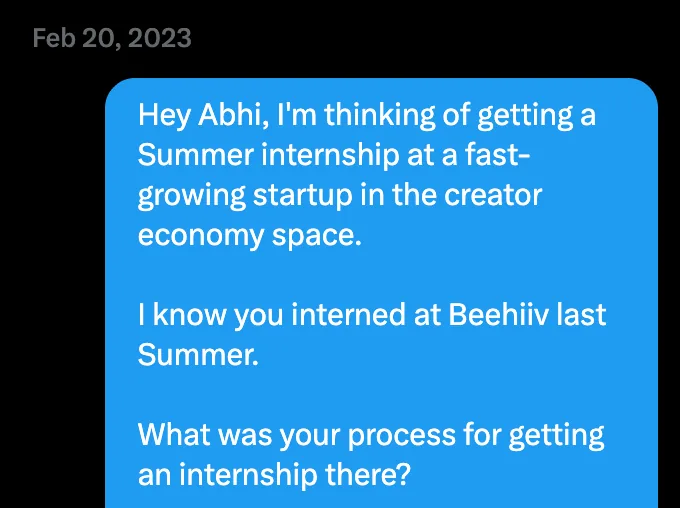
How well you prepare, shows how much you care.
When Sarah Graves enrolled at the University of Texas as a finance major in 2022, her basketball days looked like they were behind her. But a month in, she realized she couldn’t give it up.
So she decided to try out for the Longhorns. She searched “Vic Schaefer coaching” online and found out that head coach Vic Schaefer sold a $70 coaching manual online meant for other coaches. She bought it with her own money and spent weeks studying his plays, drills, and system.
By the time she showed up to her first practice, she already knew the plays. “Sarah had studied my playbook,” Schaefer later said. “When she went through a workout, she knew most of it.”
She made the team, and by her senior year, fans were chanting her name during the NCAA March Madness Tournament games.
“When did the label ‘Try-hard’ become embarrassing?,” Sarah said. “I think it’s a compliment.”
Gift. Finally, offer them a gift. Don’t just tell them you’re the right person. Prove it by doing the work in advance. Create a prototype, draft a proposal, map out a strategy, make a pitch deck. Show them how you can solve a problem they didn’t know they had or help them achieve a goal they’ve been struggling with.
A few examples:
How to work for a billionaire
In 2018, Jeremy Mary got a job with Tom Bilyeu, co-founder of Quest Nutrition. The craziest part? Jeremy had no formal experience in social media. Instead of applying the traditional way, he spent two weeks studying everything he could find about Impact Theory, Tom’s media company, before he reached out. He built a portfolio from scratch, t-shirt designs for their store, lead magnets for their email list, social media assets ready to publish, and then bought the domain IWantToWorkForImpactTheory.com and put it all together into one pitch. Tom responded personally within 24 hours.
How to turn a part-time gig into a full-time role
When I was at beehiiv, we had a visual animator named Pri Sarmah who was based in India, working with us as a contractor. He wanted to come on full-time, so he built a website making his case: his work for the team, why he’d be a great hire, and testimonials from teammates who had worked closely with him. He made it easy to say yes. He got the full-time offer.
How to show up to an interview
When I was at Acquisition.com, we were hiring for a senior growth marketer. One candidate stood out before he even walked in the room. He had dug into our ad strategy, identified 3 specific things he would change, and built a website laying it all out. When he came in, he presented his findings. He made it easy for us to think, “Okay, this guy knows what he’s talking about.” He got hired.
How to break into an industry
Ish Verduzco had no connections in tech. To land his job at LinkedIn as an inexperienced 22-year-old kid, he designed a custom newsletter styled after the New York Times and wrote it entirely around the job description, then showed up to his interview with a printed resume built for that role. He later took the same approach at Snapchat and a16z, building a custom website and case study for each company he applied to. He’s now the head of social at Notion.
How to work with your favorite creator
In 2021, Michael Lim was a management consultant who wanted to take his career in a more creative direction. He thought it might be fun to work with some big creators, so he pitched MrBeast (the biggest YouTuber on the planet) to create a job for him. Michael wrote a rap song, hired a rap coach on Fiverr (yes that’s a thing), choreographed a full music video to it with multiple sets, costumes, props, and dancers, posted and tagged MrBeast on Twitter. It worked. He was brought on as the founding creative director for the Beast Philanthropy YouTube channel and helped build it to 8+ million subscribers.
How to go from employee to CEO
In 2015, Ayman Al-Abdullah wanted to work at AppSumo. On the side, he was doing work with Charlie Hoehn, so he asked Charlie for an intro to Noah Kagan. Charlie’s email said: “Hire this guy before I do.” Ayman also recorded a short video pitching himself for a role. It was funny, loose, and full of personality (exactly the kind of energy Noah was known for).
But by the time Noah called him back, the job was gone. The rest of the team had moved on to a new venture called SumoMe. “I think AppSumo has a ton of meat left on the bone,” Ayman told Noah. Noah gave him a two-week trial. Still working his full-time job at Microsoft, Ayman closed two deals and got the job. Over the next six years, he rebuilt the team from scratch and grew AppSumo from $3 million to over $80 million a year. Badass!
So much of getting opportunities comes down to answering one question: how can I make this a no-brainer for the other person?
Most people reach out to their target and say, “How can I help?” or “I’ll work for free.” And they think that’s being generous. But they’re putting the burden on the other person to figure out who they are, how they can help, and whether they’re worth the time.
If you want to increase the likelihood that someone says yes, do the work up front. Show them that you both WANT the opportunity and that you can CRUSH the opportunity.
For me, I gravitated toward pitch decks because they were the best way to show a lot of work in a structured format. They were visual, skimmable, and easy to flip through quickly. But the format matters less than your effort.
In 2008, Barbara Corcoran got a call asking if she wanted to be on a new TV show called Shark Tank. She signed the contract without even reading it, told everyone she knew, and went out and bought expensive luggage for the trip.
Two weeks before filming, the phone rang again. They’d changed their mind. They were giving her seat to another woman.
She sat down and wrote an email to producer Mark Burnett. The subject line was “Still Swimming.” Instead of begging for her seat back, she proposed something better: fly both of us out and let us compete for the seat. Your show will be stronger if you see us side by side. At the bottom of the email, she wrote, “I’ve booked my flight for the 6th and hope to be on that plane.”
Burnett read the email and invited her to compete. She won the seat. 17+ years later, she’s still on the show.
What I love about that email is that Barbara made it easy for Burnett to say yes by framing her ask around what he needed, not what she wanted. “Your show will be better with both of us there” is a fundamentally different pitch than “please give me another chance.”
Here’s the email she wrote:
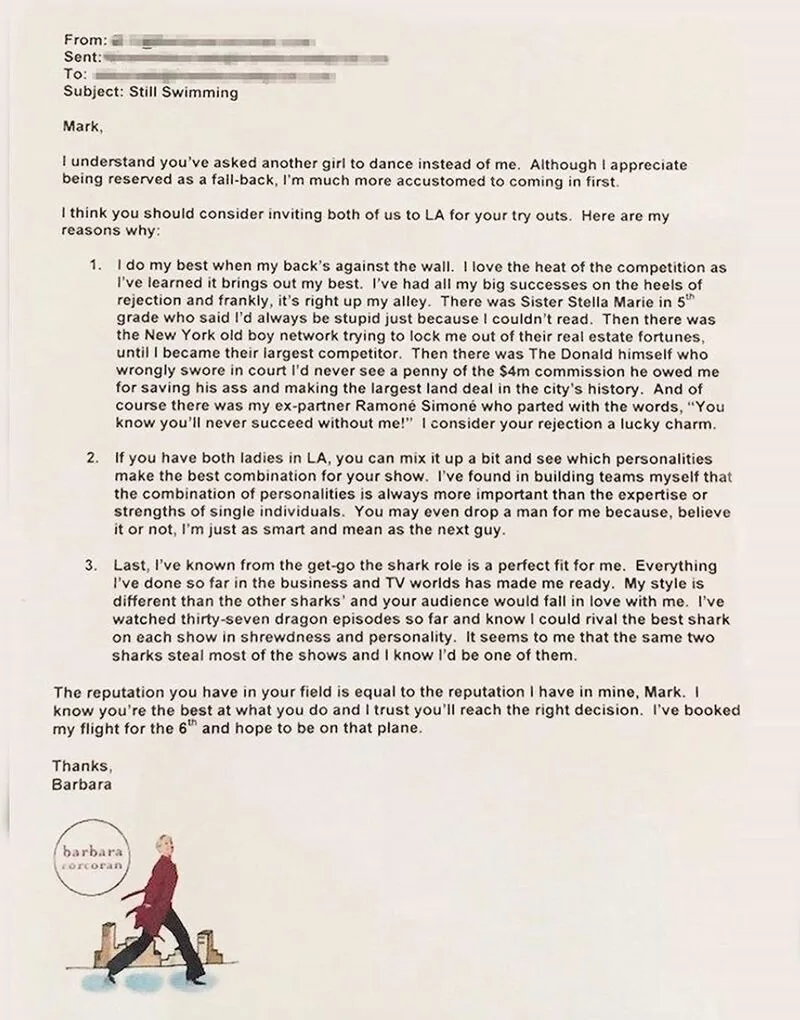
Here’s how I applied the TAG Method when I pitched Noah Kagan:
Target. I found out that Noah was looking for help growing his newsletter in preparation for his book launch (I talk about how I found out in the next chapter). I had followed him on Twitter and watched a ton of his YouTube videos, so I was familiar with his work and knew his career was the direction I wanted to go.
Audit. I didn’t know Noah’s background that deeply, so I spent about 50 hours researching everything I could about him and his business.
I Googled “Noah Kagan”, scrolled all the way down, and went to the 2nd and 3rd pages of results. I watched his oldest videos on YouTube from over a decade ago. I listened to the podcast interviews he went on. I figured out the backstory of AppSumo, the key people in his life, his best friends, things people had said about him, things he’d said about himself in old interviews. I wanted to understand how he thought, what he cared about, and what his priorities were.
Then I audited his newsletter from top to bottom. I asked myself, “If I had this job, what would be the first thing I do to put together a strategy?”
I tried to answer every question I could think of:
I pulled the SimilarWeb data on his traffic sources. I looked at what percentage of his traffic was coming from each platform. I could see that Twitter and LinkedIn had a ton of room for growth that he wasn’t taking advantage of.
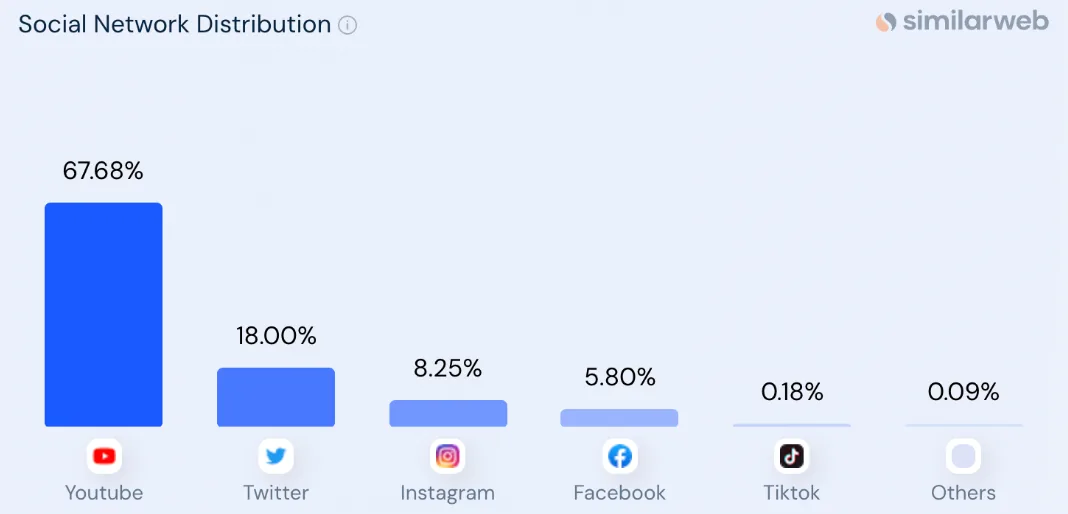
I also studied his content across every platform. What type of content was he posting? How often? What was getting engagement and what wasn’t?
Gift. Once I had all the research, I needed to turn it into something Noah could look at and immediately understand. So I built a 19-slide deck in Google Slides. It was purposely scrappy-looking because I knew Noah valued people who were real and approachable (not corporate and button-upped). I made it visual and skimmable because I knew he was a busy guy who probably wouldn’t read a 10-page memo.
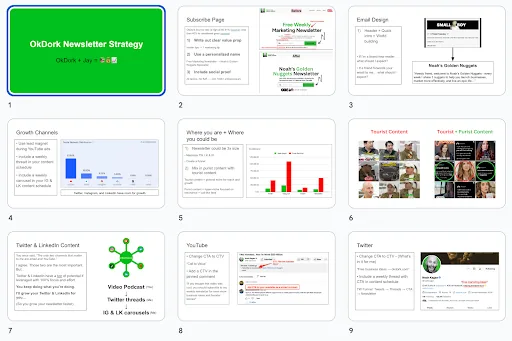
Then, to remove any remaining doubt, I created 9 pieces of ready-to-publish social media content that he could post right away to test whether I knew what I was talking about.
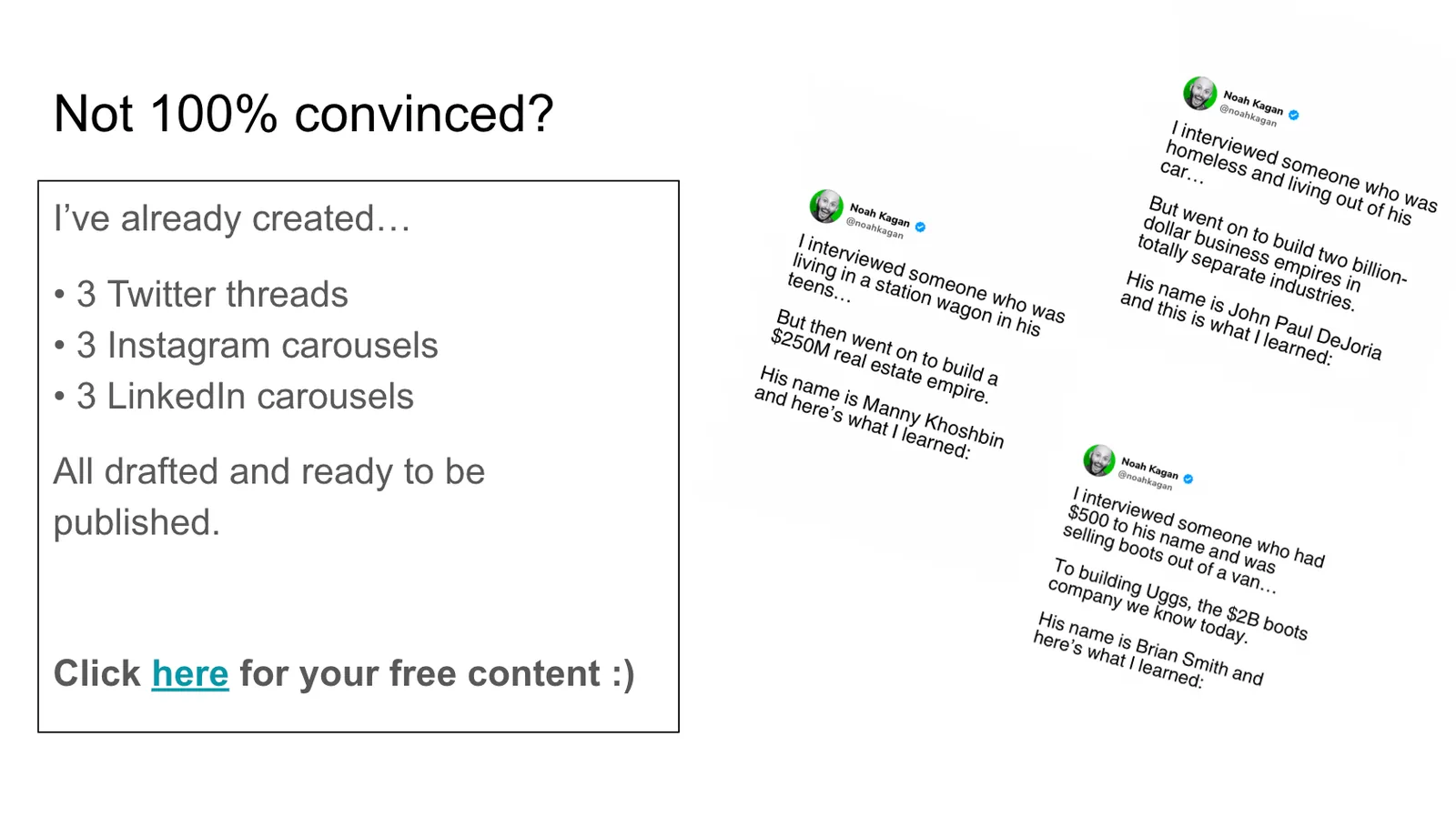
He loved it. I became his Head of Content at 17 years old.
If you want to download the pitch deck, grab it here:
Get the free Work With The Best bonuses →
Now, you might be thinking, “This sounds amazing, but it also sounds like a ton of work. I’d rather just apply to a bunch of internships and not have to think about it.”
I get it. It IS a lot of work. I don’t recommend using this process for just anyone. The most important part of the TAG method is the T: picking the right target that aligns with your North Star.
But for anything in life, it’s not just about what you achieve. It’s about who you become in the process.
If you know that you are the product, and the goal is to make yourself as valuable as possible, then doing the work upfront serves you regardless of the outcome.
All the research, analysis, strategizing, and structuring… that makes YOU better. Even if the person says no, you’ve sharpened skills that will serve you the next time.
A question I like to ask myself before I take on an initiative: how can I win even if I lose?
Even if Noah had said no, I still would have done:
All of that would have made me better and more prepared for the next opportunity.
I also could have taken the structure and research from that pitch deck and adapted it for someone else. Your work isn’t wasted. It’s transferable.
You’ve also proven to yourself that you can ask, which to me might be one of the most powerful belief shifts in the world.
The point is, there’s no downside. It’s an asymmetric bet with limited risk and unlimited upside. That’s a bet I would take every time.
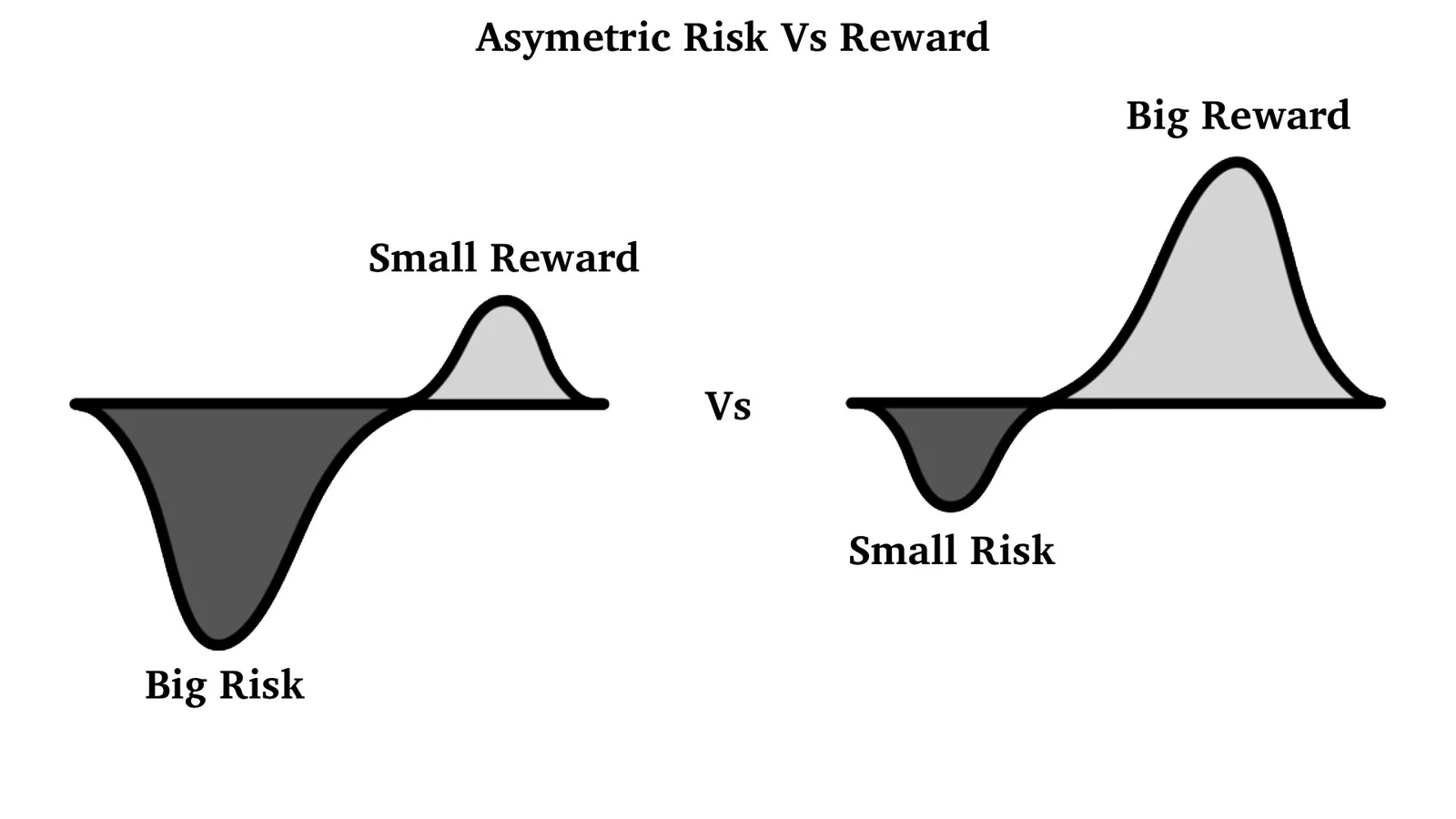
Now that you know how to use the TAG method to create value, the next question is: how do you get your work in front of the right person?
I’ve spent a lot of time thinking about this, and I’ve boiled it down to four ways to get in front of someone. Every opportunity I’ve ever gotten, fits into one of these four categories.
I call this The Contact Quadrant.
There are only two types of people in the world: people you know and people you don’t. Friendlies and strangers.
There are only two ways to reach out to people: In public or in private. 1:1 or 1:many.
Let’s go over each of them.
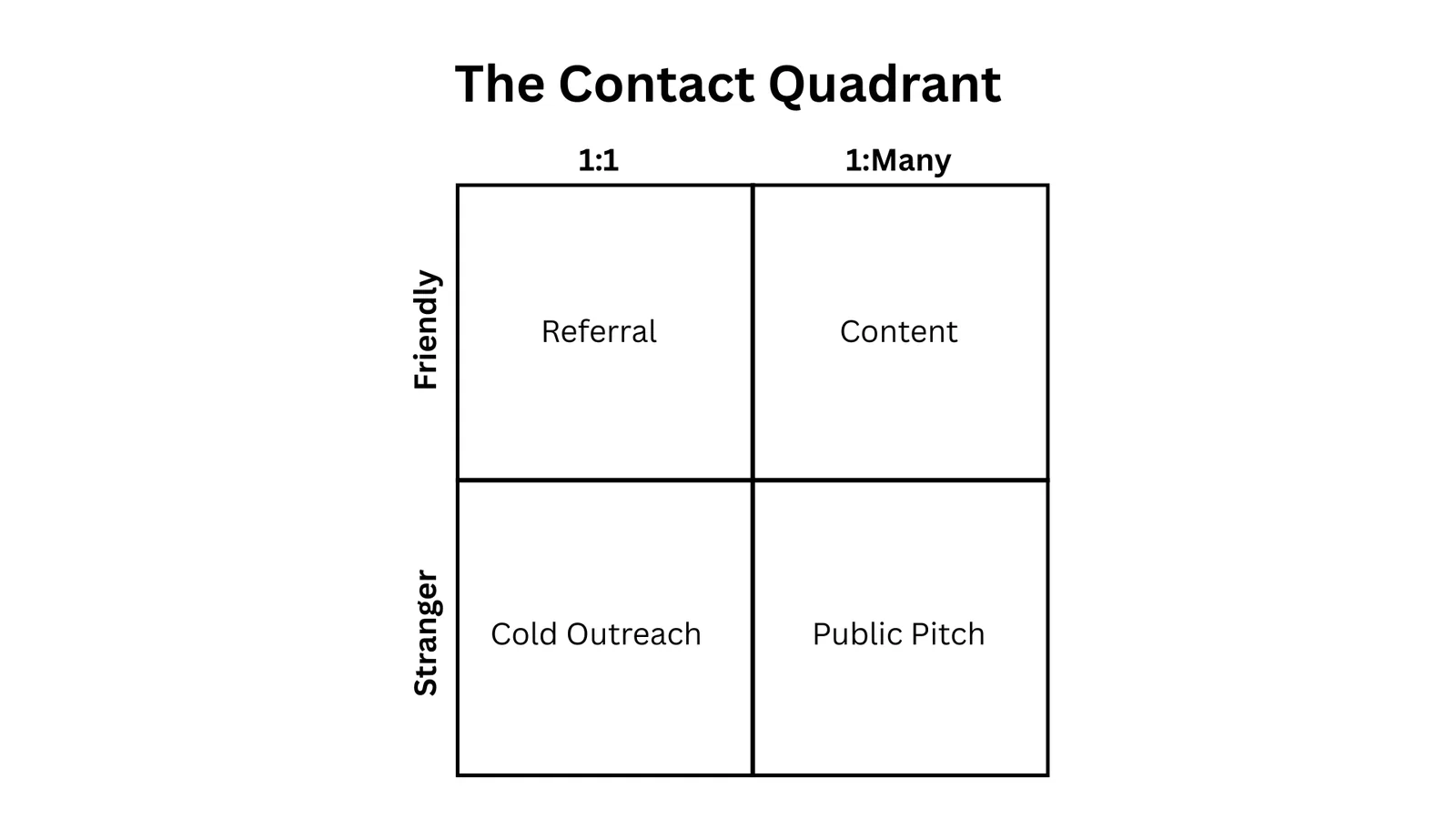
“You can have everything in life you want, if you will just help other people get what they want.” – Zig Ziglar
“If you light a lamp for somebody, it will also brighten your path.” — Gautama Buddha
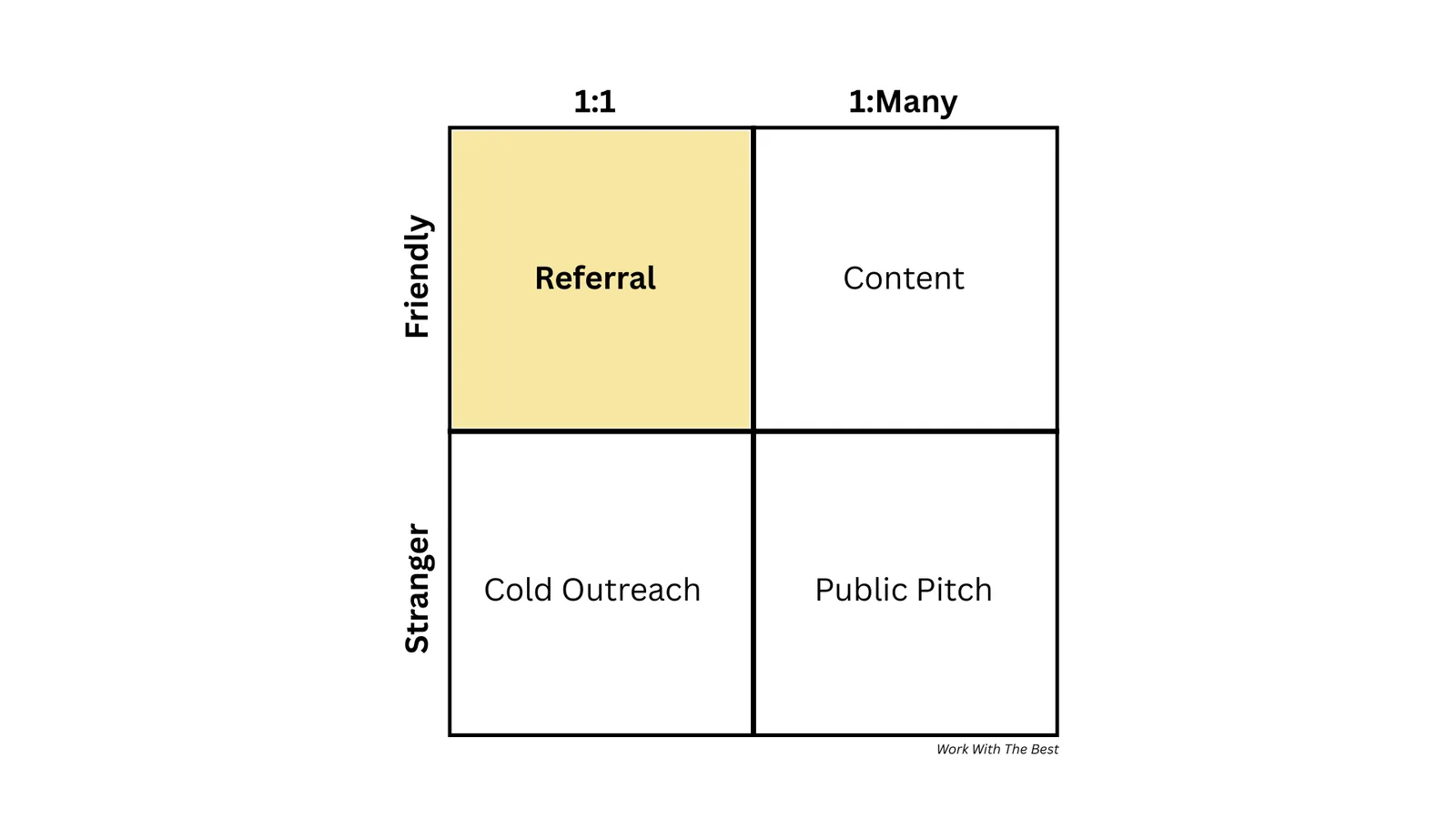
A referral is where someone you know introduces you to the person you want to meet. It’s the most effective way to get in front of anyone, and it’s wildly underused by people who think they need to do everything on their own.
How to ask for a referral:
Once you’ve picked your target, do some research and see if you have any mutuals.
The mistake most people make when asking for an introduction is simply saying, “Hey, can you connect me with so-and-so?”
But that puts a lot of burden on your friend to figure out what they should say to the person you want to reach out to, how to frame it, whether it’s worth doing it, etc.
Instead, write the message that they can send to your target for them. Make it easy for them to say yes.
An introduction is borrowed trust. You want to make your friend look good, because otherwise they probably won’t refer you in the future.
Use this:
Hey [friend’s name], quick question. Do you know [target’s name] well enough to intro me? I’ve been following what they’re doing at [company] and I think I could help them with [specific thing].
If you’re down, here’s something you can send them:
“Hey [target’s name], my friend [your name] wanted to chat. They’re really good at [skill] and had some suggestions on [specific thing]. Thought you two would get along great. Open to an intro?”
Once you get the connection, you can send a message like this:
Thanks for the connection, [friend’s name]! Nice to meet you, [target’s name], I’ve been following [company] for a while and I put together a few ideas on [specific thing]. [Attach the ideas]
Pro tip: never underestimate the second in command. You don’t always need a direct line to your target. Sometimes the most powerful person to know is the chief of staff, executive assistant, assistant coach, head of content, etc. These are the people who have the decision-maker’s ear, and they often have way more influence over who gets in the room than you’d think.
Plus, it increases the chances you get a response. Many people reach out to famous people. Maybe 1% of those people reach out to their #2.
When I wanted to work with Noah Kagan, I didn’t cold email him out of nowhere (there was a super low likelihood he saw it). Instead, I messaged Jeremy Mary, who was Noah’s YouTube creative director. Jeremy read my pitch deck and sent it to Noah (I’ll explain how I met Jeremy in the next section).
If you have a connection, even a loose one, use it. Ask for the introduction. There’s no nobility in making things harder than they have to be. You can cut your lawn with scissors, but that doesn’t make you a better person. If you have an advantage, use it. The worst that happens is they say no.
One of my favorite examples of this comes from Bryan Harrison who was trying to land his first job out of college. He knew what he wanted to do and he knew which company he wanted to do it at. So he went on LinkedIn, searched for employees at that company who had gone to his same university, and found three. He messaged all of them asking for a quick informational conversation.
“Of the three, one responded,” Bryan said. “They sent me the VP of HR’s email and said to call them in the next hour. I had a brief Zoom call, which I had already prepared for by learning as much about the company as possible. I had an interview the next week and a job offer emailed by the time I got back home.”
The connection that got him in the door wasn’t a close friend or a family member. It was a stranger who happened to be an alumnus at his same school.
This works for products too. In 2016, an Australian bikini brand called Triangle wanted Kendall Jenner to wear their product. They knew that if she wore it, they’d blow up. But Kendall Jenner gets a million inquiries a day. They couldn’t get to her directly.
So they went around her. They identified her circle of friends (the ones who weren’t quite as famous) and sent each of them free bikinis. Ten of Kendall’s friends all started wearing Triangle bikinis because they liked them. Eventually, Kendall’s team reached out to Triangle and asked if they could send some her way. Her friends were all wearing them and she wanted in.
Pro tip: The best time to dig the well is before you’re thirsty. Similarly, the best time to build a network is before you need it.
Permissionless Challenge: Make a list of 10 people who could change your life if only they paid more attention to you or knew about you. What can you do to get in front of them?
How do you do this in practice? There’s a concept I love called pebbling. When male penguins want to show affection, they search for the perfect pebble and offer it to their mate. If it’s accepted, it becomes the first stone in the nest they’ll build together.
I’ve always loved that image because it shows that even the strongest relationships start with something small. In practice, a pebble can look like:
These pebbles often take less than a minute to send, but they compound over time. When you’ve been sending pebbles back and forth for months or even years, reaching out for an introduction doesn’t feel like a cold ask. It’s just two friends helping each other out.
Here’s an example of a pebble that I sent to a friend because he had recently moved to San Francisco:
On a similar note, if you think something nice about someone, tell them.
One of the things that makes me sad about funerals is the eulogy. Everyone takes turns saying these incredible things about the person who passed away, but that person never gets to hear any of it. Why do we wait until someone is gone to tell them how much they meant to us?
Same thing with friends. We talk positively about them behind their backs all the time but rarely say it to their face.
Pretty much every day now, whenever I think of something nice about a friend or someone who’s been on my mind, I tell them. It can be as simple as, “Hey, thought about you the other day. Keep crushing.”
Let people know they’re on your mind and that you care about them, because otherwise they won’t know.
I call this “Luck Farming.” Life becomes a real-life video game when you view your actions as seeds. Every compliment, shoutout, and “pebble” is another seed planted. And the coolest part is you have unlimited seeds to plant. Spread them liberally. Forget how, when, or if they’ll sprout and you’ll be pleasantly surprised every time they do.
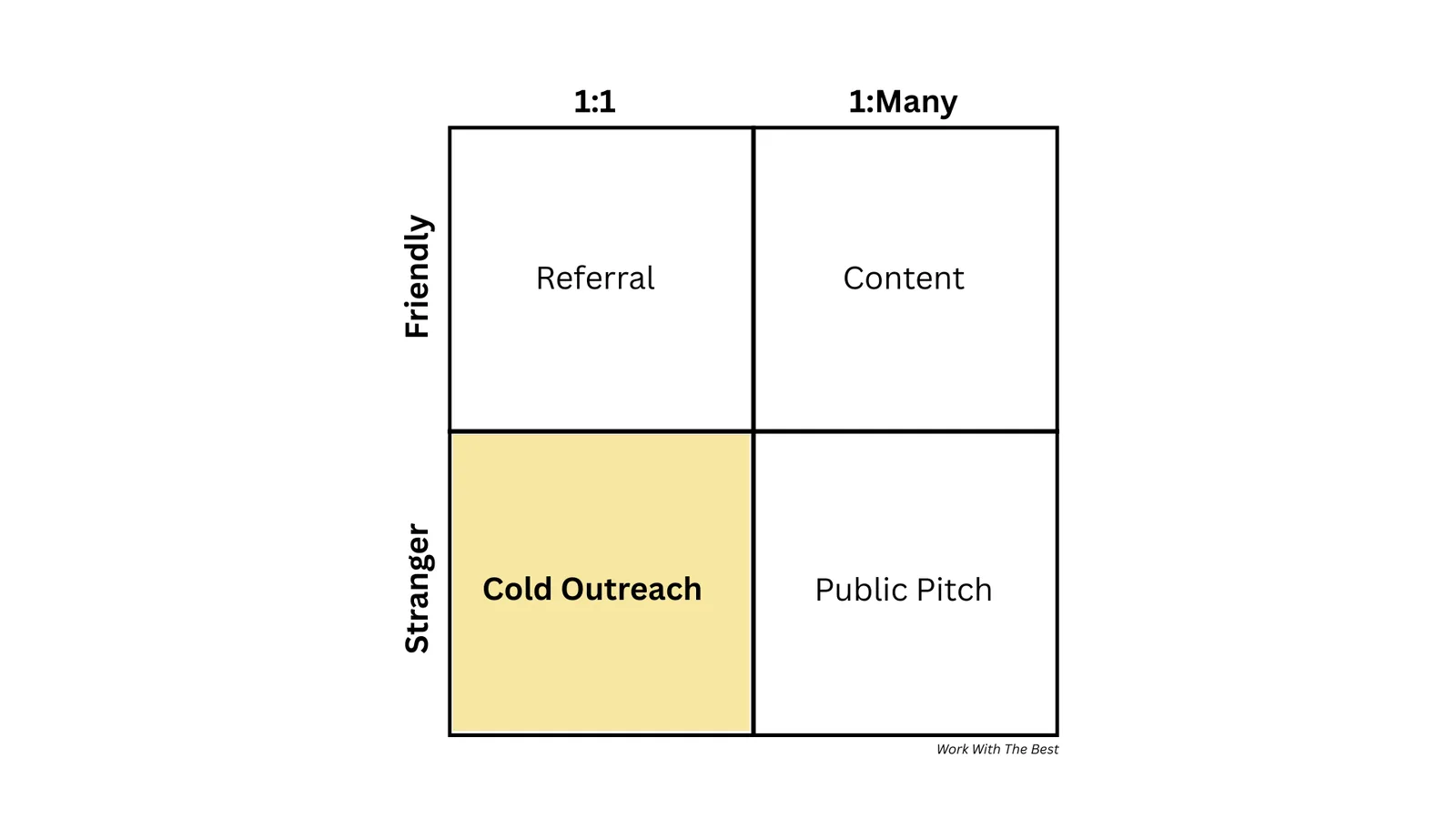
Cold outreach is when you reach out to someone who has never heard of you before.
The advantage of cold outreach is you can send a message to anyone with a public email or social media account. Think about that for a second.
The disadvantage is that so does everyone else. High-profile people get hundreds, sometimes thousands of messages, so the bar to get a response is high.
There are 4 types of cold messages you can send:
(1) The Compliment
The Compliment is the easiest of the four because you’re not pitching or asking for anything. You’re just reaching out to tell someone that their work meant something to you.
I wish more people did this. As someone who made the switch from consumer to creator (and has many creator friends), I can tell you that the creators you look up to don’t get complimented as much as you think they do. When they do get a genuine message, it means a lot. My DMs are open… kidding ;)
A good rule of thumb: whenever you like something, find the creator and tell them. Give them a specific compliment, not just “love your work” but something that shows you paid attention. Even if nothing comes of it immediately, you’ve put yourself on their radar and likely made their day. Win-win.
How do I know this works? I complimented Jeremy Mary on his podcast, Backstage Careers, because it inspired me to cold email Tyler Denk. Once Jeremy and I got to talking, he’s the one who told me that Noah Kagan was looking for someone to help grow his email newsletter.
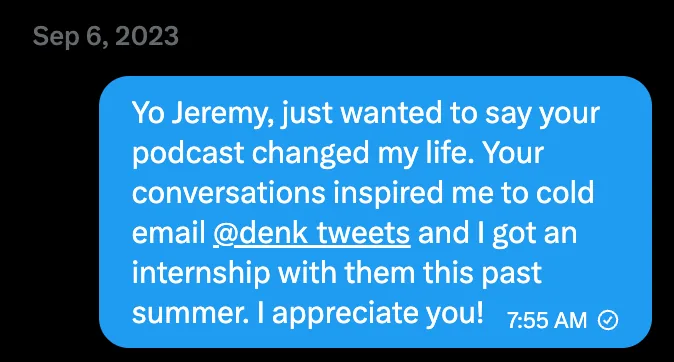
Another example:
In November 2017, Billy Oppenheimer read a book called Perennial Seller by Ryan Holiday. Billy read it on his flight back to Colorado. By the time the plane landed, he had ordered everything else Ryan had ever written.
He went down the rabbit hole, reading Ryan’s blog, the Daily Stoic emails, and listening to all of his interviews. He learned that Ryan had started his own career by apprenticing under Robert Greene, the author of 48 Laws of Power, and offering to help with research.
On June 12, 2018, Billy sent Ryan an email with the subject line “Just some words of thanks and admiration.” He thanked Ryan for his work, told him how his books had sent him down a rabbit hole of reading, and mentioned that if there was ever an opportunity to work for him, he would do it for free.
Ryan responded quickly, but it wasn’t for another couple months until Billy got the first task to work on (and it was a very slow evolution to full time).
Today, Billy is Ryan’s full-time research and writing assistant. He’s helped Ryan research, write, and publish five books, grow his email lists by over 500,000 subscribers, and publish an article a week.
All from a cold email expressing admiration.
(2) The Foot-in-the-Door
I had a follower send me this message the other day:
“Hey Jay, been seeing your content lately, really respect the consistency and clarity in your writing. I’m building a media brand right now and working with a few clients. Would love to connect and hear how you’ve approached growing your platform.”
Now, to be clear, there’s nothing inherently wrong with this message. It’s a good, well-meaning, and honest message. The problem is there’s a lot of friction for me to respond.
When you ask right away, it signals that all you want is to get something from the other person (which, to me, is offputting). It’s just like in real life. You wouldn’t ask a stranger you just met to marry you.
So what should you do instead?
If that person reached out with a specific compliment, opened the conversation, asked a specific (easy to answer) question… it would’ve made it 10x easier for me to respond.
Your first message doesn’t have to close the deal. It just has to open the door.
In psychology, this is called the foot-in-the-door technique. In essence, small yeses lead to bigger yeses.
Instead of saying, “Will you be my mentor?” Say, “I’m testing this landing page for my first product. I know you ran a bunch of tests on yours, and if you had 10 seconds (even if you’re on the can), what’s the one thing you’d change?”
The more specific the ask, the easier it is for them to respond.
Then, the next time you reach out, you can show them you implemented their feedback. Something like, “Hey, I changed the headline like you suggested and conversions went up 15%. Thank you so much.”
Now you’ve shown that you’re someone who takes initiative and does something with the advice they’re given (which makes them more inclined to respond again).
A simple compliment leads to a conversation. A conversation leads to a relationship. A relationship leads to many opportunities.
(3) The Piece of Feedback
The Piece of Feedback is where you give a piece of feedback to your target on something they can improve (creative name, I know).
One of my favorite examples of this is from Wouter Teunissen. He noticed Shaan Puri’s YouTube thumbnails weren’t great and created a Twitter thread deconstructing what he’d change and why. Shaan loved the breakdown and invited him into his company’s Slack channel.
For two months, nobody on the team knew why Wouter was there. But he kept showing up and sending ideas. Then one day the team needed someone to sell newsletter ads for their daily newsletter Milk Road. Wouter stepped up and said he could do it. He went on to sell over $250,000 in ads in 60 days, during a crypto bear market, and less than a year later, Milk Road went on to sell for a reported eight figures. What a stud!
This works because of the law of reciprocity (people feel obligated to return favors, gifts, or kindnesses received from others). Instead of complimenting someone or making an ask, you reach out with a useful observation or piece of feedback about their business, content, or product. When you give, people want to give back. Or at the very least, they want to keep you in their orbit.
How to implement:
(4) The Direct Pitch
The Direct Pitch is when you make your core ask in the pitch.
This is where the Permissionless Approach from the last chapter becomes crucial, because again, you don’t want to put the burden on your target to figure out who you are and what you can do.
The question I like to ask is: “how can I make this ask feel like a give?”
So how do you write a cold email that gets a response?
This is where knowledge of copywriting comes in handy.
In 1891, advertising legend Elias St. Elmo Lewis coined a copywriting formula called AIDA. To put this into perspective, this was when “marketing” meant newspaper ads, the fastest car reached just 39 mph, and the telephone was still a luxury item.
AIDA stands for Attention, Interest, Desire, Action.
It works for websites, ads, product pages, and in our case, cold emails:
1. Attention
You can write the best cold email in the world, but if no one opens it, it will fall on deaf ears. Your subject line is where you “sell” the open.
Pro Tip: Specificity and clarity are key. The best subject lines are short, specific, and reference something the recipient cares about. If your subject line is vague and confusing, it’s game over.
Bad subject lines:
Good subject lines:
2. Interest
Now you need to earn their interest. You do this by showing them, as fast as possible, that you’re relevant to their world.
Three ways to do this:
1) Show proof or credibility that’s specific to them.
You wouldn’t write a love letter and then address it “to whom it may concern.” Similarly, the person on the other end should be able to tell within the first two sentences that this isn’t a template you blasted to a hundred inboxes.
Don’t send a message so generic it could’ve been addressed to literally anyone. Reference their work. Mention something specific about what they’re building and why it resonates with you.
If you know they need help with YouTube: “My name is Jake, I run a YouTube growth agency. We’ve helped [their competitor] and [another name they’d recognize] grow from X to Y subscribers in six months.”
2) Reference something they said or did recently.
“I saw your talk at SaaStr last week. The bit about using LinkedIn DMs was so smart.”
This shows you’ve done your homework and you’re paying attention to their world, which immediately separates you from the hundreds of templated messages in their inbox.
3) Break their expectations.
You can also open with something completely unexpected. This works best with founders and creators who appreciate personality.
This was the first line in a cold email Tyler, The Creator sent to record labels when he was 17 years old:
“I know you’re like, what the fuck is this. I’m 17, and just released an album for my mixtape. I compose my music and rap.”
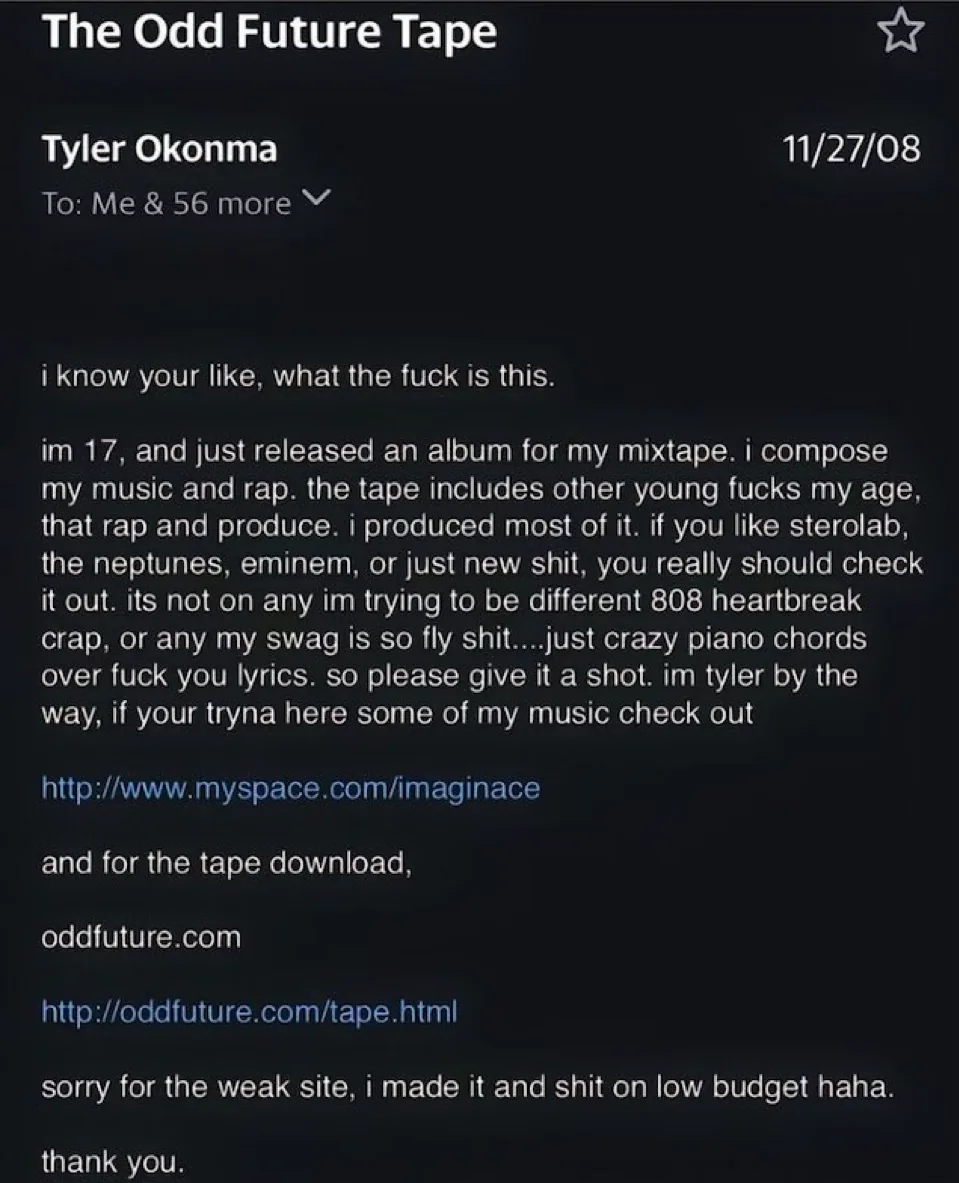
Pro Tip: be funny.
This was the start of a cold email that entrepreneur Omar Waseem wrote for his friend’s recruitment agency. Half of the people who opened it replied saying it was funny. Half of those replies closed.
“What if I — err… someone — ran over you with a bus? What would happen to your business? To your employees? After almost getting run over myself, I realized that I was spending my life on things that were easily outsourceable.”
3. Desire
You’ve gotten their attention and earned their interest. Now give them a reason to want to respond. This is where you show what you bring to the table.
Most people write something like “I’m a hard worker, a fast learner, and a team player.” But so is everyone else who emailed them today. Don’t TELL them you’re valuable. SHOW them. Mention a result you’ve gotten, reference a project that’s relevant to their world, or do what we talked about in the last chapter and attach something you’ve already built for them.
“I’m a finance major graduating from Illinois in May, and I spent the last year doing financial modeling for 3 early-stage startups through our school’s venture lab. I put together a short breakdown of how I’d approach your pricing model based on what’s public. It’s attached.”
Keep it short. People are busy, and nobody owes you their attention. Get to the point: who you are, why you’re reaching out, and what you’re offering. If they have to scroll to find the ask, you’ve already lost them.
Your writing should also be skimmable, so instead of writing in big blocky paragraph chunks, break up your sentences.
Bad version:
Better version:
Here’s one of my favorite examples of keeping your email skimmable:
This cold email got a reply from Evan Spiegel (former Snapchat CEO):
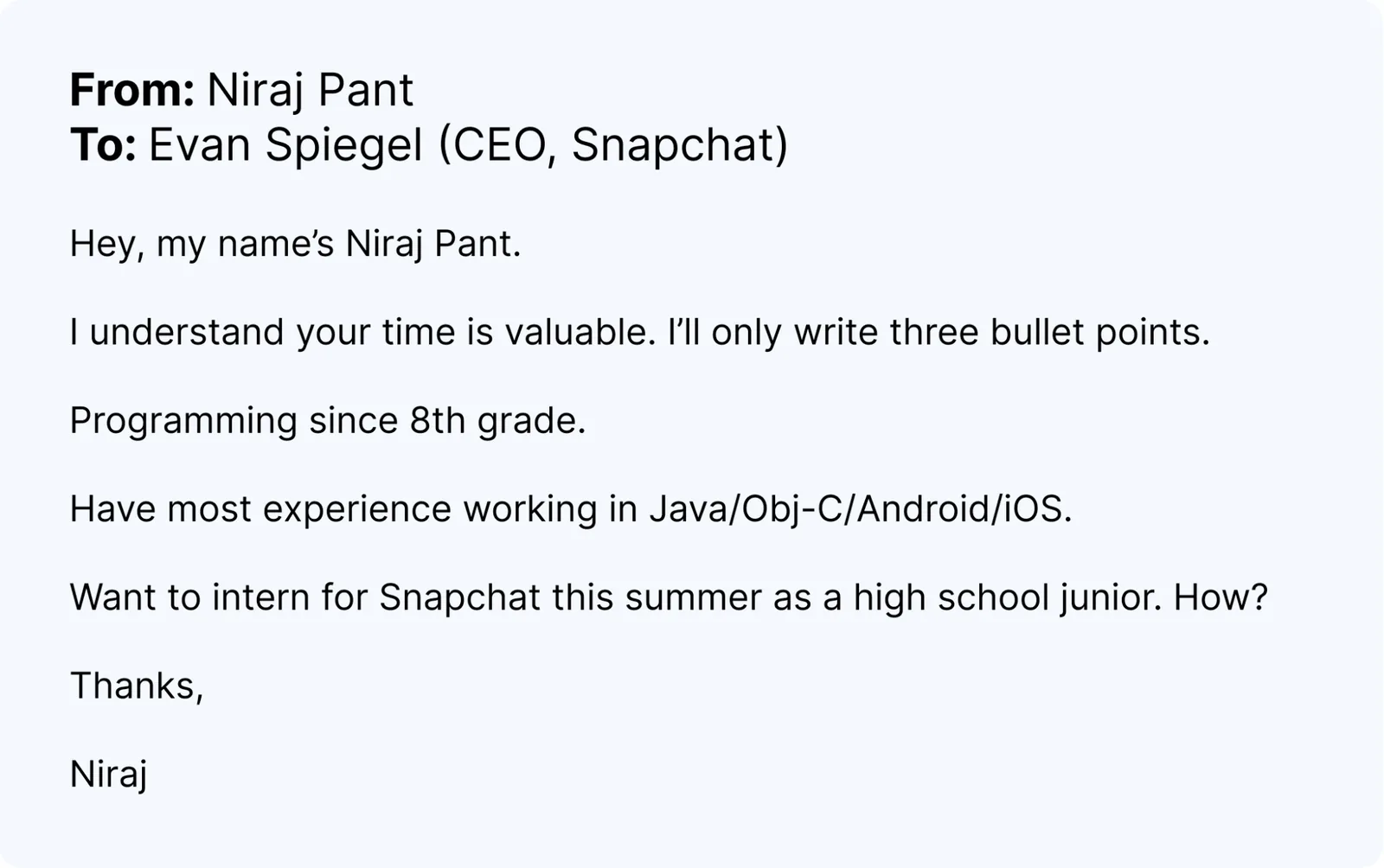
4. Action
This is your ask. You want it to be clear, specific, and easy to say yes to.
Bad: “I’d love to connect and discuss synergies.”
Synergies? About what? This puts all the work on the receiver to figure out whether they should say yes.
Better: “Would you be open to a 15-minute walking call next week? I have two more ideas that could help with your Series A prep.”
Time-bound, low commitment, and contains a give. Much easier to say yes to.
Pro Tip: Be specific about what you’re asking for. The recipient should be able to respond with one of three responses: yes, no, or let me forward this to the right person.
As Tim Ferriss said, “Life punishes the vague wish and rewards the specific ask.”
Here’s what a full email looks like when you put it all together:
Before You Hit Send: The 3 P’s
Once you’ve written your email, run it through this checklist.
Personalize. Is it obvious this email was written for this specific person? Could you swap out the recipient’s name and send it to someone else without changing anything? If yes, it’s not personalized. Go back and reference their business, their content, something that shows you did your homework.
Prove. Did you include any evidence that you can deliver? A result you’ve gotten, a project you’ve completed, a piece of work you’ve built for them?
Plan. Is it clear what happens next if they say yes? They shouldn’t have to guess why taking a call with you or responding to your email is worth their time.
An important note: there are many different styles of cold emails. Some people swear by being direct. Others just swear (like Tyler The Creator). But no matter which style you prefer, following the AIDA formula will give you the highest likelihood to get a response.
Pro tip: Attack space. Notice how the title of this section is “Cold Outreach” NOT “Cold Email”. Sometimes the best way to reach your target is to go where others aren’t. If their inbox is flooded but they use Twitter (X) frequently, direct message them on X. If they have a large X following but a smaller Instagram, message them on Instagram.
One of the most creative outreach attempts I’ve ever seen: a founder sent venture capitalist Robin Guo one cent on Venmo with their pitch in the memo line. Although if I were to do this, I’d send 2 cents and weave the pun into the pitch. ;)
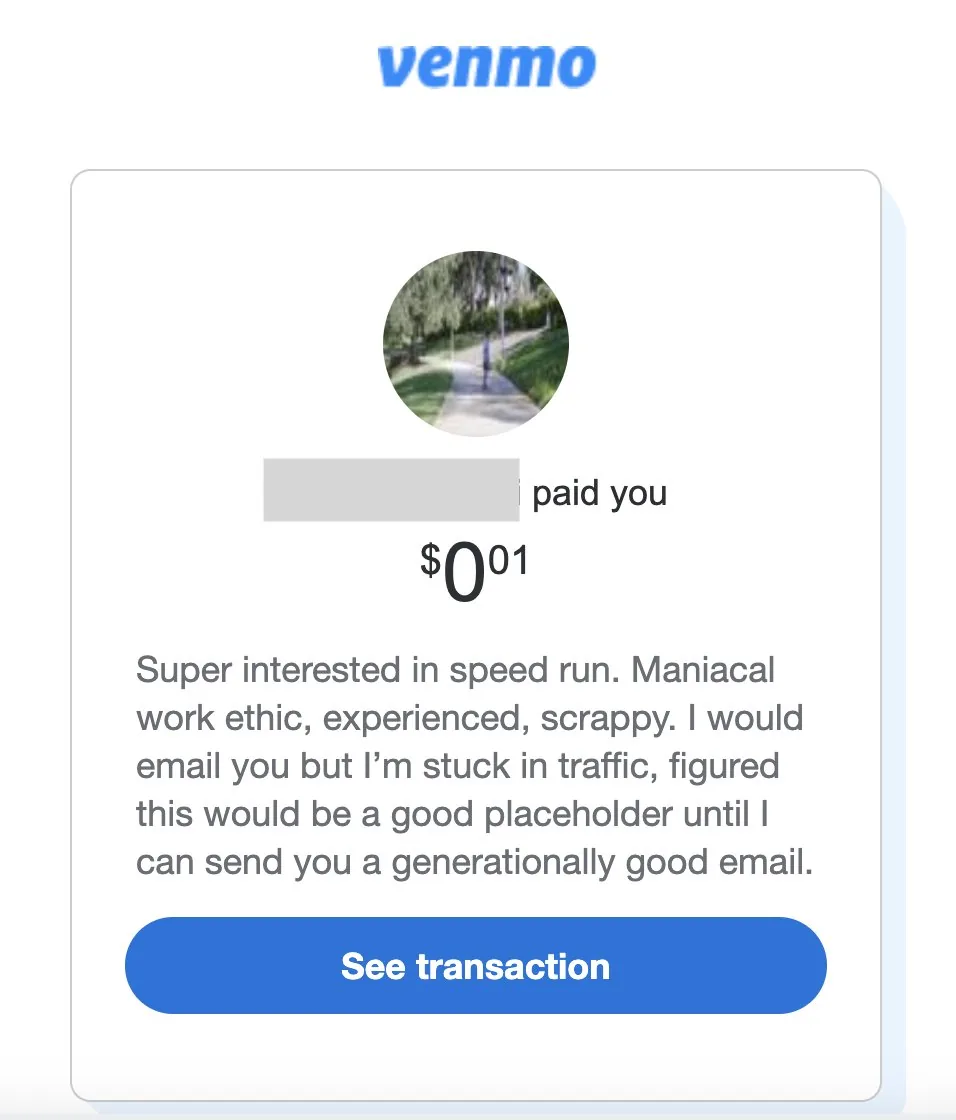
Another one I love: Moe Levine, the CEO of a no-code startup called Tadabase, wanted to get in front of investor Mark Suster. He knew Suster had Google Alerts set up for his own name.
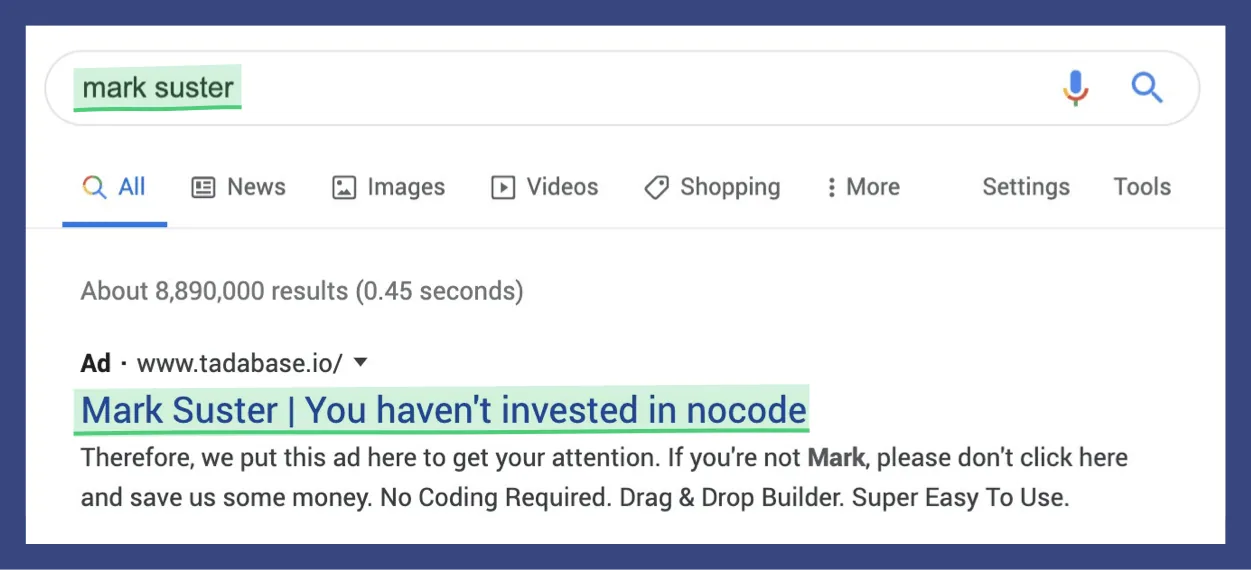
So Levine bought Google Ads targeting the phrase ‘Mark Suster,’ with copy reminding him that he hadn’t invested in no-code yet.
Before Suster even saw the ad himself, Product Hunt founder Ryan Hoover spotted it and tweeted about it.
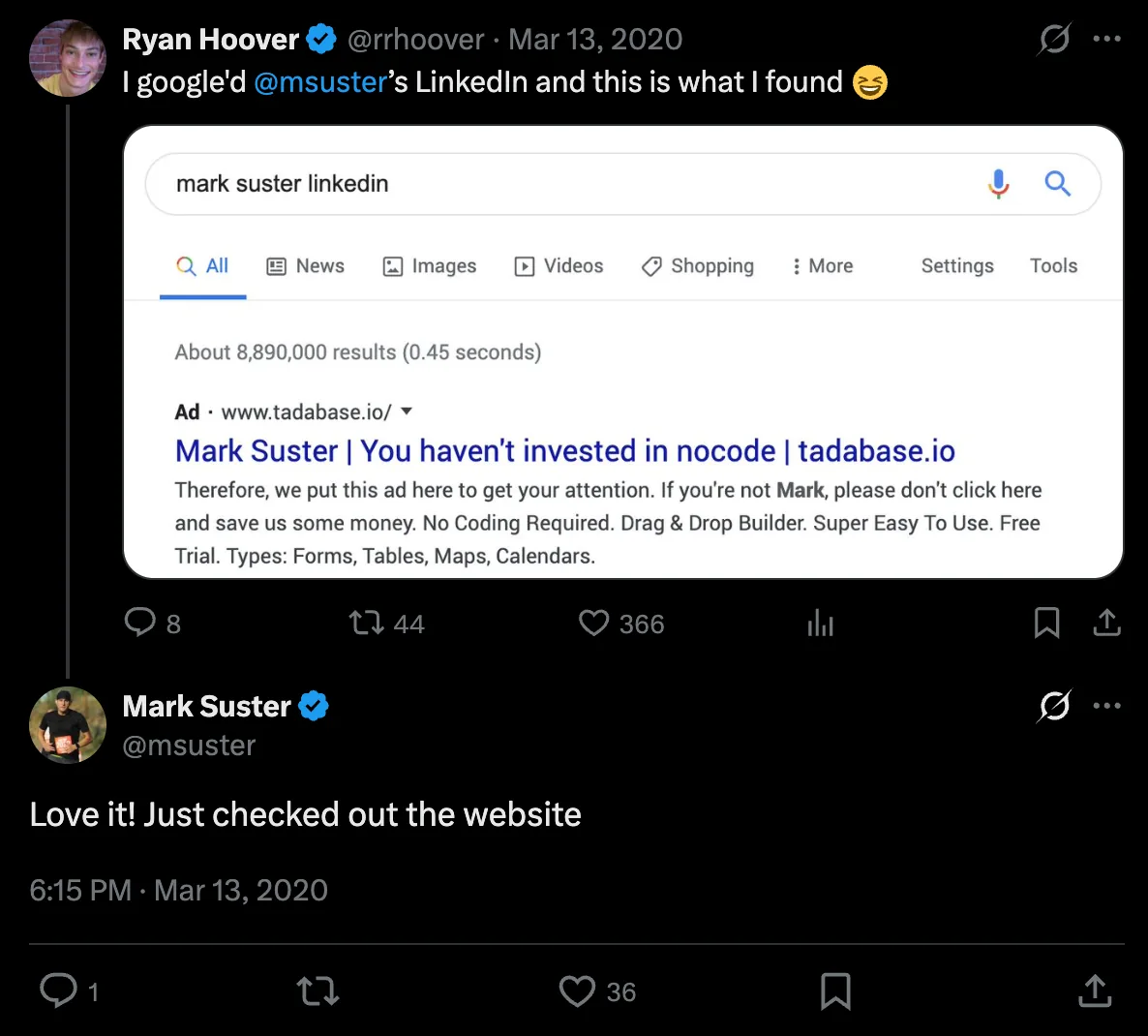
Suster saw the tweet and called Levine that day.
If they don’t respond, should you follow up?
Short answer: yes.
Longer answer: Typically, there are 4 reasons someone doesn’t respond to your message:
A lot of people take silence personally, but busy people get hundreds of messages a day. Your email might have landed at the wrong time, gotten buried, or maybe they meant to come back to it.
That said, most follow-ups are terrible. They look something like this:
Or worse:
Weak follow-ups only make your target less likely to respond because you come across as needy and annoying.
Every follow-up you send should deliver new value and stand completely on its own. Something they can use. If the new value is good enough, they’ll go back and read your original message themselves.
Ideas for what that value can look like:
A rule of thumb I like to follow: Send your first follow-up 3 days after your initial message. Your second follow-up 7 days after that. Your third follow-up 7 days after that.
Examples of what good follow-ups look like:
Example 1:
Let’s say you pitched a local real estate agency to help run their social media. You sent them a few sample posts and a short strategy outline, but you got no response.
Example 2:
Let’s say you applied to be a video and analytics assistant for a college basketball program and didn’t hear back.
Example 3:
Let’s say you pitched an architecture firm to help with their marketing and client presentations, but you didn’t get a reply. This is your final follow-up.
After 3 follow-ups with no response, move on. You’ve given them 3 chances to engage, and each time you led with value. If they’re still not responding, the timing isn’t right, you’re not the right fit, or they’re just not in a position to say yes right now. That’s okay.
Never burn the bridge with a passive-aggressive “guess you’re not interested” message. Just move on to a different target or a different method from the Contact Quadrant. You can always circle back in a few months with something new.
Pro Tip: use your age to your advantage. If you’re young or still in school, use your school email address to reach out to people you admire. You have a higher likelihood of getting a response because people like to help people who are just starting out.
Permissionless Challenge for young people: Email everyone on the Forbes list, tell them you’re X age, ask for a 10-minute phone call to interview them.
Permissionless Challenge: I have a friend who created a little ritual she calls “Shoot Your Shot Wednesdays.” Every Wednesday, she emails someone who’s out of her league, out of the blue, and it’s legit changed her business and life. Why not give it a go?
Sending a cold email is a high-agency person’s rite of passage.
If you talk to anyone who’s building something cool, there’s a large probability that they’ve done some sort of cold outreach in their past.
When you can tell your story of how you cold messaged someone successfully (or unsuccessfully), you immediately gain a level of respect.
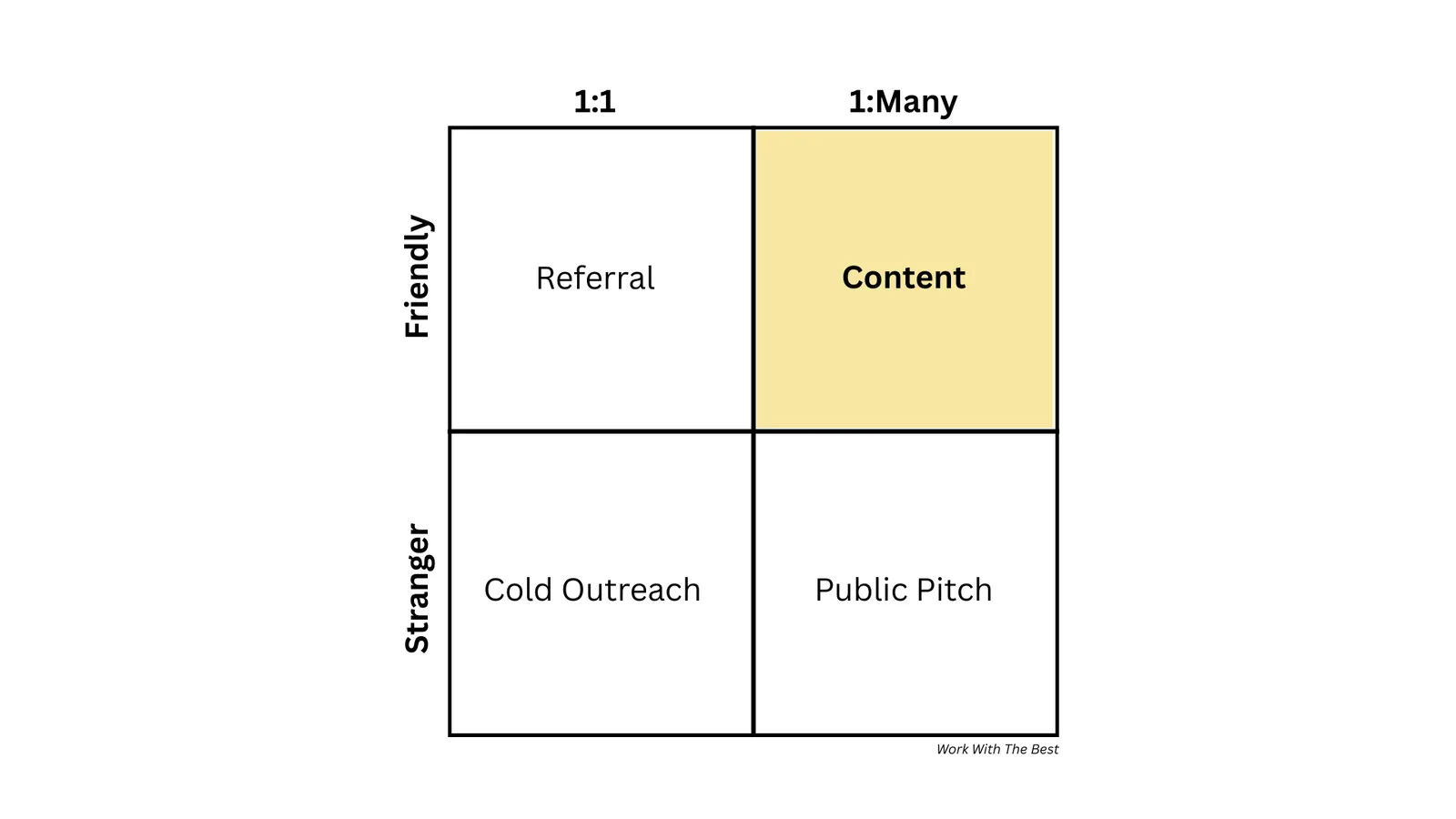
Content, content, content. It feels like everyone and their grandma is talking about creating content, building a personal brand, and growing an audience these days.
According to a recent survey, kids today are 3 times more likely to want to be YouTubers than astronauts. I get why it might sound like noise at this point. But before you tune out, let me explain what content is in the context of this book and why you should consider it.
Creating content is NOT just about becoming an influencer. There are plenty of resources out there if that’s your goal, but that’s not what we’re doing here. For our purposes, content is a way to make ourselves and our ideas easier to find, trust, and say yes to. That’s it.
Why does this matter? Do you remember how I said earlier that opportunities aren’t evenly distributed? Well, money flows where attention goes. Attention is on social media… which means opportunities are on social media too.
Content creation isn’t a new concept. Winston Churchill had written over 40 books by his 20s, chronicling his time as a soldier. Napoleon penned around 60 essays, novels, philosophical pieces, and open letters before the age of 26.
The medium may have changed, but the principle hasn’t. If you want people to know what you’re capable of, you have to put your thinking where they can see it.
Military strategist Sun Tzu had a concept called ‘shi,’ which roughly translates to strategic positioning. The idea is that the winning general puts themselves in a position where they can execute on plan A, B, C, or D before the battle even begins. His metaphor was a boulder at the top of a hill that can be rolled down in multiple directions in the path of unsuspecting adversaries.
Similarly, I view creating content as creating optionality. No matter what you do, having an army of people who know, like, and trust you will help you capitalize on it with maximum leverage.
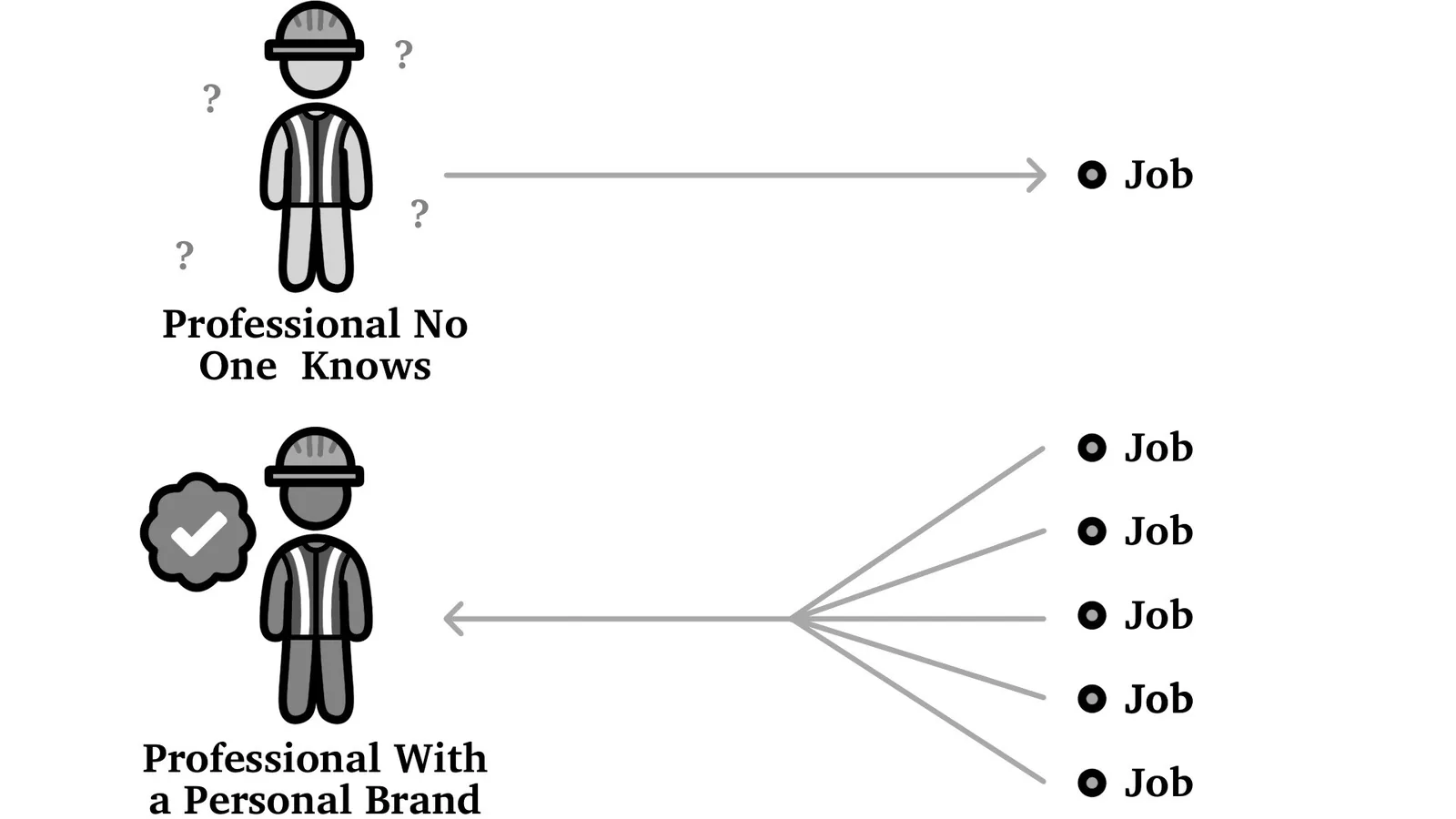
When I wanted to work with Noah Kagan, the content I had already published is part of what gave Jeremy Mary the confidence to vouch for me. When I was building my ghostwriting agency, content is what brought clients to me instead of me having to chase them down one by one.
Every major opportunity I’ve gotten in the last few years has been connected, in some way, to something I put out into the world.
Creating content online is a bat signal for friends, opportunities, and money. My writing has helped me land internships, jobs, clients, investment deals, lifelong friends, and hopefully one day my wife (fingers crossed, I’ll keep you updated).
The question we’re trying to answer in this section is: how do you increase the likelihood that people notice you and, more importantly, want to work with you?
The answer comes down to two things: being well known and being known well.
Being well known is about reaching people. It’s the distribution side of the equation. Basically, how many people see your content.
Being known well is about what those people think of you once they find you. It’s your reputation. It’s the associations people have when your name comes up.
Most people only think about the first part. They want reach, followers, and their posts to go viral. But reach without resonance is just noise. Ideally, you want both. You want eyeballs and hearts. You want to get impressions and to make an impression.
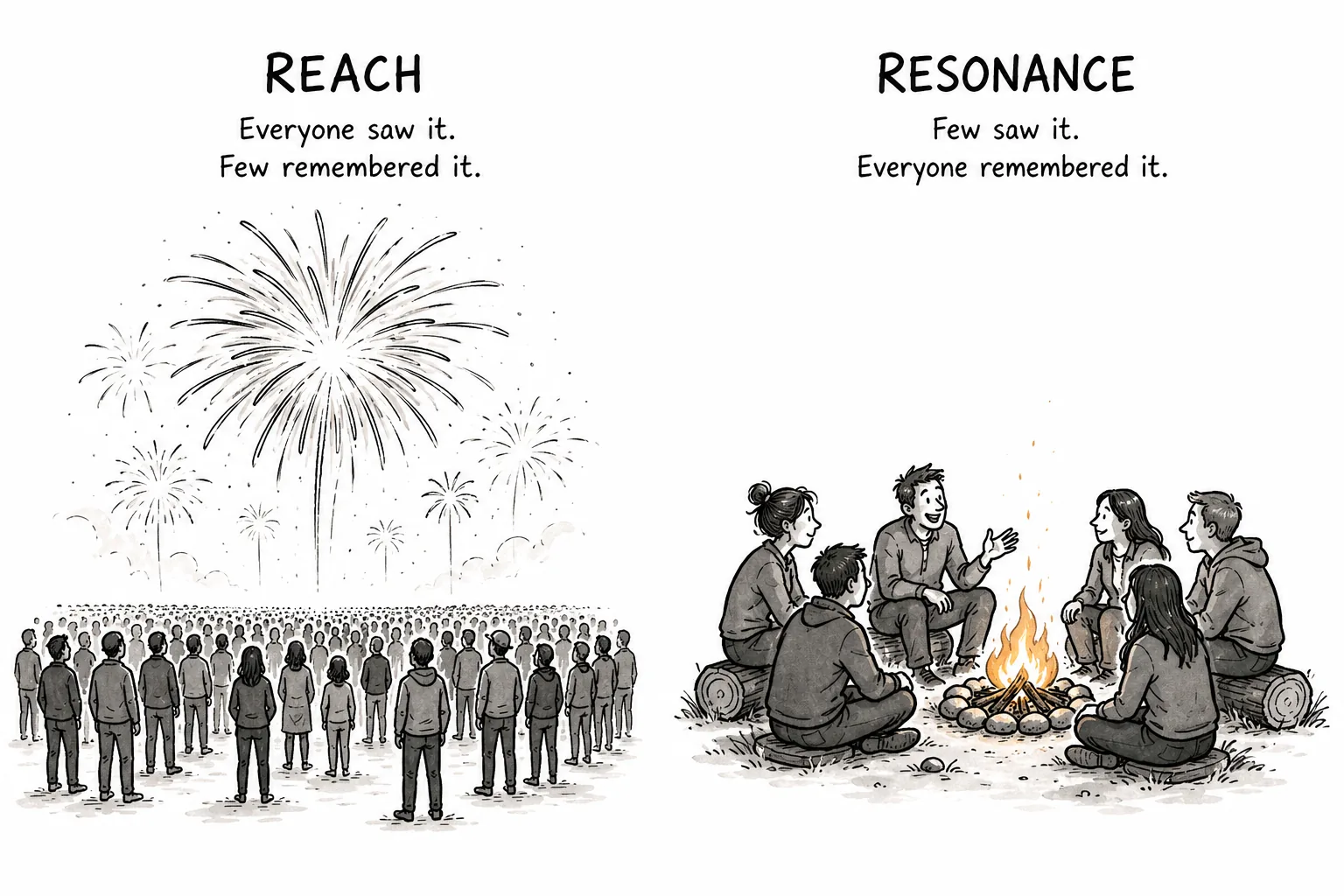
Let me start with being known well. If someone looked at your online presence right now, what would they think you’re about? What words would they use to describe you? If you don’t know the answer to that question, or if you don’t like the answer, then we need to get clear on what your “brand” is.
Caleb Ralston, the former director of brand at Acquisition.com and the founder of Ralston Consulting gave the best explanation for what a brand is that I’ve ever heard. He defines a brand as the result of branding. And branding is the pairing of (ideally relevant) things, done consistently.
That’s it. Not a logo, color scheme, or catchy bio. It’s just what people associate with you based on what you repeatedly put in front of them.
What I love about that definition is it takes branding, this thing that feels abstract and amorphous, and makes it concrete.
It makes it something you can architect, work backwards from, and influence. Because if branding is just “pairing relevant things done consistently,” then all you have to do is figure out which things you want to be paired with and start doing it over and over again.
Ask yourself: what do you need to be known for in order for the people you want to work with to want to work with you?
Let’s do it right now. Grab a pen or open your notes app.
First, write down the specific person or type of person you want to work with. A founder, an agency owner, a head coach, a venture capitalist, whoever it is. You should already have your answer from the TAG Method that we talked about previously.
Now ask yourself: what traits would that person need to see in me before they’d want to work with me? Write down that list. It might be things like resourceful, sharp, consistent, creative, hardworking, knowledgeable about their industry.
Finally, next to each trait, write down how you could show that quality through content.
Once you have that list, you basically have your content strategy. Everything you publish should reinforce one or more of those associations.
I call this The Public Challenge:
If I wanted to land a product design role at a startup, I might pick 30 startups I’d kill to work at and redesign one screen from each of their products. Every day, I’d post the before-and-after with a short breakdown of what I changed and why. Then I’d tag the founder and anyone else on the team. After 30 days, I wouldn’t have to convince anyone I could design.
If I wanted to land a role as an assistant coach for an NBA basketball team, I might start a video series where I break down my favorite team’s offensive plays and defensive schemes and how I would tweak them. Then I would tag that team’s coaching staff in each video to increase the likelihood that they see them.
If I wanted to get a scholarship to play on a college lacrosse team, I might start a daily video series where I document my journey towards getting a scholarship. I’d show my workout routine, diet, and how I’m improving every area of my game.
I had a friend who wanted to become a copywriter and decided to take on a “one sales page per day” challenge. For 30 days, he’d contact businesses offering to write a free sales page for them. If they didn’t respond he wrote it anyway and shared it online. He didn’t finish the challenge. Someone hired him on day 12.
Over time, those associations compound. The people who follow you start to think of you as “that person who really knows marketing” or “that person who’s always building something interesting.” And when an opportunity comes up that fits that description, your name is the one that comes to mind.
Here’s an example of a public breakdown by Andreas Janes (who runs an email marketing agency) breaking down a brand’s email marketing.
If I wanted to land clients, I would do a public breakdown every single day.
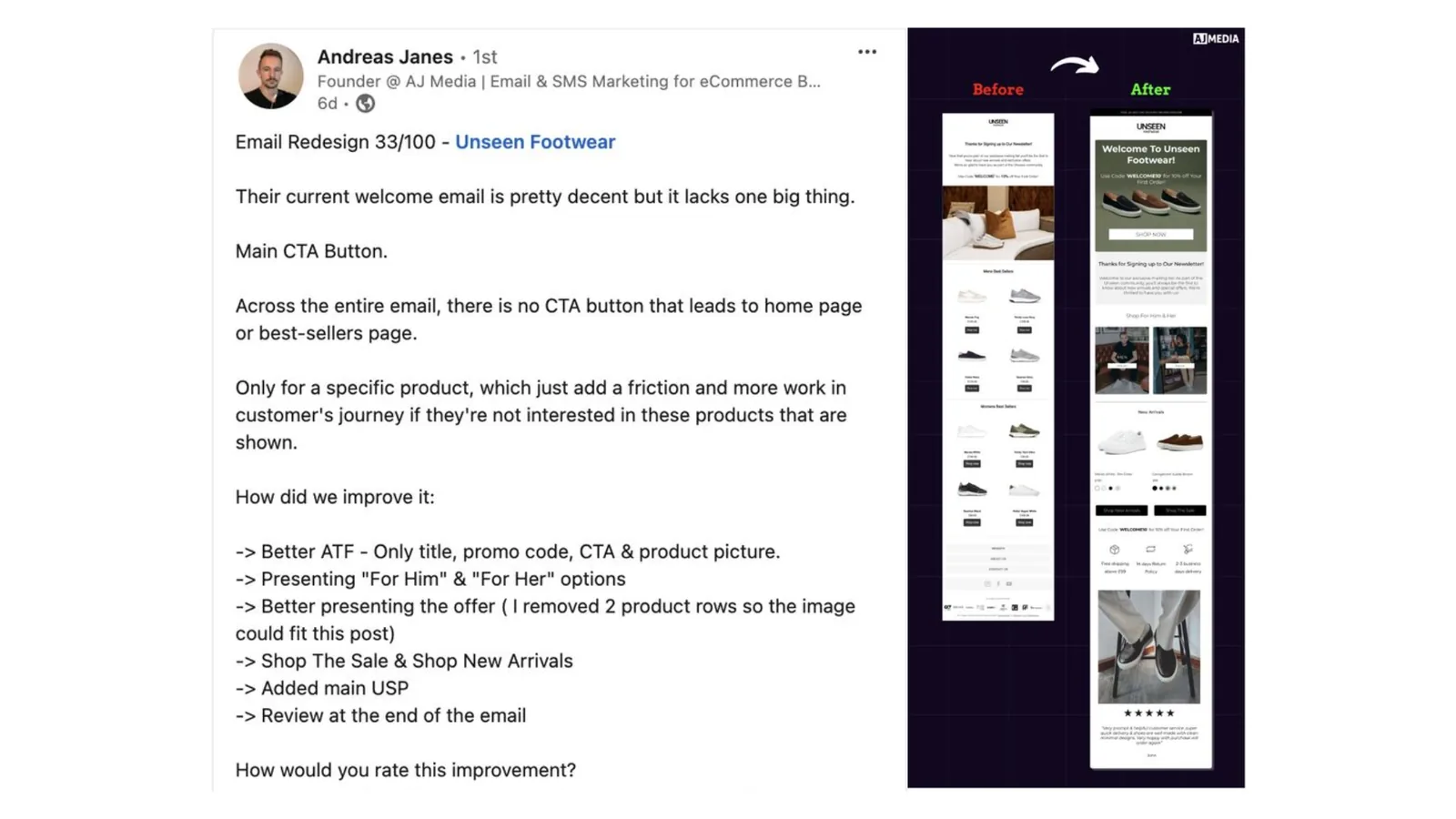
When Harry Dry was 23 years old, he built a website called Marketing Examples where he broke down marketing case studies. What makes this landing page work? Why did this email convert better? How do you improve your headlines?
Over time, his newsletter grew to over 130,000 subscribers, he quit his day job, and he built a marketing consultancy off the back of it. When he started, he didn’t have a marketing degree or any background in marketing at all. He just started publishing what he was learning, and his work spoke for itself.
Side note: whenever I need to write a piece of copy or design a landing page, I always open Marketing Examples first to get inspiration. It’s my favorite website of all time.
Chenell Basilio spent years working in paid ads. But she kept seeing creators build massive audiences without spending a dollar on advertising, and she wanted to know how.
So in December 2022, she started a newsletter called Growth In Reverse where every week she’d pick a top creator, spend 20 to 25 hours researching how they grew their audience, and publish the full breakdown. She covered Justin Welsh, Lenny Rachitsky, Codie Sanchez, and dozens of others.
Within two years, over 40,000 people subscribed to read her research. She turned it into a full-time business. And the creators she’d been studying? They started reading her newsletter too.
Chenell didn’t break into the newsletter space by posturing as an expert. She built her reputation by learning in public and becoming one in real time.
You don’t need to be an expert to get started, but you need to get started to become an expert.
When most people think about creating content, they think about giving advice to people who are a few steps behind them (how-to playbooks, frameworks, and templates). And that’s not a bad approach if you’re trying to build an audience.
But if you’re creating content to build a network and get in front of specific people, you have to also post upwards. You have to post for the people you admire, not just the people who admire you.
Instead of only teaching your own frameworks, you find your target and curate, summarize, and synthesize their ideas.
Here’s an example:
When I synthesized Shaan Puri’s ideas and tagged him in the post, I increased my visibility to him and showed that I’m a like-minded person who thinks deeply about the same problems he does.
Anytime you consume something, whether that’s a book, a newsletter, or a podcast… summarize what you’ve learned, share some of your personal perspective, and post it.
This works on a much bigger scale too. You don’t have to just make one post about someone. You can build an entire body of work around their ideas.
A few years ago, my friend Lewy Convery started a fan page for psychologist and author Jordan Peterson called Jordan Peterson Archive, where he would curate and clip the best videos from Jordan’s interviews. He had no background in social media or content. He grew the page to 85,000 followers, got the attention of Jordan’s daughter, and later became Jordan’s head of social media. That role launched his career, and today he leads content for bestselling author Arthur Brooks.
Eric Jorgensen took it even further. He spent years curating and compiling Naval Ravikant’s best ideas into a book called The Almanack of Naval Ravikant. Naval eventually gave him permission to publish the book, and they became friends (oh, and the book also ended up selling 2 million+ copies). He did the same for Balaji Srinivasan and Elon Musk.
Now let’s talk about being well known, which is the distribution side of the equation. How do you get your content in front of people?
At its core, content has to provide more value than it extracts. When people say your content needs to get people to “pay attention,” it’s because people are literally paying their time and attention for your content.
You can trade value in the form of education, entertainment, or inspiration, but fundamentally you have to give more than you get… otherwise, they won’t come back. Especially with today’s algorithms, it’s less about how many followers you have and more about the quality of each individual piece of content, because it gets pushed to a new audience every single time.
So how do you create something that gives more than it takes?
Every piece of content, whether it’s a tweet, a LinkedIn post, a YouTube video, or a newsletter, has three main parts: the hook, the body, and the call to action (CTA). If you understand how each one works, you can create content on any platform.
The Hook
The hook is the first thing people see, hear, or read - and its only job is to stop the scroll. If the hook doesn’t land, nothing else matters, because nobody will read the rest.
For educational content, a hook becomes viral-worthy when it nails four things: benefit, relevance, credibility, and perceived effort.
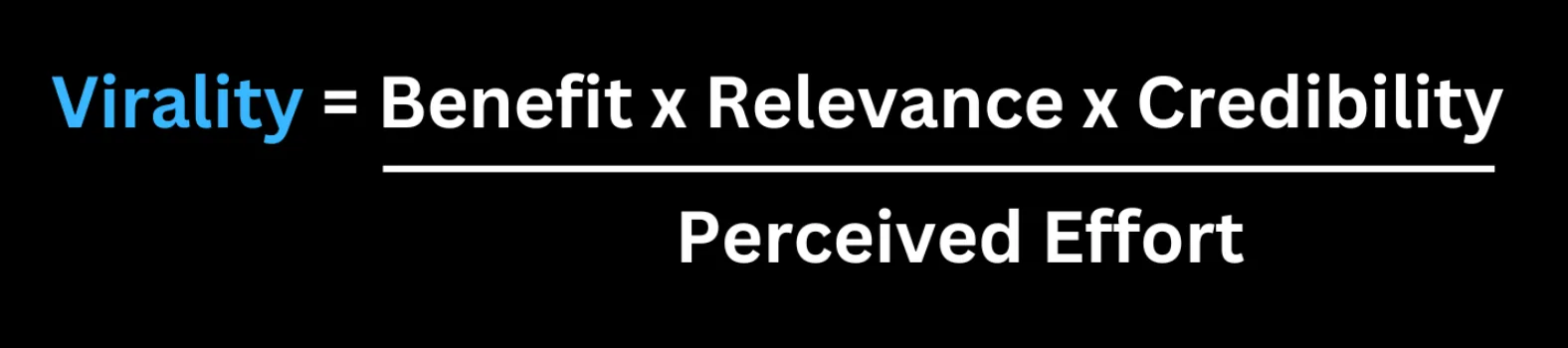
Here’s an example of a post I wrote with Noah:
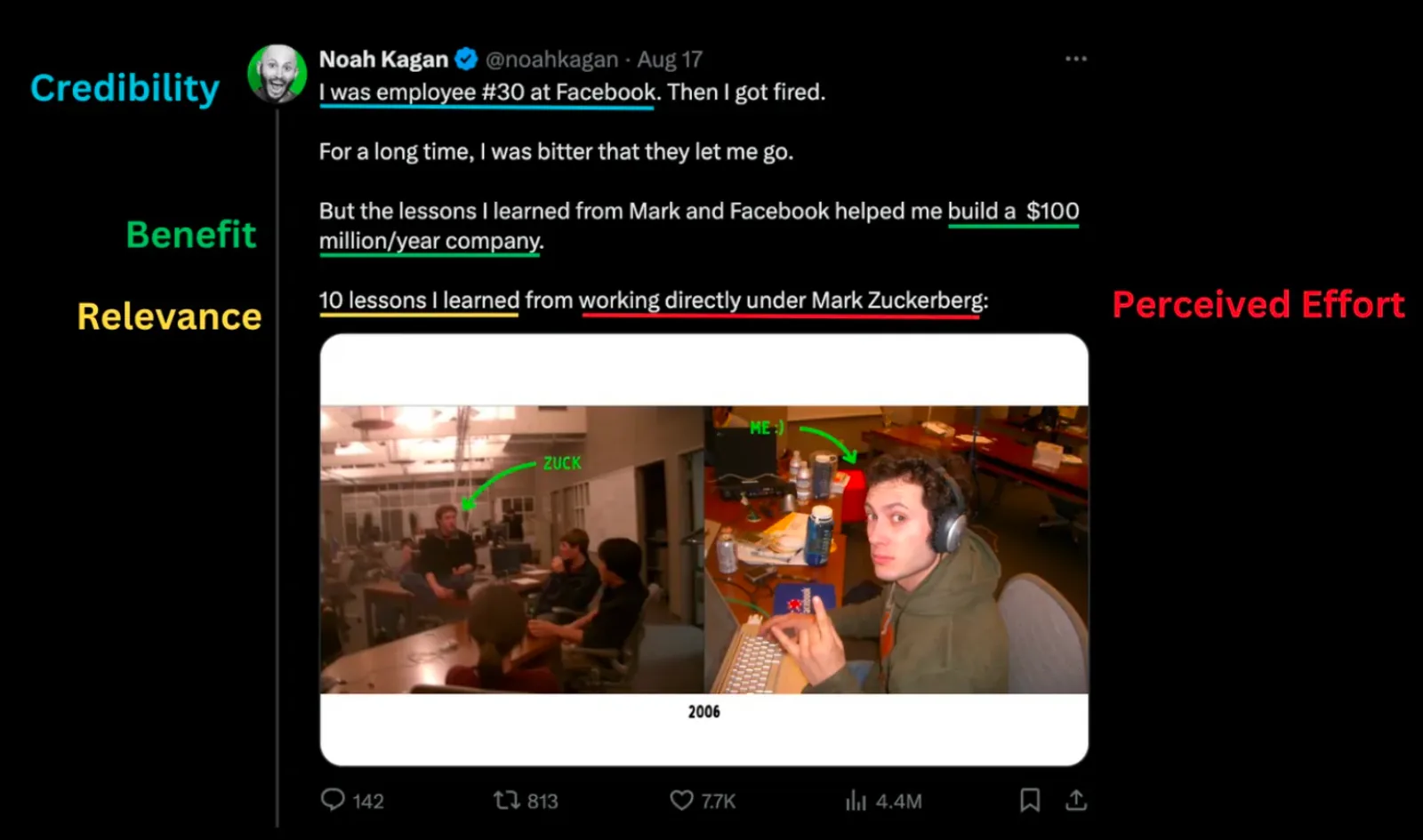
You want to:
To download my hooks playbook, grab it here:
Get the free Work With The Best bonuses →
Pro Tip: Before you publish, run your educational content through the Name Test.
Cover your profile picture and your name, and just read the hook. Could someone tell it was you who wrote it? If they can’t, your content is too generic. Your content should be one-of-one.
The more of your personal story and credibility you weave into your hooks, the more your content will stand out (and the harder it is for anyone else to copy what you’re doing).
This brings up a question you might be asking yourself: why would anyone read my content when they can just ask AI to get to the same conclusion?
The thing is, there’s nothing new under the sun. Everything’s been said already. But people need to be reminded more than they need to be taught - and sometimes common sense said through your perspective clicks with a reader in a way that someone else’s take on the same truth wouldn’t.
The same message said from a different messenger takes on a different meaning.
Documenting > Creating
People like watching someone like them figure things out in real time. Your “real-time figuring” helps them “figure.”
The market for content can’t be saturated, because if you are being you and sharing your unique perspective, then no one else can compete with you being you.
For storytelling content, the best hooks drop the reader straight into the middle of the action. This is called in medias res (Latin for “in the midst of things”), screenwriters use this all the time and it works because it creates an immediate question in the reader’s mind that they need answered.
I wrote a newsletter about running my first marathon, and it opens like this:
I felt like crying and passing out at the same time.
My legs felt like they were stuck in quicksand, and my back ached like it was carrying a thousand trees.
I looked to my left. A woman in her mid-50s was sobbing.
I looked to my right. A man in his 30s was bent over throwing up.
When the writer opens in media res, you want to keep reading. You’re wondering what happens next, and how this story ends.
The Body
Once you’ve stopped the scroll, you need to keep them reading. The body is where you deliver on the promise your hook made.
Content that earns attention says obvious things in an unobvious way. It takes something people already kind of believe and gives them a fresh angle, a personal story, or a perspective they hadn’t considered.
If I wrote a post that said “meditation is good for you, you should try it,” nobody would care. That’s an obvious statement. Everyone already knows that.
But if I said, “As someone who suffers from chronic ADHD, I used to hate meditation because I couldn’t sit still. My mind would wander constantly until I tried this simple breathing exercise.”
See the difference? It’s the same topic, but now it’s coming from a unique perspective.
Most content falls into one of two categories: storytelling or education. Each one has a structure that works.
For storytelling, I love the framework “But, Therefore,” from Matt Stone and Trey Parker, the creators of South Park.
Most people tell stories using “and then.”
That’s boring. There’s no tension or surprise, nothing to pull you forward.
The best stories replace “and” with “but” and “therefore.”
See how that pulls you in? Every “but” introduces a problem, and every “therefore” introduces a response, which creates this rhythm of tension and resolution that keeps people reading.
For educational content, clarity matters the most. If people don’t understand what you’re saying, they won’t get any value from it, and they’ll scroll right past.
I love to use the “What, Why, How” framework.
If you’ve been paying attention, you might notice that this entire section of the book follows that exact structure. I told you what content is, why it matters, and now I’m showing you how to do it.
The CTA
Most people don’t think about the end of their post at all. But again, we’re not creating content just to create content. We’re creating content to drive results.
Two important ideas for calls to action (CTAs):
1/ One CTA at a time.
There’s nothing worse than giving people three different things to do because it decreases the likelihood that they do any of them.
In psychology, this is called the Paradox of Choice. The more options you give someone, the less likely they are to act on any of them. Pick ONE thing you want them to do and make that the only thing you ask for.
2/ Be Specific.
Tell them who it’s for, what to do, when to do it, and how to do it.
x “Subscribe to my newsletter.”
✓ “If you’re a marketer who wants to get better at cold outreach, I break down one example every Friday in my newsletter. Link in bio”
Pro Tip: If you’re just starting out, the best CTA you can use is “follow me for more.”
A follow is a sign of future intent. They can subscribe to your newsletter, buy from you, and reach out to you later. But if they don’t follow you, those next steps become less likely.
Man, oh man, wasn’t that so much fun? I don’t know about you, but the psychology of content just lights me up.
I know that was a lot, and there’s a ton more nuance that I’ve intentionally left out because I don’t want to overwhelm you.
If you’re reading this and you’ve never posted content before, or maybe you have but you’ve been inconsistent, I’ll show you the simplest way to start in just a second.
But first, let me address something you might be thinking: “Jay, I don’t have enough credibility to be posting content. I haven’t done anything impressive yet. Who am I to be writing about this stuff?”
The best mental reframe for that thought is this: you don’t have to be the guru, you can be the guide. Some of the best content comes from someone who’s one or two steps ahead of their reader, not already at the top of the mountain.
My friend Kieran Drew calls this “serving your shadow.” If you feel like you’re posturing or you’re not credible enough, chunk down. Find the thing you know well and zoom in on that.
And remember what we talked about earlier: if you’re worried about credibility, you can always write upwards. Curate other people’s frameworks, synthesize their ideas, and tag them.
Okay. Here’s how I’d start:
(1) Create a reintroduction post.
A reintroduction post where you reintroduce yourself online and let people know what to expect from you going forward
This serves three purposes:
Your reintroduction post should cover three things: who you are, your story and credibility, and what you’re going to be creating about.
Pro Tip: you can make reintroduction posts more often than you think. Not everyone sees every post you make. I like to make a reintroduction post every 90 days (and every time I cross a big follower milestone).
Here’s an example from Matthew Brown (who runs a social media ghostwriting agency):
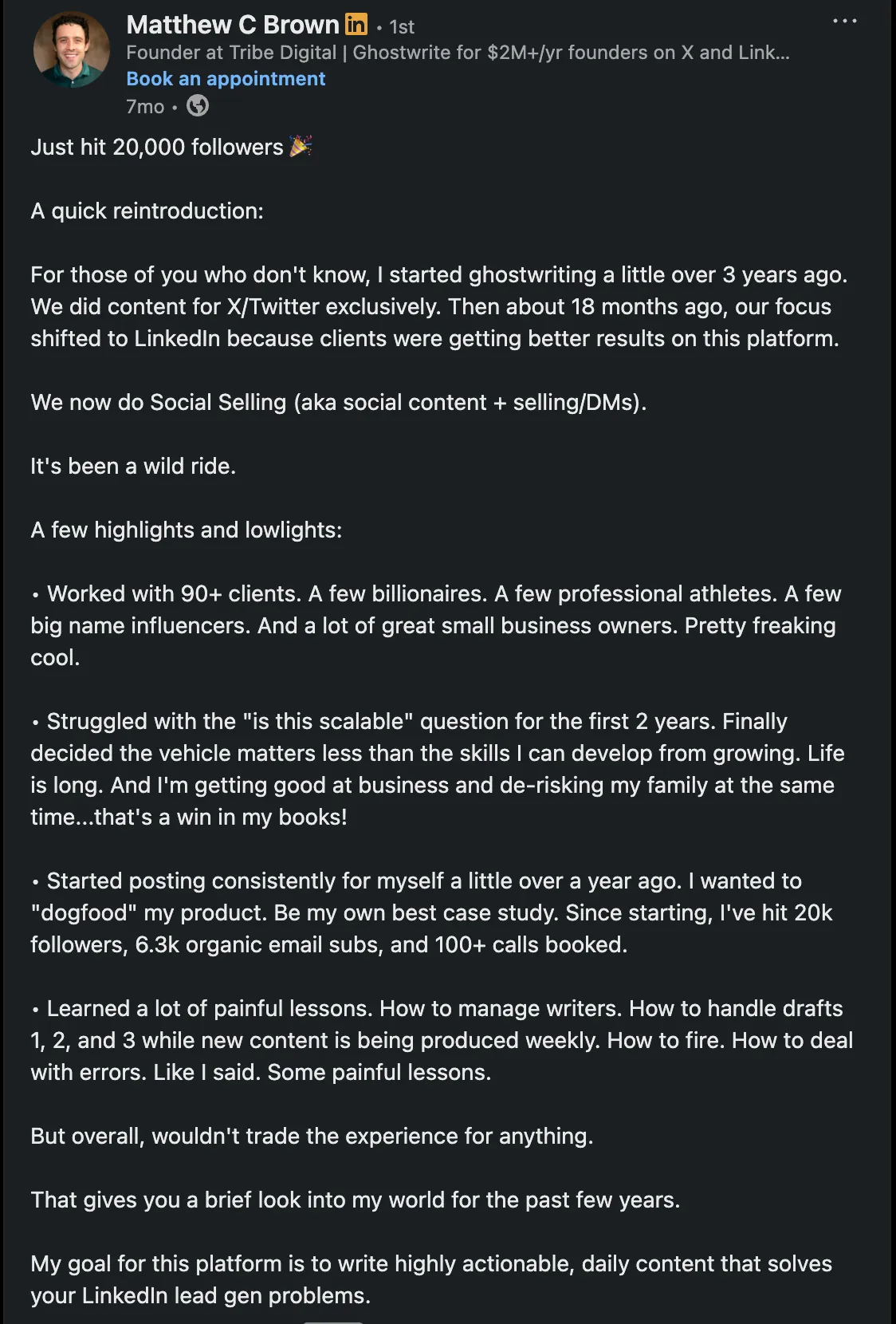
(2) Pay more attention to your life.
When most people think about creating content online, they think that they need to have a monumental event in their life for it to be worth talking about.
That’s not the case. In fact, some of my best posts are when I’m sharing a tiny win or a small fear and being honest about it, because that’s what’s relatable to others.
At the end of each week, I want you to ask yourself three questions:
Author Orson Scott Card once wrote, “Everybody walks past a thousand story ideas every day. The good writers are the ones who see five or six of them. Most people don’t see any.”
Note: If you find that you’re struggling to “come up” with creative ideas, I encourage you to check your information inputs. What content are you consuming on a regular basis? We are all being influenced whether we like it or not. Are those people feeding you the thoughts you want to have?
To drive home the importance of this point even further, if we know that our life is just the collective sum of actions that we’ve taken, then we should strive to take better actions. Agreed? Cool.
Well, the best way to take better actions is to make better decisions. And the way to make better decisions is to think better thoughts. And the way to think better thoughts is to first consume better ideas.
Be picky with what you allow into your mind.
(3) Don’t break the chain.
Pick a cadence you can stick with, then do everything in your power to stay consistent. Consistency shows commitment. It shows you’re serious. It tells the world that you’re a hungry, driven, high-potential person who follows through.
When you build a catalog of work that can be binged and is relatively timeless, you make yourself easy to discover and trust. Someone can find one post, click on your profile, scroll through months of valuable content, and quickly see whether working with you makes sense.
The big idea I want to get across to you is that content is not as complicated as you might think. It sounds fancy, but creating content online is as simple as sharing useful ideas and interesting stories from your life. It’s like texting your friends an update, except you’re sending it to the rest of the world.
Of the four quadrants, this one usually takes the longest to work. But the benefit is that it keeps working for you long after you’ve stopped working on it. A piece of content you made six months ago is like a little robot bumping around the internet, attracting opportunities to you while you sleep. A cold email works once. Content works forever.
Each post you make increases your surface area for luck.
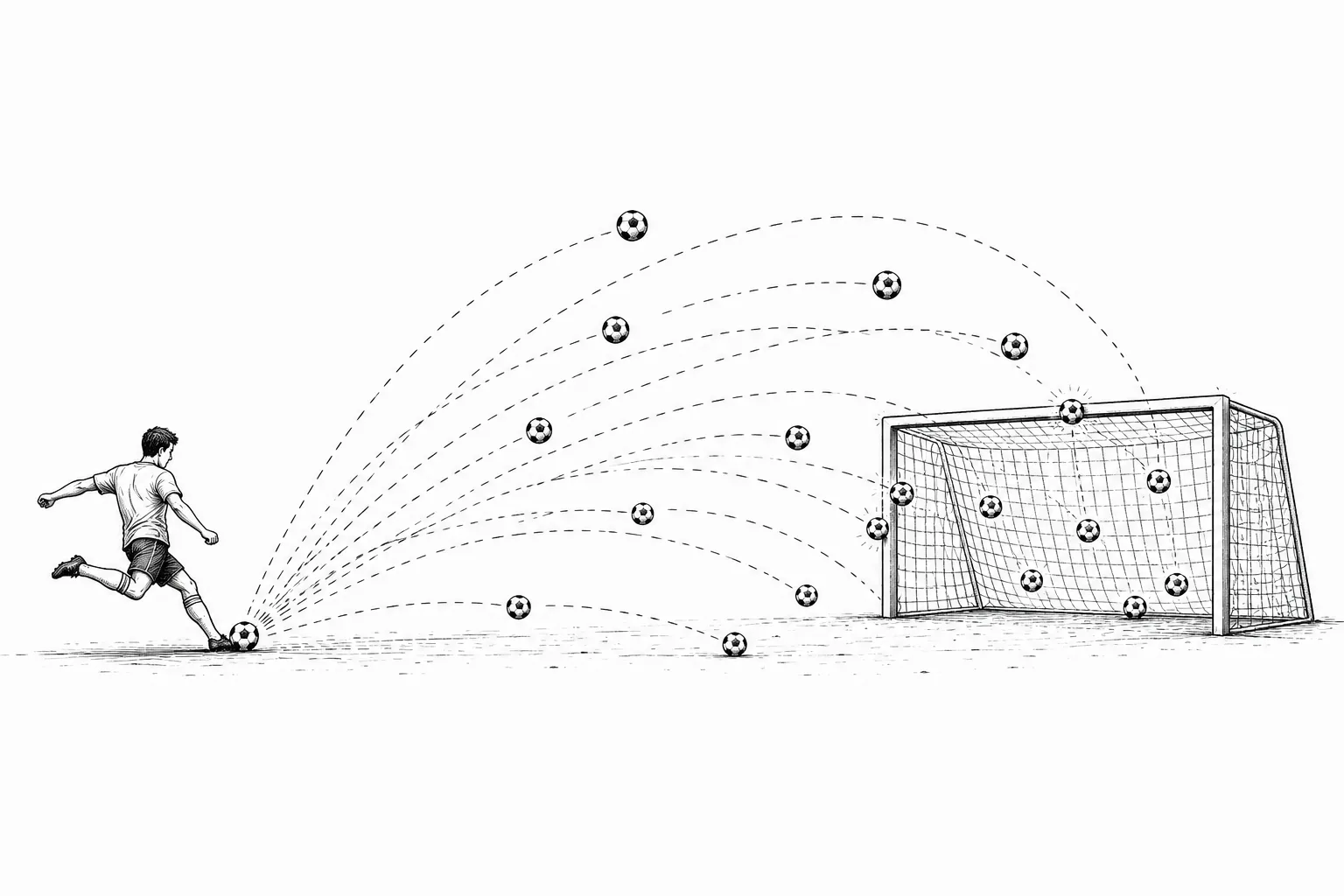
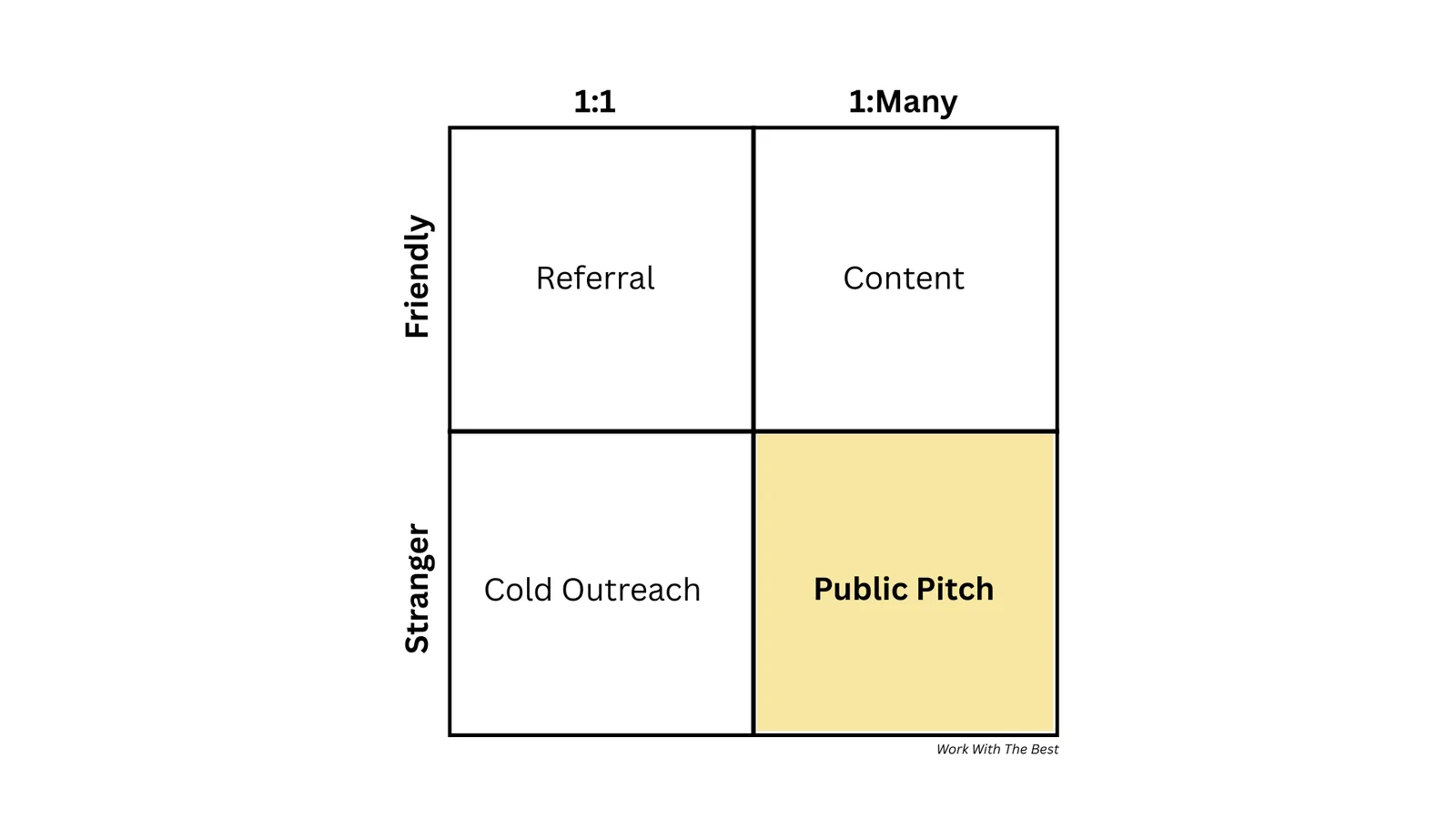
In 2014, Nina Mufleh moved to San Francisco hoping to take her career to the next level in tech.
She had a strong résumé. Three years in communications for the Queen of Jordan, three years building the first social media agency in Jordan into a 52-person company with offices across the Middle East, and a client list that included Pepsi, Samsung, and Mercedes-Benz.
She figured it would take a few months to land a role.
But a year later, after applying to over a hundred companies, customizing her résumé for every opening, and networking online and offline, she had no luck.
Her sister told her she should give up. “But I haven’t done everything I can,” Nina thought. “I’ve done the same thing multiple times, but I haven’t tried new approaches.”
So she stopped applying.
Instead, she made a decision: she would stop thinking of herself as a job applicant and start thinking of herself as a product. A product has to find a market, build demand, and prove its value before anyone buys it. Her job was no longer to ask companies to hire her. It was to create demand around hiring her.
She picked Airbnb. She had been a guest on the platform, then a host, and somewhere along the way had fallen in love with the company’s culture. She also knew that Airbnb had not expanded into the Middle East, a region she had spent her entire career working in.
She spent weeks putting together a detailed plan that included:
She designed the report to mimic Airbnb’s own brand. The first slide where she introduced herself was laid out like an Airbnb host profile. She used phrases pulled directly from the company’s internal culture documents. She even included a photo of “Okay Coffee,” an internal Airbnb project most people outside the company had never heard of.
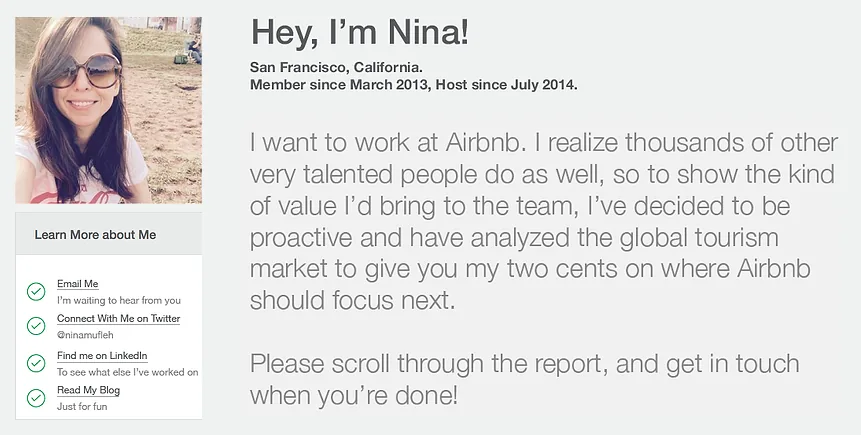
She built the site in a weekend using Wix, the no-code website builder. Then she posted it on Twitter and tagged the Airbnb co-founders directly.
Within hours, both Brian Chesky and Joe Gebbia replied publicly. Recruiters from LinkedIn, Uber, and Dropbox reached out too.
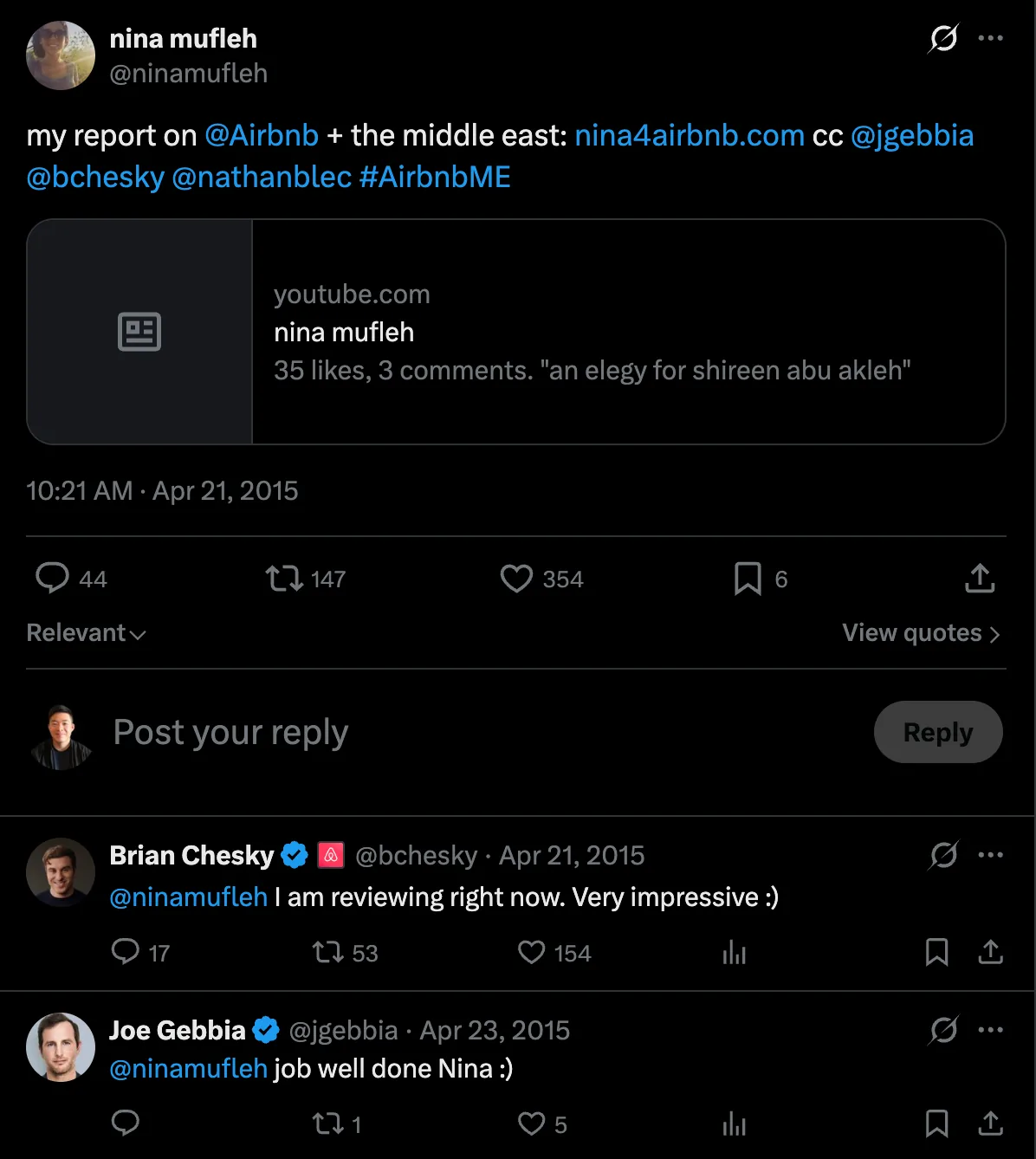
The Airbnb interview didn’t end up turning into an offer. But a few weeks later, Upwork, who had seen the report and loved her thinking, hired her as a Growth Manager.
The Public Pitch is the boldest play of the four, and one of the most underrated. Instead of sending your pitch in the DMs or through cold email (where it can be easily ignored), you create a social media post with your pitch and tag the person or company you want to reach. You post it publicly for the entire internet to see.
If you want to work with someone that you admire, this is the #1, nearly foolproof, 99% guaranteed way to get their attention and get in front of them. It blows my mind how few people use this strategy, because it’s SO freaking good.
Here’s an example of a “Public Pitch” from Jeston Lu, who was a sophomore in college:
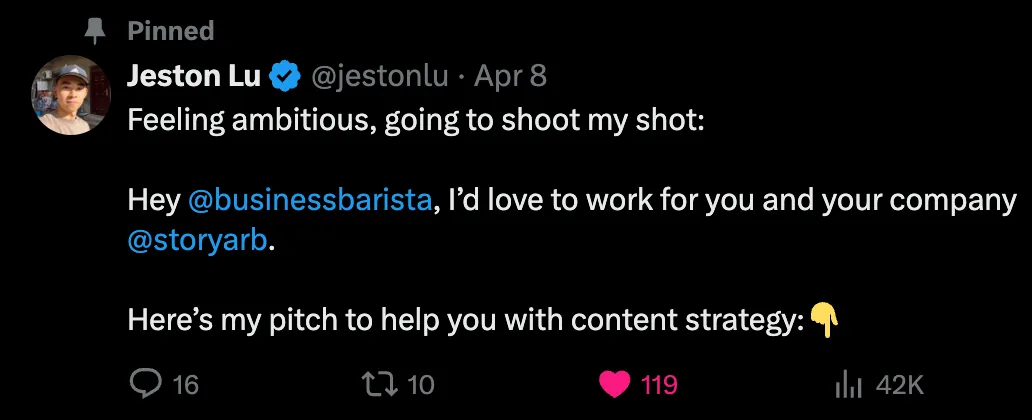
Tons of people tagged Alex Lieberman in the comments and vouched for Jeston.

He later used this strategy again with Notion and landed the internship.
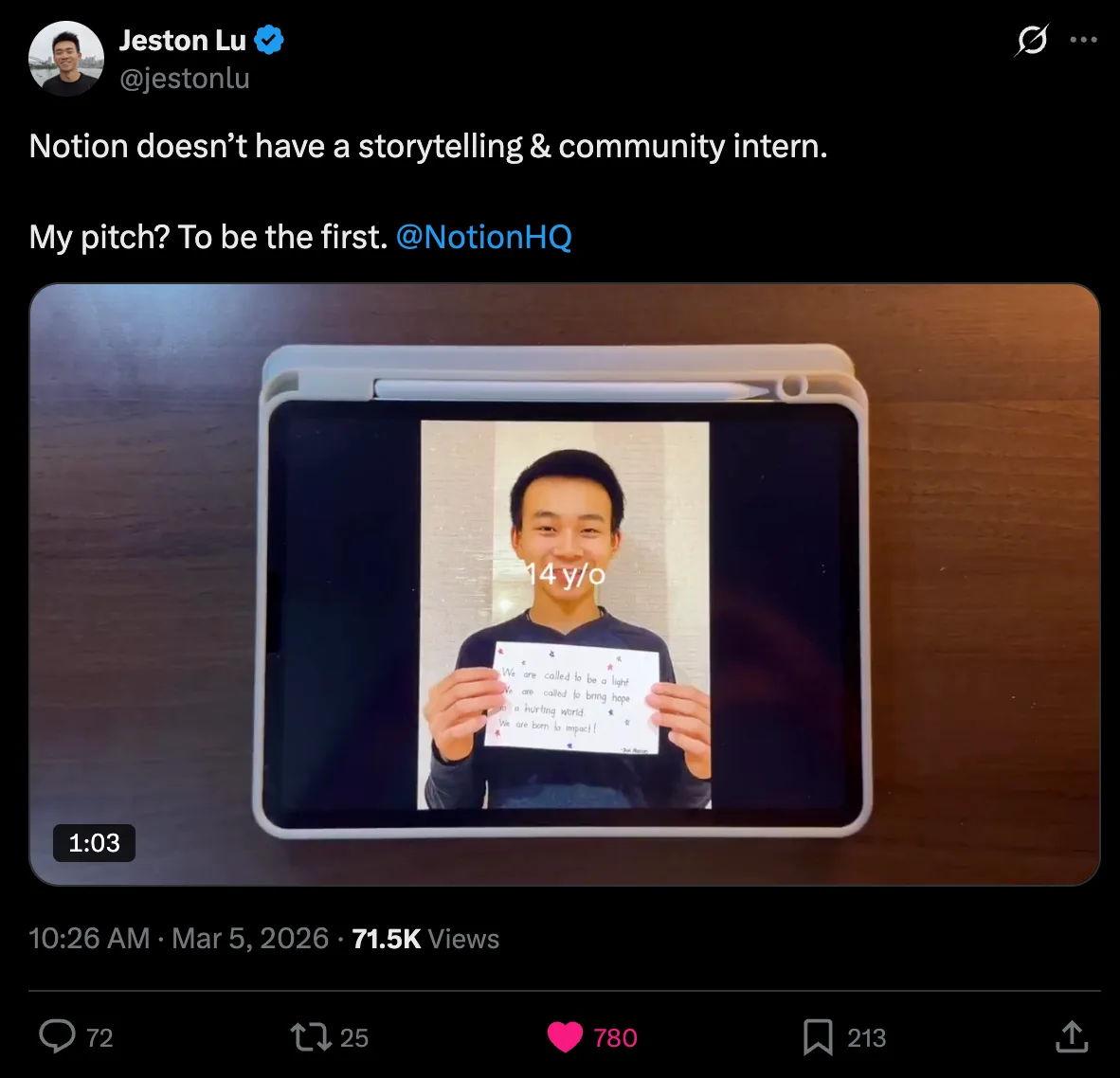
Julia Fedorin, a sophomore in University used this approach to land an internship as the first marketing intern at Shopify in over a decade. She created a video pitching herself, posted it publicly, and tagged the company.
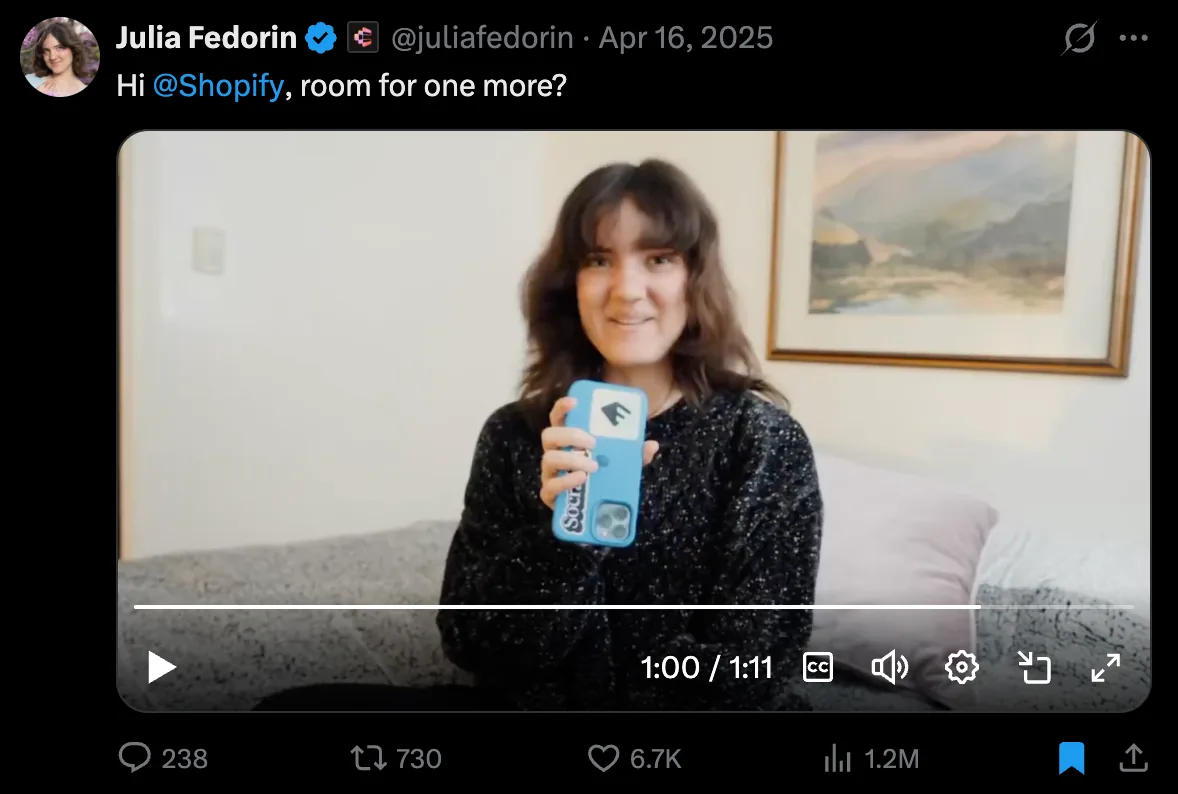
The side benefit of the Public Pitch is that it’s not just your target who sees the post, other people do too. If you post a pitch aimed at one company, you might end up getting DMs from three other companies who saw it and thought, “Wait, we want this person too.”
Effort is universally respected. The Public Pitch is one of the fastest ways to demonstrate that you’re entrepreneurial, high agency, bold, and can make things happen.
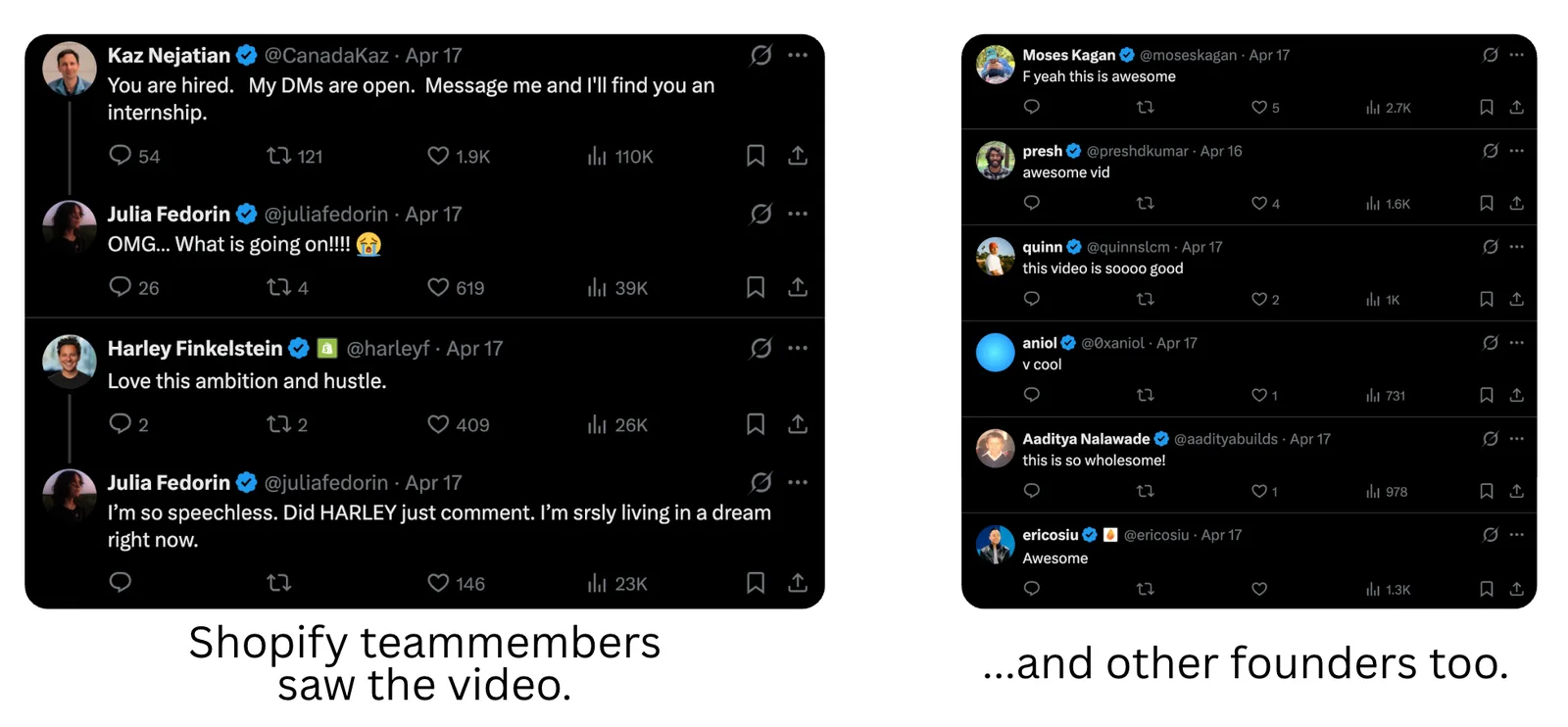
Pro tip: ask your friends to vouch for you in the comments and tag your target too. It adds social proof and creates a gentle pressure for the person to respond, because you have a crowd of people co-signing.
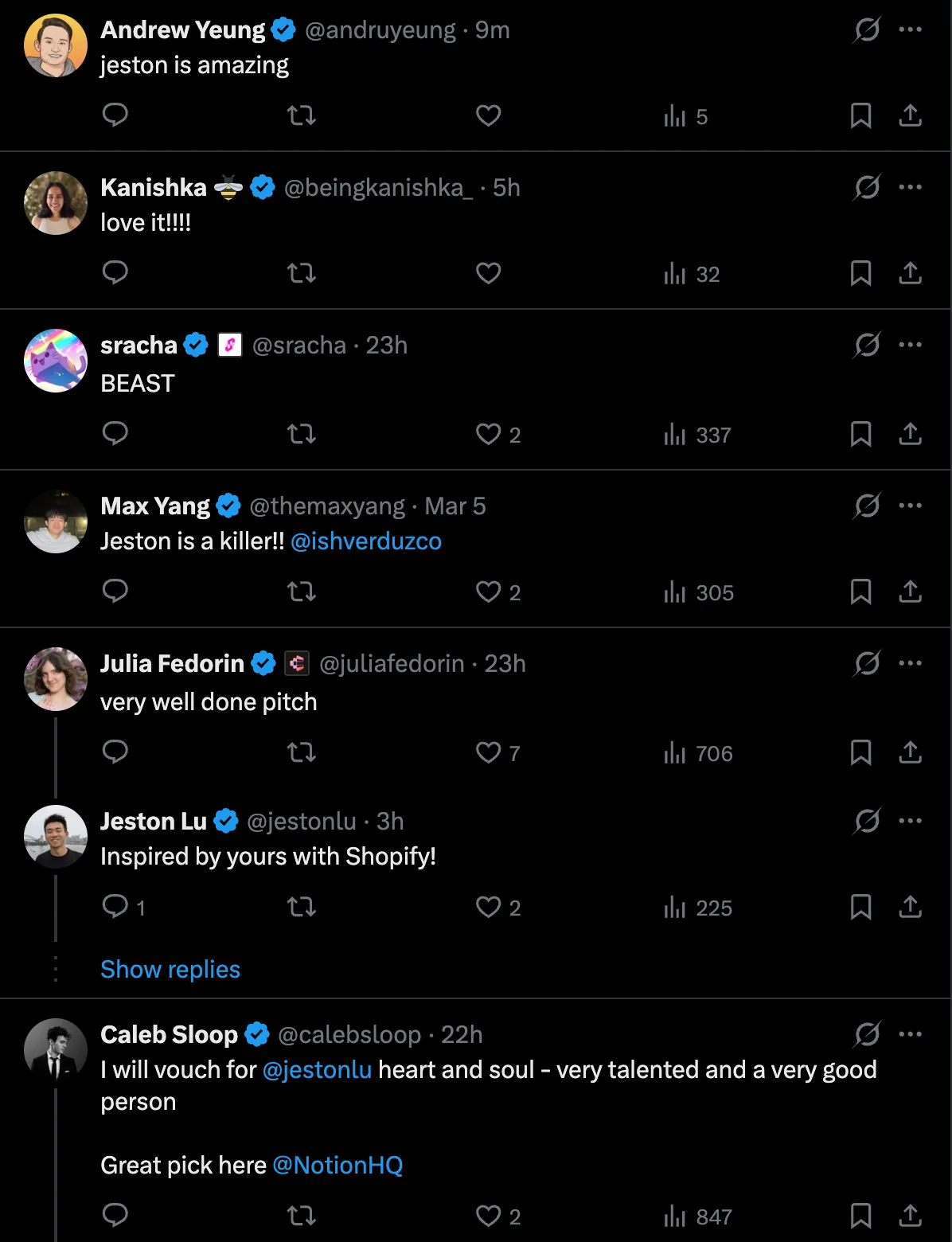
Use the A.W.A.R.E. Framework:
My brother Max used this approach to land his first internship with Eric Siu (CEO of Single Grain, a digital marketing agency), so I’m going to use his pitch as an example.
1- Ask
State clearly what you want. Don’t bury the ask.
“I want to work with [person/company] and here’s why you should give me a shot.”

2- Who you are
Who are you and why should they care? Keep it to two or three sentences. Your name, what you do, and one or two credibility points that are relevant to the role you’re pitching for.
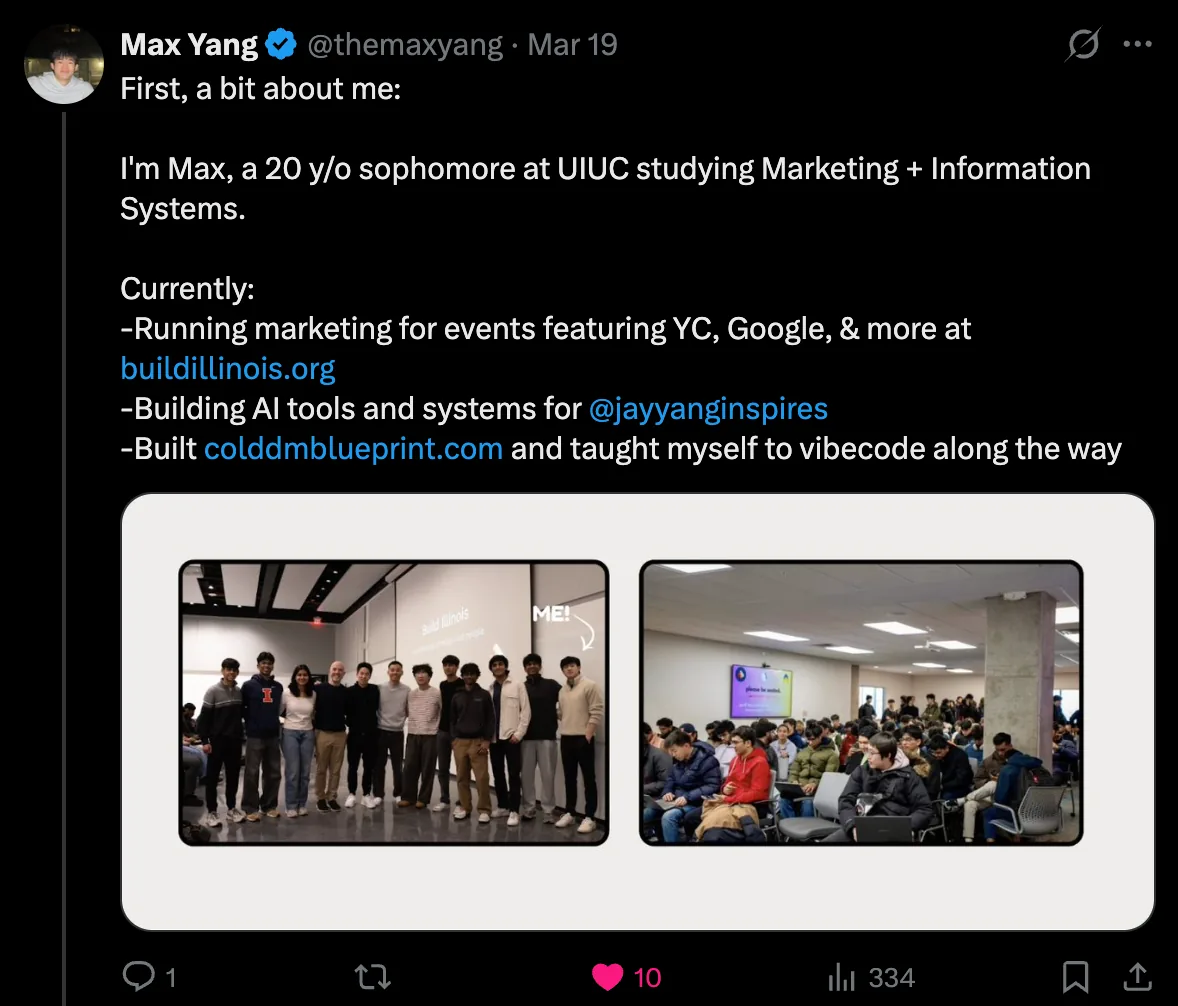
3- Achievements
Show, don’t tell. Instead of listing skills, link to proof. A portfolio, a project, a result. For example, anyone can say they’re a great marketer. Show them a campaign you ran and what happened.
4- Reason you want to work with them
Show you’ve done your homework. Reference something specific about their work, their mission, or their content that resonates with you. Your target should be able to tell this post couldn’t have been written about anyone else.
5- Extra (Permissionless) Work
Do the work up front. Attach a pitch deck, content samples, or strategy breakdown. Show that you both want the opportunity AND that you can crush it.

If you want to see more examples of the Public Pitch, I put together a swipe-file that you can download here:
Get the free Work With The Best bonuses →
Let’s say I wanted to work with author James Clear. I really like his books. I admire the way he lives his life, and I respect his content and ideas.
I’d start with the North Star question from Chapter 1: what inputs would increase the likelihood I get the output that I want? If the output is to create value for James, deliver it, and get it in front of him, I can reverse engineer the inputs.
First, I’d start with the TAG Method. I’d do a full audit on his business and brand. I’d identify the problems he’s facing, then look for the overlap with my own skills. I have experience writing on Twitter, LinkedIn, and email, so I’d probably position myself as an email and social media copywriter.
From there, I’d choose the Contact Quadrant with the highest likelihood of success.
Does this guarantee landing James Clear as a client? No. But it puts me in a strong position because it lets me work on my skill set, get closer to someone I want to work with, attract other opportunities by doing the work publicly, and learn from the outcome, whether he replies or not.
Are you starting to see how all the pieces fit together? You don’t have to apply on job sites or send out a thousand applications and pray someone gets back to you.
You can take your career (and life) into your own hands. Figure out what you want, then use probabilistic thinking to increase the likelihood you get it.
Ps. I’m not going to go into the power of consistency and playing long-term, but the next time you feel discouraged, I want you to ask yourself two questions:
“Pessimists get to be right, and optimists get to be rich.” — Patrick Collison
There’s an old parable about two twin brothers who grew up with an abusive, alcoholic father. Adulthood took them down separate paths but many years later, both brothers happened to participate in the same psychological study, though each did it separately.
The first brother was well-dressed, soft-spoken, and widely respected in his community. He managed a small but thriving business, and volunteered on weekends.
The other sat across from the interviewer in a dimly lit room at a rehabilitation center, his hands shaking from withdrawal, his relationships in ruins, and a long trail of lost jobs and failed promises behind him.
In the study, each brother was asked about his childhood, and the choices that had led him to his current life.
The successful brother spoke about nights hiding in his room, listening to bottles shatter in the kitchen, and quietly making a promise to himself that his own children would never feel that way.
The other brother talked about the same nights, but his story bent in a different direction.
As a teenager, he had started drinking just to take the edge off, then more to fit in, and eventually because he couldn’t imagine a day without it. He blamed his temper on his father’s genes, his failures on his upbringing, and every broken relationship on what had been done to him, not on what he chose to do next.
When the interviews ended, the researchers asked each brother the same final question: “Given everything you’ve lived through, what do you think most explains the life you have now?”
Both brothers paused, looked down at their hands, and let out a small chuckle. They gave the same answer:
“What else would you expect when you have a father like mine?”
When I first heard that story, I had two immediate reactions. One was that I vowed to be the first brother, not the second. The other was a deep sympathy for the second brother, because he didn’t choose to grow up with an abusive, alcoholic father. Nobody would.
Yet, as unfair as it is, things that aren’t our fault can still be our responsibility to fix.
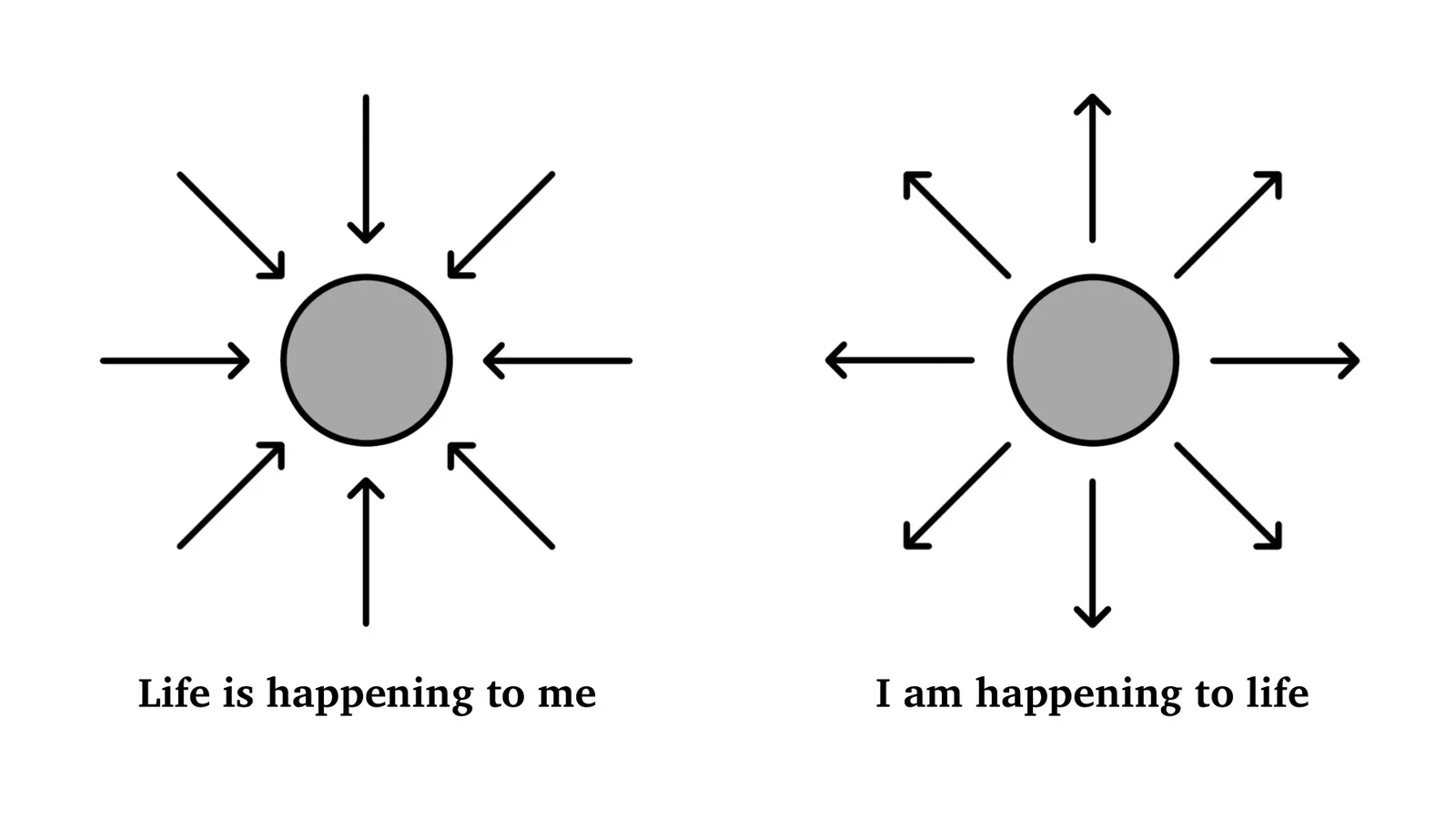
I tell you that story because we all have a version of that playing in our heads. Maybe not as extreme, but the same pattern. Some belief about ourselves or our situation that feels like it’s protecting us but is actually holding us back. After sharing the ideas in this book with enough people, I’ve noticed the same three beliefs keep coming up:
“This sounds great and all… but why would I do all this work for free? Isn’t that just free labor?”
Sure, you could see it that way. But when you’re trying to break into new rooms, it doesn’t matter what you’ve already done. To the people inside it, you’re starting from scratch.
Everyone, and I mean EVERY one, went through a period of eating shit and feeling undervalued before it paid off.
When music industry legend Jimmy Iovine was starting out, all he wanted was to learn how to make records. So he took a job as an assistant at Record Plant Studios in New York. He swept floors, set up equipment, restocked supplies, ran errands - he did whatever anyone asked him to do.
When John Lennon started recording at the studio, Iovine learned how to make his tea. It was a small task, the kind of thing most people wouldn’t think twice about. Not Iovine. “I was obsessive about that fucking tea,” he said. “I perfected it. I timed it exactly. Lennon wouldn’t let anybody else make it.”
Eventually, his boss started letting him set up mixes, then sit in on sessions, then run them, and Iovine worked his way from assistant to engineer to producer, to eventually co-founding Interscope Records and selling Beats by Dre to Apple for $3 billion.
When Warren Buffett graduated from Columbia in 1951, he wanted nothing more than to work for his professor, Ben Graham, the greatest investor alive at the time. Buffett offered to work for free. Graham told him, ‘You’re overpriced.’
But Buffett didn’t go away. He spent the next three years sending him research and suggesting stocks, doing anything he could to stay on his radar. Three years later, Graham called and offered him a job. Buffett didn’t even ask what the salary was. He was on the next plane to New York.
When Ryan Holiday first became author Robert Greene’s research assistant, he was tasked with manually transcribing podcast notes by hand. How tedious!
Put your ego away. Optimize for getting your foot in the door in the short-term so you can optimize for getting paid well in the long-term.
There’s an old story about a monk and his young student who were walking along a dusty mountain path when they passed a man on the road who began hurling insults at the monk.
“You monks are all frauds,” the man shouted. “Living off the charity of others while pretending to be wise!”
The student’s face flushed with anger. He stepped forward to defend his master, but the monk gently raised his hand to stop him. They kept walking in silence.
The insults continued until they were out of earshot. Finally, the student couldn’t contain himself. “Master, how could you let him speak to you that way?”
The monk stopped and turned to his student. “If someone offers you a basket of rotting fish, and you refuse to take it, who must carry the stench home?”
“The one who brought it,” the student said.
“Just so,” the monk replied. “His words were a gift I chose not to accept. Therefore, they remain with him.”
No matter what you do, people will always have an opinion.
A sign of maturity is your ability to tune out their voices and do what’s right for you, even if it doesn’t make sense to anyone else.
In March 2000, Amazon’s stock had fallen 80% from its peak. The media declared Jeff Bezos a failure. Analysts were openly questioning whether the company would survive the year.
But inside Amazon’s headquarters, every single internal metric was improving. Customer satisfaction was climbing, selection was expanding, and operational efficiency was increasing. The stock price was telling one story, but reality was telling a completely different one.
The market is a voting machine in the short term and a weighing machine in the long term. The crowd votes on emotion and headlines, but eventually, reality catches up.
By 2010, Amazon was one of the most valuable companies in the world, and the newspapers that declared him a failure were now writing profiles about his genius.
The people who do remarkable things are almost always willing to be misunderstood for long stretches of time. Let the news headlines be wrong as long as the history books are right.
If people are criticizing you, that’s a sign you’re doing something worth paying attention to. As Aristotle once wrote, “The only way to avoid criticism entirely is to say nothing, do nothing, and be nothing.”
Criticism is the price of relevance.
As for dealing with haters themselves, I have a simple rule: never wrestle with a pig. You’ll both get dirty, and the pig likes it.
When I first shared The Permissionless Approach with a friend, he loved it, but said, “I don’t know, man, who am I to reach out to all these people that I look up to? I mean, I’m a nobody.”
I get it. I’m not immune to that feeling. It can be scary and intimidating to reach out to someone you admire, especially if you’ve admired them for a long time. You’ve built up this parasocial relationship in your head. You’ve watched their videos, read their posts, maybe even modeled parts of your life after theirs. The idea of reaching out and putting yourself on their radar feels terrifying.
I remember when Noah Kagan first called me. I stepped out of class, and my body was trembling. I could barely get my words out. I still get goosebumps when I get a text from him.
But the older I get, the more I realize that life will meet you at your level of audacity. The people who get what they want out of life aren’t necessarily the most intelligent or the most talented. They’re the ones who had the most courage. And by the way, my favorite definition of courage is this: courage isn’t the absence of fear. It’s feeling the fear and doing it anyway.
Closed mouths don’t get fed. If you don’t ask, you don’t get. If you’ve done the work to earn it, then you owe it to yourself to put it out there. Let the world tell you no, don’t tell yourself no before you start.
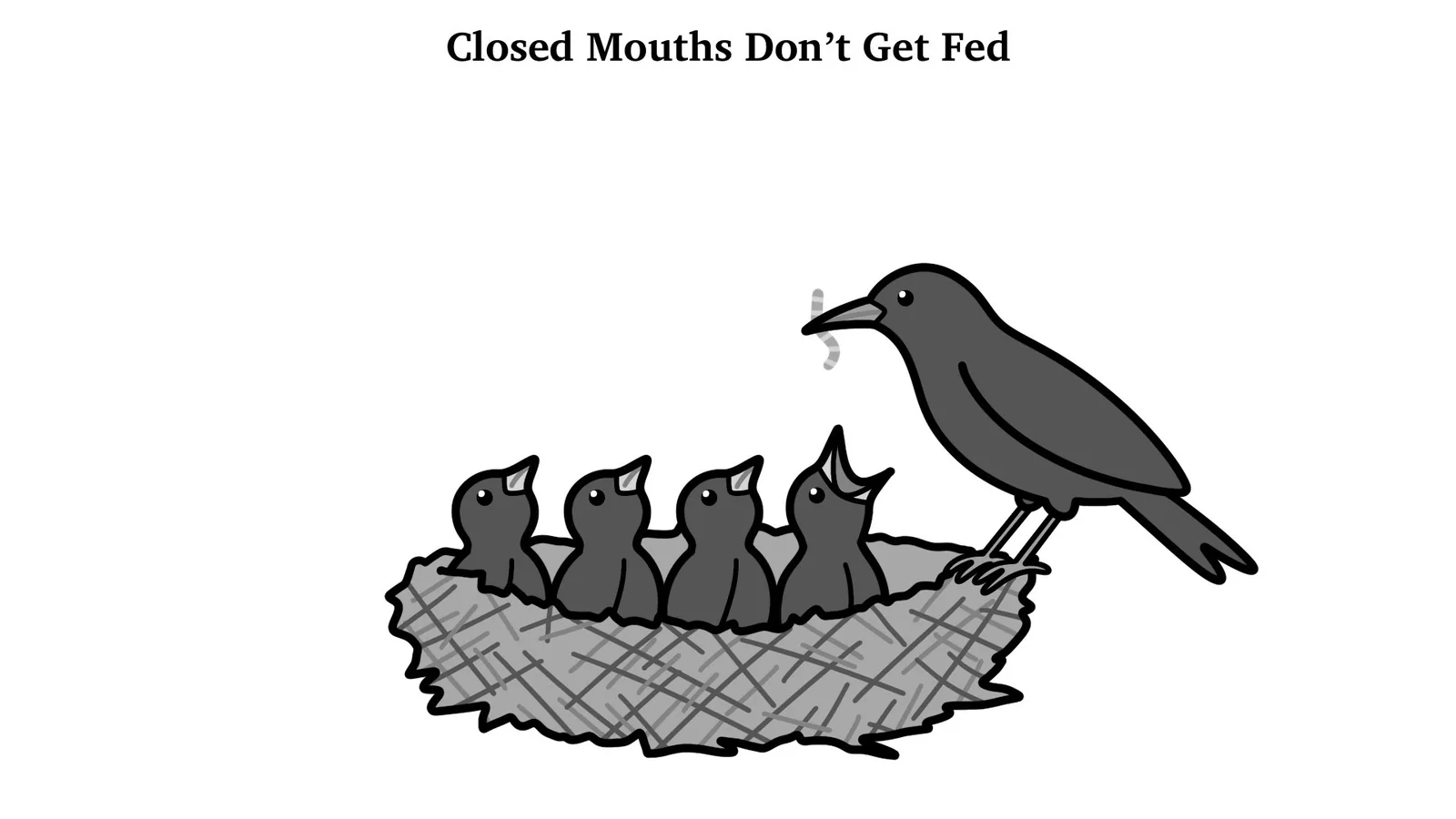
As the Chinese Proverb goes, “He who asks a question is a fool for a minute; he who does not ask a question remains a fool forever.”
Shoot your shot. Try one of the four methods from the Contact Quadrant for yourself. The worst thing that can happen is you become better in the process.
“Life shrinks or expands in proportion to one’s courage.” — Anaïs Nin
In 2009, an Australian palliative care nurse named Bronnie Ware wrote a blog post called “Regrets of the Dying.” She had spent years working with people in the final weeks of their lives, and the same regrets kept coming up.
The top regret, the one she heard more than any other, was: “I wish I’d had the courage to live a life true to myself, not the life others expected of me.”
And my gosh, that hits hard. How many people spent their last moments regretting that they never went after what they wanted? I don’t know about you, but that scares the living sh*t out of me.
I don’t want to get to the end of my life and regret that I played small.
Charlie Munger once said, “If you need a tool and haven’t bought it, you’re already paying for it.” On a similar note, if you have a dream and you haven’t started acting on it, you’re already paying for it.
You think that not taking action is no big deal, but every time you pass up on your dreams or forgo what you want to do, that inaction debt compounds.
The ironic part is, the people who accumulate the most inaction debt are usually the most intelligent. Some of the smartest people I know are also the most stuck. They can diagnose every problem in every industry, pick apart anyone’s business model, and explain why something won’t work, but they haven’t built anything themselves.
Being really smart yet never doing anything with it is a trap.
High intelligence with low agency is the pipeline to unexplainable anxiety. All that horsepower and nowhere to direct it eventually turns inward, and it slowly eats you from the inside out.
As psychologist Carl Jung said, “The world is full of people suffering from the effects of their own unlived life … The artist who never makes art becomes cynical about those who do. The lover who never risks loving mocks romance. The thinker who never commits to a philosophy sneers at belief itself. And yet, all of them suffer, because deep down they know: the life they mock is the life they were meant to live.”
You can’t solve a courage problem with more intelligence.
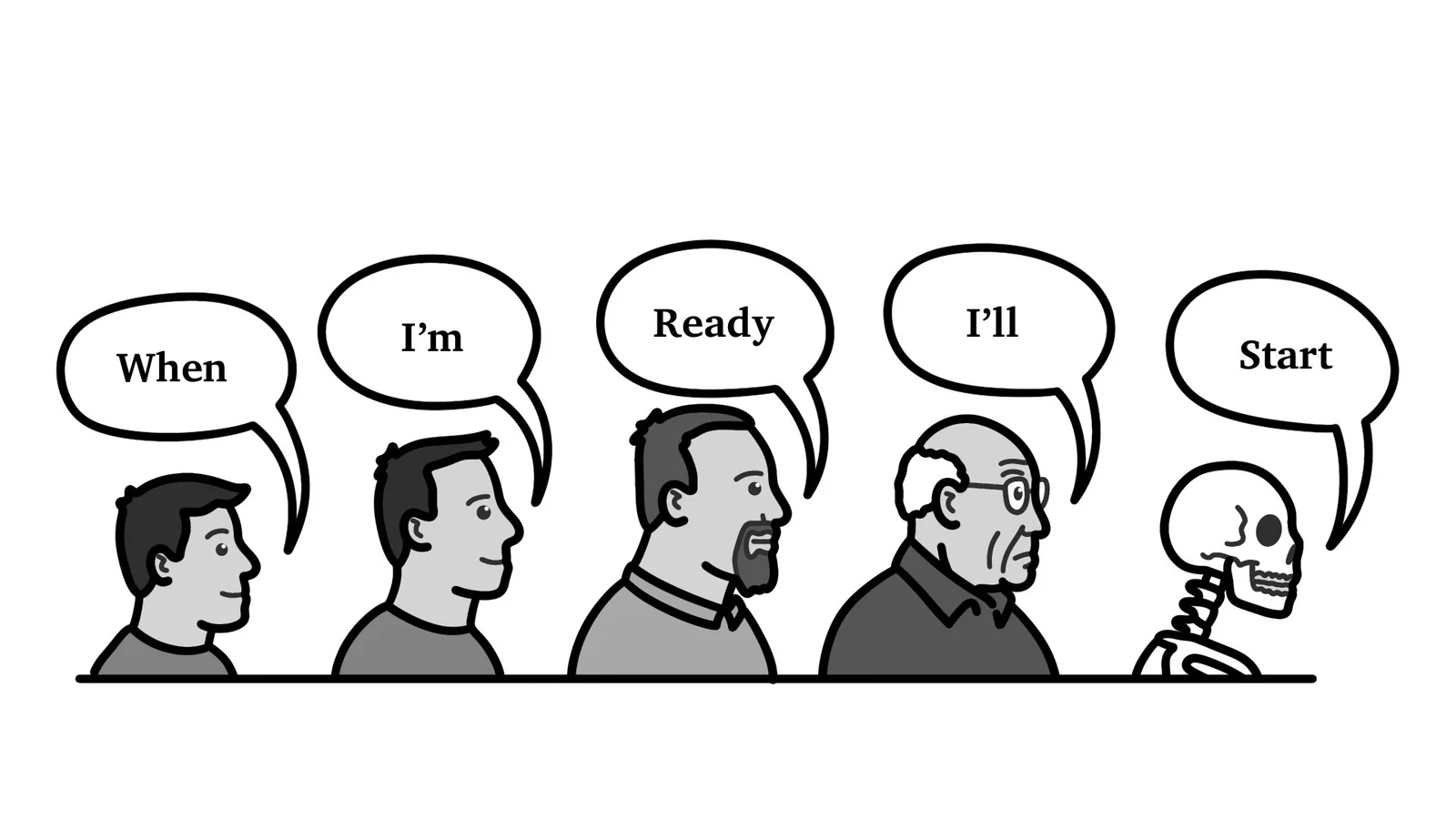
I’m convinced that everyone should take at least one big swing at some point in their life and experience what it’s like to truly go all in on a meaningful pursuit, otherwise they grow bitter with age.
And trust me, I understand. Taking a swing means you might miss. You might pour your heart into something and watch it fall apart. You might put yourself out there and get rejected. It means you might bet on yourself and be wrong. That’s terrifying. I get it. I hate rejection as much as the next person.
But what if your fear of being wrong is the very thing that’s making you miserable? You’re always half in and half out. Tiptoeing around the decision. Never giving anything a real shot. Of course you haven’t found what you’re looking for. You keep giving up before you even start, giving half effort, keeping your guard up, and playing it cool. That’s not protecting you. That’s robbing you of the experience of being alive.
To me, the worst regret isn’t failing. It’s knowing you never gave it a real shot.
If you’re going to start a business, quit talking about it at parties and actually start it. If you’re going to write the book, stop researching and planning and use some gosh darn ink. If you’re going to love someone, pour your soul into them. Be all in. No half measures. Fail spectacularly if you have to, because at least you’ll know.
You only get one shot at this life. One. So take the swing. Yeah, you’ll get things wrong. You’ll send texts you regret. Take the wrong job. Trust the wrong person. Change directions so many times you forget where you started. Feel lost while everyone else seems to know exactly where they’re going. But that’s what happens when you’re in the game.
I saw this line the other day that stopped me cold:
“Your death will come on an ordinary day, in the middle of unfinished plans, and the world will continue without you.”
I don’t want to reach the end with a perfect, unlived life. I want to arrive exhausted from feeling everything. From trying and failing and trying again. From loving too hard and trusting too much and taking the swing even when my hands were shaking.
I’d rather have stories than regrets.
I’d rather say “I can’t believe I did that” than “I wish I’d tried.”
What about you?
If you want more ideas, stories, and strategies for living life with intention, you can find me in a few places:
I’d love to hear from you - what you liked, what resonated, or even how you’ve started taking action after reading this book.
Email me at jayyanginspires@gmail.com or message me on any of the platforms above.
Ps. If you introduce something valuable to someone, they associate that value with you. If you’d like goodwill from another ambitious person - send this book their way :)
First and foremost, to my mom and dad:
When I told you I was dropping out of college, you didn’t scream. You asked questions. When I said I was moving to Vegas to work for some guy on YouTube, you helped me pack. When I called you with problems, you didn’t say “I told you so.” You asked how you could help.
I’m stubborn. I’m different. I chose a path most parents would panic about. But you loved me anyway. You love me still.
When things go wrong, I don’t fall apart. I don’t spiral into self-hatred. I don’t drown in self-pity. I problem solve. I move forward. Because that’s what I watched you do for 18 years.
The voice in your head is an echo of the voices that raised you. If you’re lucky, those voices were gentle. If you’re lucky, they believed in you before you had any reason to believe in yourself.
Thank you, Mom and Dad. For many things, but mostly for this: when I talk to myself, I talk to myself the way you talked to me.
To Tyler Denk, EJ White, Cory Levy, Noah Kagan, Jeremy Mary, Alex Hormozi, Leila Hormozi, Michael Lim, and many others, thank you for taking a chance on me.
To Jack Butcher for creating The Permissionless Apprentice course and only making it $1. I took your course when I was 15 and it completely changed my life. To Charlie Hoehn (Author of The Recession Proof Graduate) and Alex Banayan (Author of The Third Door) for writing incredible books that inspired this one.
To Jonathan Goodman and Alex Wieckowski for your insights on book publishing. You guys are awesome. To Lisa DiMona and David Moldawer for taking the time to share nuggets that helped with this book’s positioning.
To Michael Boorman (@wisdommadeeasy) for the incredible visuals in this book. You are an absolute wizard, and I’m so honored you agreed to collaborate with me.
To my editor Dylan Kurt, thank you for always reminding me to prune, prune, prune so the diamonds will punch, punch, punch.
To my ghostwriting clients, both named and unnamed, thank you for trusting me with your voice and brands.
To the early readers of this manuscript, Noah Zender, Stetson Stallworth, Armaan Agrawal, Kevin Shim, Mateo Martez, Louis Shulman, James Floyd, Kyle Junlong, John Hill, Kevin Kim, Jeston Lu, Brooke LeBlanc, Corey Wilks, Justin Jacobson, and others, thank you for your thoughtful feedback. Your insights made this book far better than it would have been otherwise.
To friends, family, and everyone who encouraged me along the way: your support has meant the world to me.
And if I’ve forgotten anyone, please forgive me. Feel free to add your name here:
________________________________________.
Finally, to you, dear reader: life is short, and you chose to spend some of your precious time and attention with this book. I don’t take that lightly. Thank you.
– Jay Yang (March 2026)

Jay Yang is an author and marketing strategist. He writes The Spark, a weekly newsletter on marketing, strategy, and personal growth. At 19, he became an Amazon bestselling author with his debut book, You Can Just Do Things. He advises founders and CEOs on creative strategy and angel invests in early-stage media and creator-led companies.
A weekly letter where I share what I’m learning about marketing, strategy, and building.